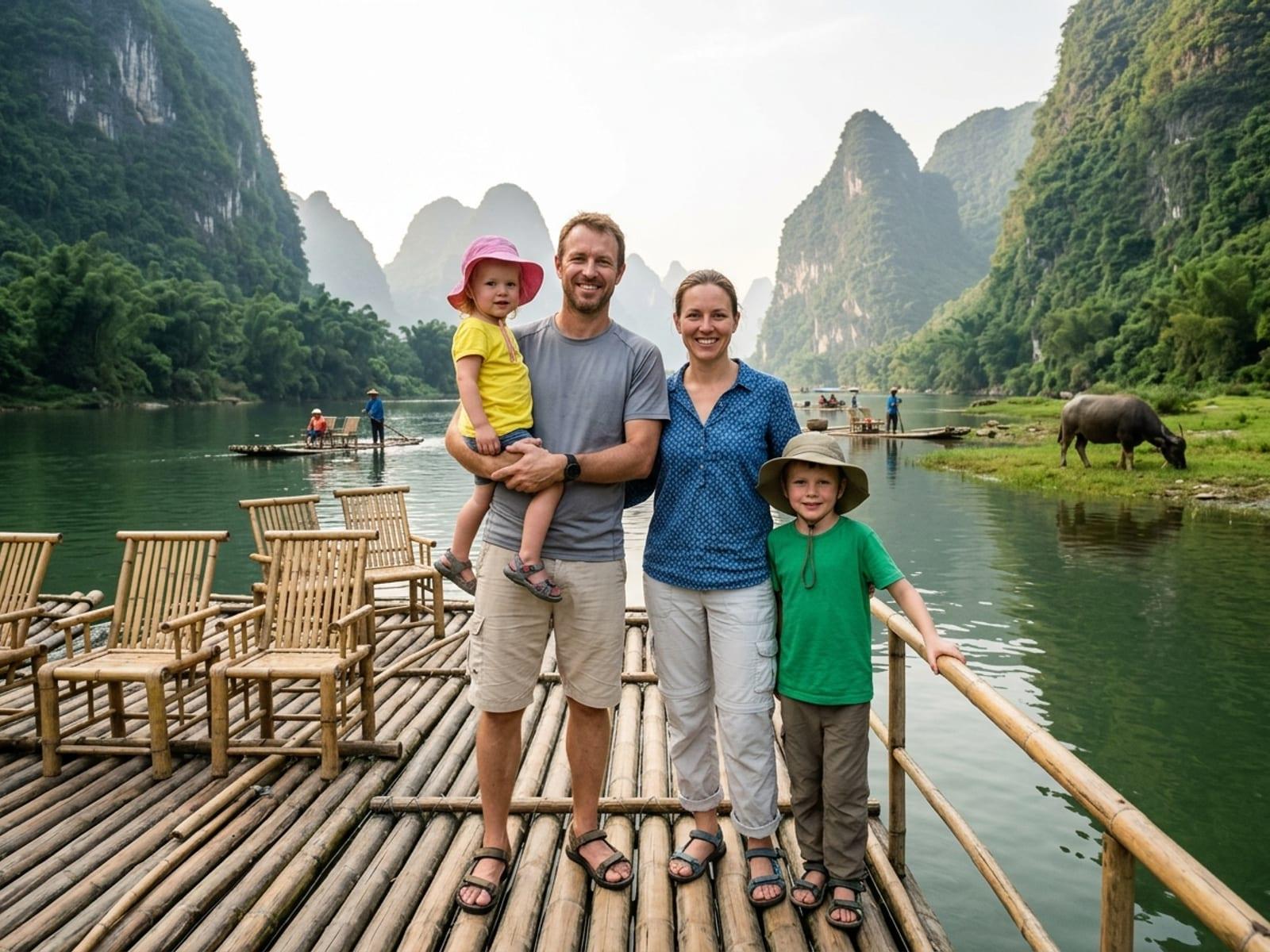
Jagged peaks line both banks of a green river as far as you can see, mirrored in the water. The Li River, which flows from Guilin to Yangshuo in the Guangxi Zhuang Autonomous Region of southern China, is famous for scenery that looks like an ink-wash painting. It even appears on the back of China's 20-yuan banknote. For a family, a two-day plan keeps the pace easy for children: see Elephant Trunk Hill in Guilin, cruise down the river and spend the night in Yangshuo, then explore the area by bamboo raft or bicycle the next day.
Peaks carved out of dissolving limestone
The Li River rises in Xing'an County, north of Guilin, and flows 164 km through Guilin and Yangshuo to Pingle. It is part of the Pearl River system, and between Guilin and Yangshuo it drops gently from 141 meters above sea level to 103 meters.
The extraordinary scenery on both banks is karst, formed over a very long time as rain and water dissolved the limestone. Around Yangshuo you see fenglin, or "peak forest," where peaks 30 to 80 meters high rise like towers from flat ground. Along the river gorge are fengcong, "peak clusters," where the peaks join at their bases, with hundreds of caves large and small. In 2014 the peak clusters along the Li River in Yangshuo County and other sites were added, as Guilin Karst, to the UNESCO World Natural Heritage site South China Karst. The same kind of limestone cones rising from flat ground appear in Yunnan, where rapeseed flowers fill the gaps between the peaks at Luoping.
The peak clusters along the gorge are said to hold 23 caves with passages over 1 km long, so behind the rock faces there is a whole underground world you can't see from outside.
The scene on the back of the 20-yuan note shows peaks reflected in the water at Huangbutan, on the edge of the town of Xingping in Yangshuo County. When your boat or raft passes that stretch, take out a 20-yuan note with your kids and compare the picture with the real thing. It may turn out to be the moment they remember best.
In Guilin itself: Elephant Trunk Hill
The sight to see with children in Guilin is Elephant Trunk Hill (Xiangbishan). It is a rocky hill where the Li River meets the Taohua River, and just as the name says, it looks like an elephant dipping its trunk into the river to drink. The round opening between the trunk and the legs is called Water Moon Cave; it is said that at night the moon reflects on the water through the arch, so it looks as if there is a moon both above and below the water. Elephant Trunk Hill is regarded as the symbol of Guilin.
Guilin has other places to see karst up close, such as Seven Star Park. For a rainy day, Reed Flute Cave (Ludiyan) is a good choice. It is named for the reeds growing outside the cave, which could be made into flutes. Inside the 240-meter cave are stalactites and stalagmites with names like "Crystal Palace" and "Dragon Pagoda," lit in many colors. More than 70 inscriptions of poems and travel notes written in ink survive inside, the oldest dating from 792, in the Tang dynasty. The story of its rediscovery in the 1940s by people fleeing the war tends to spark a child's sense of adventure. The floor can be wet, so wear non-slip shoes.
Outside the city is the Lingqu Canal, dug in 214 BC.
A cruise boat, or a slow bamboo raft
A Li River cruise is famous across China, and millions of people take one every year. There are two main ways to do it: a cruise boat heading downriver from the Guilin side toward Yangshuo, or a sightseeing raft departing from the Yangshuo County side.
Cruise boats spend a long time on the stretch where peak after peak appears on both banks, so you can take in the changing scenery at leisure. Rafts, on the other hand, move slowly close to the water, and you look up at the peaks from river level. Drifting on bamboo between rock peaks has an even longer history at Mount Wuyi's Nine-Bend Stream, home of Wuyi rock tea, where rafts have carried sightseers for over a thousand years. When choosing with children, check before you book how long you will be on board, whether there is a roof and a toilet, and whether there is cover from sun and rain. With small children, a shorter trip means less panic if they get cranky. Departure points, journey times and prices differ by vessel, route and season, and sailings can change with the weather and river levels, so confirm the latest information when you book.
Whether on a boat or a raft, always put children in life jackets and hold their hands so they don't lean over the side. The sun on the river is stronger than you'd expect, so hats, sunscreen and water are essential. The Li River is also long known for cormorant fishing, in which trained birds are used to catch fish.
West Street and the farmland between the peaks
Yangshuo, where the river trip ends, is the main town of a county under Guilin. It has a long history: the county was established in 590, and a street from that period became today's West Street (Xijie). By the 1990s it had become such a draw for international travelers that foreigners ran most of the shops on the street. In 2023 West Street drew 21.1 million visitors. The fishing village in Xingping, known for the 20-yuan view, was named one of the first Chinese Traditional Villages in 2012.
There is plenty to do outside town as well. The peaks around Yangshuo are known for rock climbing, and you can reach places such as Moon Hill by bicycle, bus or shared minivan. The area around the Yulong River, which winds between the peaks, is another Yangshuo highlight. If you are cycling with children, check that you can rent bikes or child seats suited to their ages, and avoid roads with heavy traffic as much as possible.
The family side by side on a bamboo raft, peaks rising behind: pokesta's AI photos ($1 per photo, first one free) can make that shot before you even leave home.
Getting there and when to go
The main airport is Guilin Liangjiang International Airport (KWL), about 28 km southwest of central Guilin. You can reach Yangshuo by boat down the river from Guilin or by bus. By high-speed rail, Yangshuo Station on the Guiyang–Guangzhou high-speed railway is in Xingping. You can also do the trip in reverse, arriving by train from Guangzhou and heading north from Yangshuo to Guilin. That way you can start the day with yum cha at one of Guangzhou's old teahouses before boarding.
The Li River is lovely all year, but in the hottest or rainiest seasons, plan around your children's well-being, for example by keeping time on the water short. Boat and raft prices and schedules can change, so confirm the latest when you book. Entry requirements for China depend on your nationality, so check your own government's official information before you travel.
References