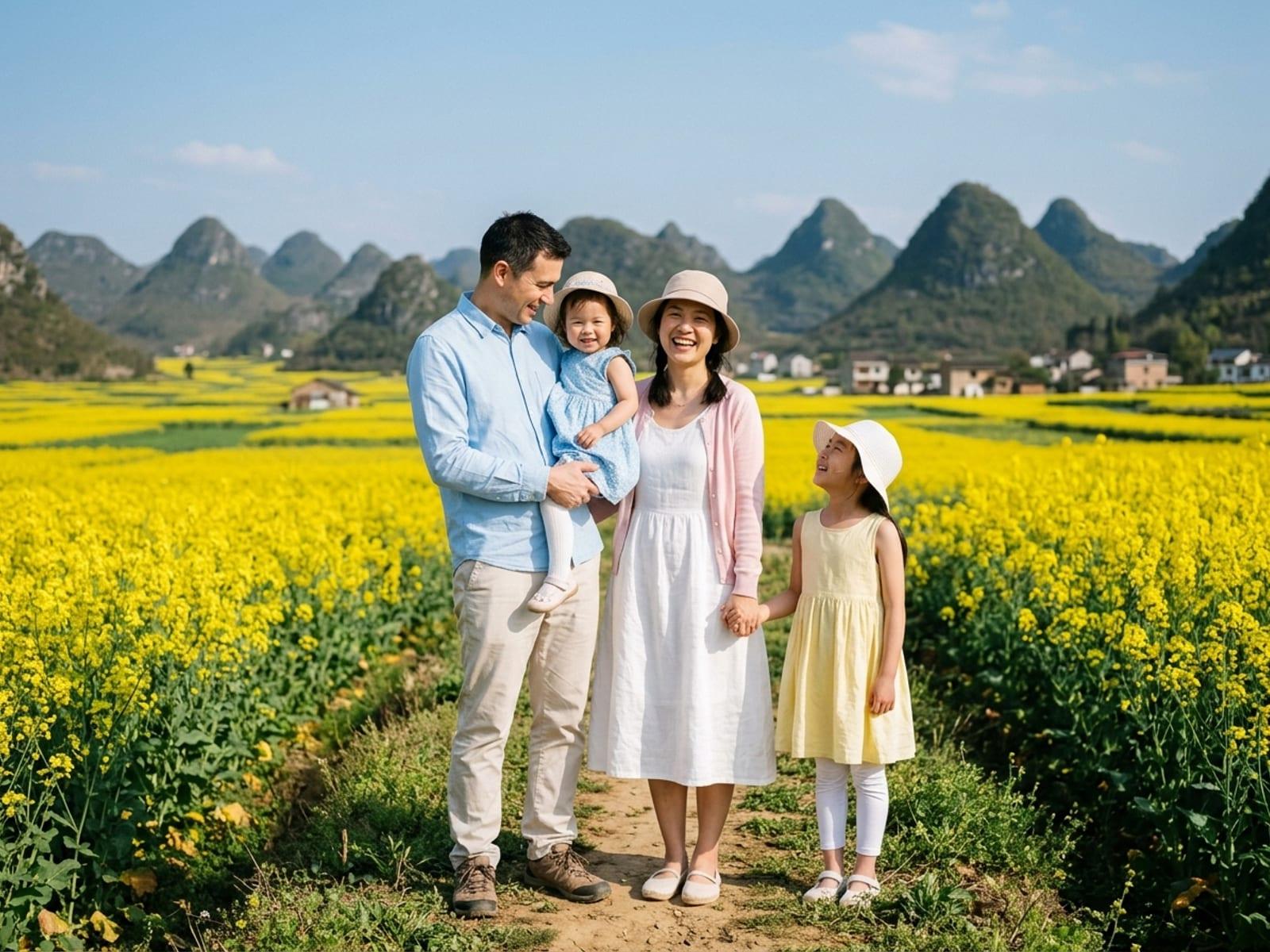
Yellow fills a basin as far as the eye can see, broken only by rows of small cone-shaped peaks. In Luoping, in Yunnan province in China's southwest, rapeseed flowers bloom all at once every February and March, and the sheer scale of it has earned the place the title of "the world's largest natural garden." It's a famous view, but it's also major rapeseed and honey country. The bloom is short, and matching your dates to its peak is the main challenge of a family trip here.
Rapeseed country where Yunnan, Guizhou and Guangxi meet
Luoping County lies in eastern Yunnan and is part of Qujing city, close to where Yunnan, Guizhou and Guangxi meet. It's about 240 km east of Kunming, the provincial capital. The county sits at roughly 1,500 meters above sea level, and most of its rain falls in the summer months, around June to September. It's also home to many peoples, including several branches of the Yi and the Bouyei. Walk the village lanes in flower season and you'll see people at work in the fields.
The county is a national rapeseed production base, and each February and March some 200,000 mu of rapeseed bloom at the same time (one mu is about 667 square meters, so that's roughly 130 square kilometers). In 2002, a Shanghai-based Chinese record registry (unrelated to Guinness World Records) recognized Luoping's 300,000 mu of rapeseed fields as "the world's largest natural garden." A rapeseed flower festival has been held since 1999.
These flowers aren't planted for tourists. They're a crop grown for rapeseed oil. The view is a by-product of farming: for a few weeks each spring, fields that pay people's bills happen to stop visitors in their tracks.
Jinjifeng and Jiulong Falls, the two big sights
The best-known view of Luoping's fields is Jinji Fengcong, the "Golden Rooster Peaks." Cone-shaped limestone peaks, worn down by rain, rise out of the flat land, with yellow flowers filling every gap between them. Chinese National Geography magazine named it China's most beautiful peak forest. You can see the same kind of limestone peak forest in Guangxi on a Li River boat trip from Guilin to Yangshuo; the difference at Luoping is the solid yellow around the feet of the peaks.
The other highlight is Jiulong Waterfalls, a chain of cascades. In 2005 it was named one of China's most beautiful waterfalls. It offers a cool, misty change from the fields, so spending one day on the flowers and another on the falls keeps children from getting bored.
A little planning helps with how you see it all. Standing in the middle of the fields, you're surrounded by yellow, but to take in the peaks and fields together as one view, you need to look down from somewhere higher. Build at least one spot into your itinerary that looks out over the whole area, such as a viewing platform or a raised roadside, and you'll be sure to see the view Luoping is known for.
The light changes the scene a lot, too. At midday, with the sun high, the colors can look flat, but in the slanting light of morning or late afternoon the shadows of the peaks stretch across the fields and the yellow takes on depth. For family photos, early morning, when faces aren't cut by hard shadows, or late afternoon as the sun starts to drop, work best. Luoping's rain comes mostly in summer, so February and March are relatively dry.
Kunming to Luoping is about 240 km. Squeezing the fields into a round trip makes a very long day for children. Given the travel time, staying one or two nights in Luoping, with the fields on day one and Jiulong Falls on day two, is much easier on kids.
Rapeseed honey and little yellow ginger
Luoping is a base for building up bee colonies in spring, and processing honey and other bee products is a big local business. Wall-to-wall rapeseed in early spring is ideal forage for honeybees, and Luoping honey is one of the county's well-known products.
Another local specialty is xiaohuangjiang, a small yellow ginger. Bring home some honey or ginger and you'll have a taste of Luoping's spring long after you get back. When buying honey, ask the shop which flowers it comes from and where it was collected.
Don't give honey to babies under one year old, though. Health authorities in many countries advise against it because of the risk of infant botulism.
What to wear, and what to watch for with kids
In February and March, Luoping feels pleasantly spring-like in the sun during the day, but mornings and evenings can be cold. Wear a light shirt with a jacket on top that you can take off and put back on. At this altitude the sun feels strong, so bring hats and sunscreen. The paths between the fields are bare earth and turn muddy after rain, so wear comfortable shoes you don't mind getting dirty.
For photos, white, pale blue and other light colors work well; against all that yellow, people in pale clothes stand out clearly. Yellow clothes disappear into the flowers, so they're best avoided.
The thing to watch out for is bees. This is beekeeping country, and the fields are full of bees flying from flower to flower. Tell your children three things before you set out: stay away from the hives, don't swat at bees, and don't carry around drinks with a sweet smell. Anyone who has had a severe reaction to a sting should talk to a doctor before the trip.
The fields belong to farmers. Don't walk into the flowers or pick them; stay on the paths between the fields or at viewpoints. Even lined up along a path, your background will be full of yellow.
To see how your family might look standing in a sea of rapeseed flowers, you can try pokesta's AI photos ($1 per photo). For another trip in Yunnan, the Water-Splashing Festival in Xishuangbanna in April is a favorite with families.
When to go and getting there: February to March, and plan ahead in Spring Festival years
The flowers are at their best in February and March each year, with the peak moving a little depending on that year's temperatures. In years when it overlaps with the Spring Festival (Lunar New Year) holiday, roads and hotels fill up with domestic travelers, so a weekday outside the holiday makes for a calmer visit. The date of Spring Festival moves every year, so check that year's calendar, and see our guide to Spring Festival in Beijing for more.
The gateway airport is Kunming Changshui International (KMG), with international routes to cities in Southeast, East and South Asia. It's about 25 km northeast of the city center, and Metro Line 6 runs into town. From Kunming to Luoping you can take the train (Luoping station on the Nanning–Kunming railway), and in flower season buses leave Kunming's bus station roughly every hour. Entry requirements for China depend on your nationality, so check your own government's official information before you leave.
References