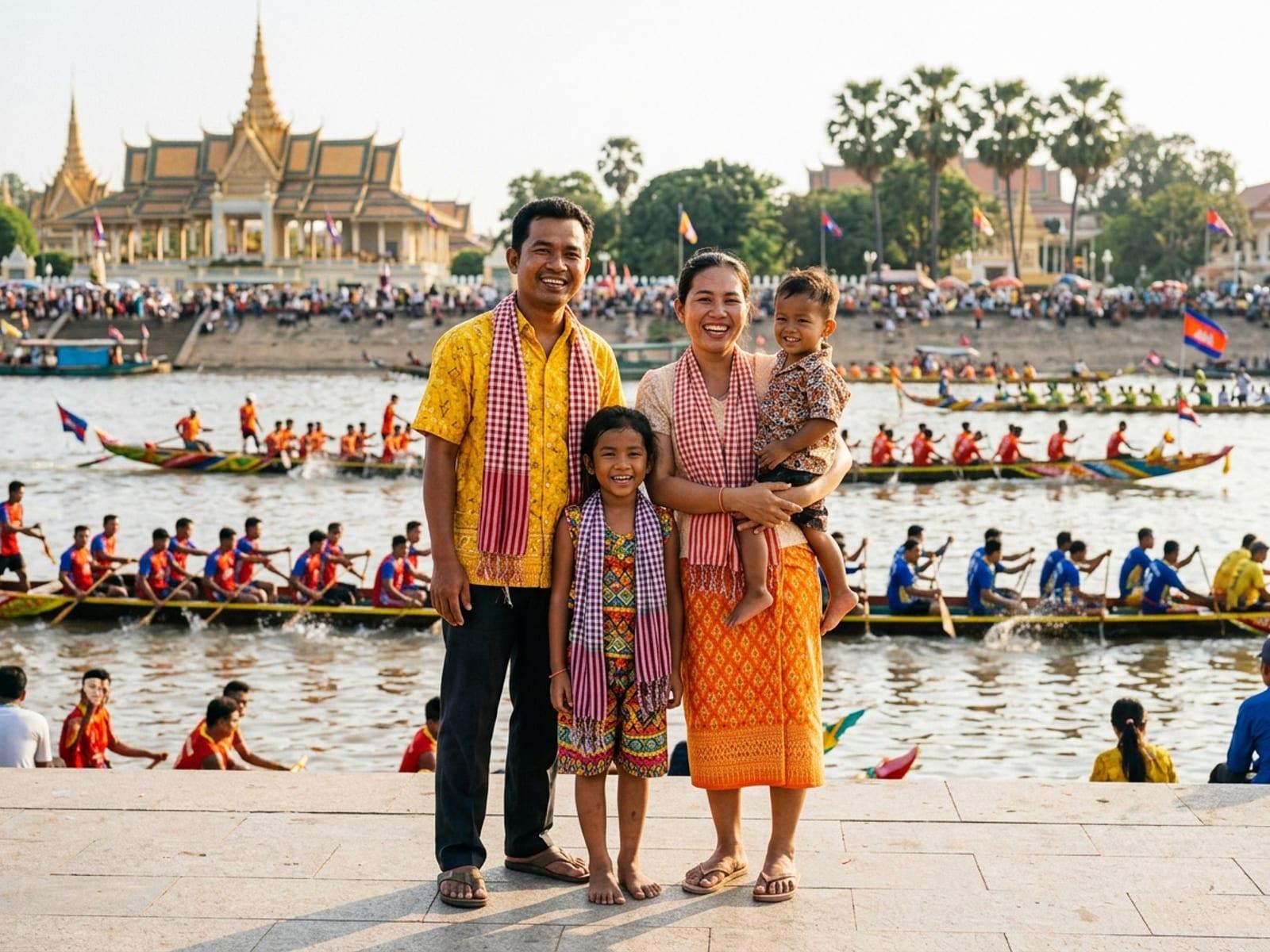
As the rainy season ends, the Tonle Sap River in front of Phnom Penh starts flowing the opposite way. Bon Om Touk, Cambodia's three-day Water Festival, celebrates that turning point. In the years it's held in the capital, long, narrow boats from pagodas all over the country race by the Royal Palace, and at night illuminated boats drift downstream under fireworks. For 2026 the Phnom Penh events have been canceled, the second year in a row. The November 23 to 25 holiday stands, though, and you can still see boat races in Siem Reap, Kampot and other provincial towns.
In 2026 the boats race in the provinces, not Phnom Penh
A government circular dated June 25 and signed by Prime Minister Hun Manet called off the celebrations planned for November 23 to 25 on the Tonle Sap in front of the Royal Palace. The government says it's putting the border situation with Thailand and the needs of displaced civilians first. The three-day public holiday stays, and the provinces may celebrate according to local tradition and their own capacity.
According to a Cambodian report from October 28, 2026, three provincial events fall on the holiday. Plans can change, so confirm with your hotel or a local tourist office before you set off.
- Siem Reap: November 20 to 25, lights and decorations along the Siem Reap River, with boat races on November 23 and 24
- Kampot: November 23 to 25, three days of boat races on the Kampot River
- Kampong Speu: November 24, boat races and stage performances
There's more earlier in the month. Kampong Thom on the Stung Sen River and Pursat on the Pursat River both hold races on November 7 and 8, with evening concerts and exhibitions of local products. Svay Rieng runs from November 7 to 12, with boat races on November 8 to 11 alongside canoe and kayak contests and night concerts. Mondulkiri holds three days of festivities at Senmonorom Reservoir from November 13 to 15.
If you want to travel over the holiday itself, Siem Reap and Kampot are the two to look at. Siem Reap is the town for Angkor Wat, and the province says it will set aside riverside space for vendors and check food hygiene, so you can walk the temples by day and head to the river in the evening. Kampot also makes a good base for visiting the Kampot pepper farms.
A river that changes direction every six months
Phnom Penh sits where the Mekong and the Tonle Sap rivers meet. In the rainy season the Mekong swells, and from around May or June its water pushes up the Tonle Sap River into Tonle Sap Lake upstream. In the dry season the lake covers about 2,500 to 3,000 square kilometers, but by the end of the rains it can spread to around 16,000. Then, from around November, the water stored in the lake flows back down the river toward the sea. The Water Festival celebrates this reversal and the end of the rains, and announces the start of the fishing season.
The river and the lake underpin life in Cambodia. About 1.2 million people live around Tonle Sap Lake, and roughly 60 percent of the country's freshwater fish catch comes from the area. A visit to Kampong Phluk, the stilt village on Tonle Sap Lake, where houses stand on posts to ride out the changing water level, shows that life up close. Winning a race was traditionally believed to bring luck to the village's fishing season. Part of the reason the rowers are so serious is that the result is bound up with their village's hopes for the year.
In Khmer, Bon Om Touk means "boat paddling festival," and you'll see it romanized in several ways, including Bon Om Tuk, Bon Oum Touk and Omtuk. The festival's full name lists four parts: the boat races (Bon Om Touk), the ceremony of the illuminated boats (Bandaet Protip), the salute to the moon (Sampeah Preah Khae) and the eating of flattened roasted rice (Ok Ambok). According to Professor Ang Choulean, a Cambodian scholar of culture, a king combined the boat games once held in villages with a moon ceremony that took place about a month apart, making them a single festival.
A popular theory traces the boat races back to the navy of King Jayavarman VII in the 12th century. Professor Ang, on the other hand, believes the Water Festival as a royal court event began under King Norodom in the late 19th century, after the capital moved from Oudong to Phnom Penh. One of the earliest recorded festivals took place in 1873.
Three days of racing boats, illuminated floats and the full moon
When the festival is held in Phnom Penh, the boat races are the main event by day. On the river along Sisowath Quay in front of the Royal Palace, boats from pagodas across the country compete in knockout heats. The winning boats from 2010 to 2019 were built for crews of 64 to 77. Each boat is believed to house a spirit. Between races they're kept with care at the pagoda, with eyes painted on and names of their own. A dancer at the bow cheers the rowers on with gestures and keeps them in rhythm, and on some boats an older man works an oar while chanting incantations. There's also a traditional belief that pregnant women should stay away from the boats for luck.
On the first night, illuminated boats from government ministries float down the river, followed by a ceremony to pray for peace and fireworks. At midnight on the second day comes Ok Ambok. Ambok is rice that has been roasted and pounded flat, and it's eaten with banana and coconut juice. At Sampeah Preah Khae, when offerings are made to the full moon, people also tell the legend of the rabbit in the moon. On the last day, a Brahmin from the Royal Palace cuts a ribbon from a boat in the middle of the river, a ritual that represents the water returning to the sea.
Prepare for the crowds and treat the riverside as one-way
When the festival is on in Phnom Penh, people come from all over the country to the riverside. In 2010, a crush on the bridge to Diamond Island killed 351 people. At provincial races too, avoid the riverbanks and bridges at their busiest if you have children with you, watch early and head back before the crowds build. The races run in heats, so there's no need to stay for all of them. A few rounds are enough to take in the speed of the paddles and the cheering on the bank. Try counting the rowers with your child: once you reach sixty or seventy, you'll get a feel for how long these boats are. Agree on a meeting point in case you get separated, and put a note with your contact details in your child's clothes.
Touts approach tourists along the river. Keep bags in front of you and don't go along with strangers' offers. If your child doesn't like loud bangs, ear defenders help during the fireworks.
There's no dress code. November is the start of the dry season and there's less rain, but the daytime sun is strong, so hats and drinks are essential. A bright cotton shirt with a krama, the red-and-white checked scarf, around your neck works as both a sweat cloth and a sunshade. Mosquitoes come out by the river at night, so pack a thin long-sleeved layer.
Phnom Penh often goes without its festival
The capital's festival has been called off nine times since 2010: in 2011 and 2013 because of floods, in 2012 when the late King Sihanouk died, in 2015 when water levels were low, in 2020 and 2021 because of COVID-19, in 2022 for the ASEAN summits, and in 2025 and 2026 because of the border situation with Thailand. In 2025 the three-day holiday stayed in place too, and provinces such as Kampong Cham, Battambang and Siem Reap held small boat races and dancing.
The government decides whether the festival goes ahead in the capital, and the 2026 circular was made public on July 1. For future years, check the announcement before you book flights. The riverside promenade in Phnom Penh fills with locals cooling off every evening, and in the mornings people exercise in front of the Royal Palace. The Royal Palace and the Silver Pagoda face this promenade, so even with no festival you can tour them by day and walk the river in the evening.
The full moon sets the date: November 23 to 25 in 2026
The Water Festival takes place over three days around the full moon, usually in late October or November. The 2026 holiday is November 23 to 25. A public holiday listing site shows November 12 to 14 for 2027, but the government sets the holidays, so look for the official notice as well. Phnom Penh's gateway is Techo International Airport (KTI), which opened in September 2025, and airport buses run into the city from 5:30 am to 11:30 pm. For Siem Reap, the gateway is Siem Reap–Angkor International Airport (SAI), about 50 km east of town. If you're planning around the riverside events, book your accommodation early. Visa requirements depend on your nationality, so check your own government's official information and the Cambodian government's e-Visa site.
You can try out what a family photo with the racing boats behind you might look like before the trip with pokesta's AI photos ($1 per photo, and the first one is free), including a Water Festival family photo designed for the occasion. Pchum Ben, the autumn festival of pagoda offerings, comes one to two months earlier.
References