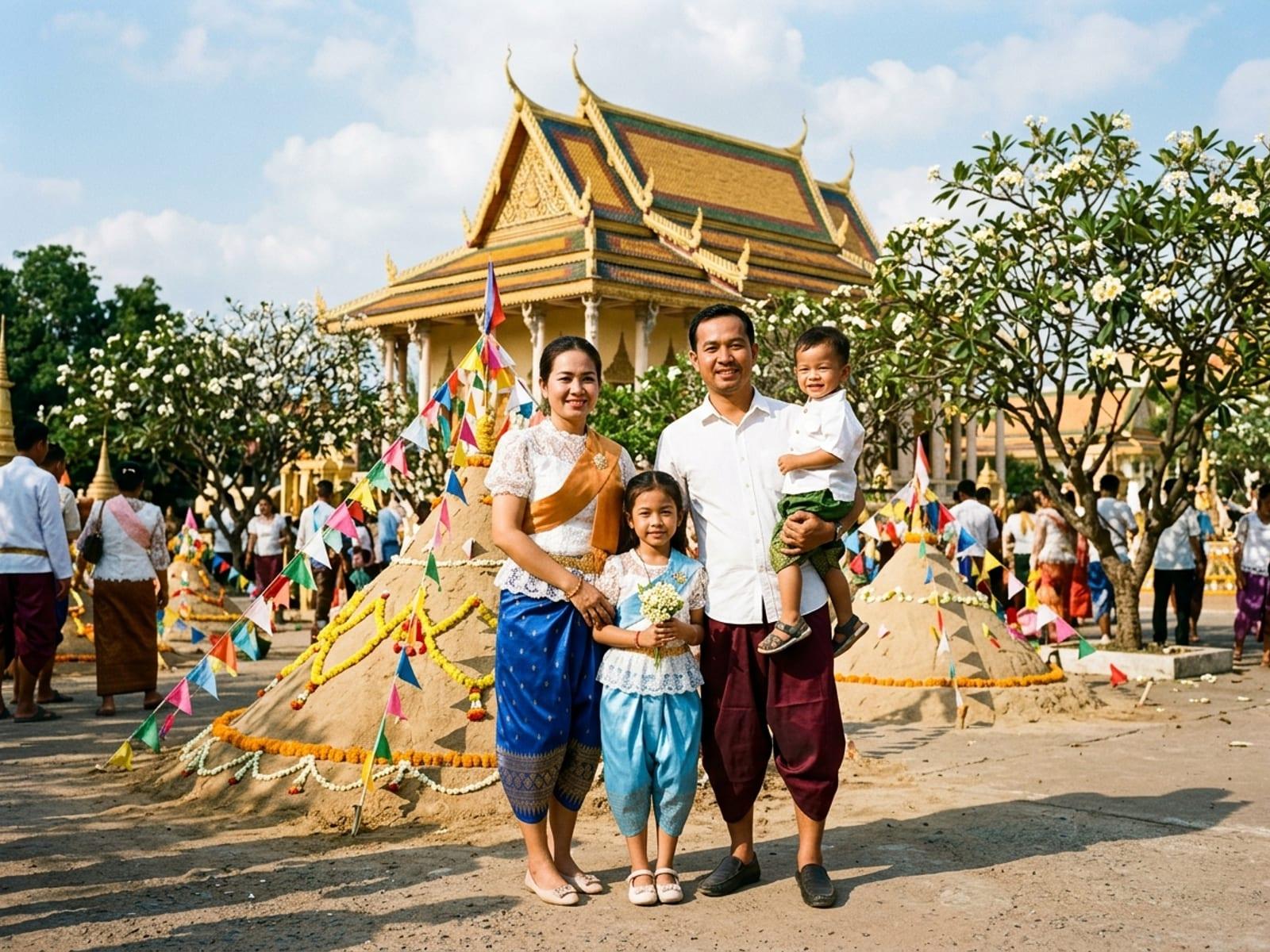
Cambodia's New Year, Choul Chnam Thmey, usually runs for three days from April 14 to 16 (in some years it starts on the 13th). It falls as the rice harvest ends, and the new year is counted by the solar calendar. People put on their best clothes and go to the pagoda, build sand stupas in the temple grounds and pour scented water over Buddha statues and their elders. Visitors can watch the temple rituals and join the folk games in public squares, and if you want family photos in festive clothes, these three days are the best chance of the year.
Each of the three days has its own meaning
The first day, Moha Sangkran, marks the end of the old year and the start of the new one. Families tidy their home altars and greet the new year with prayers and offerings. There's also a ceremony to welcome the tevoda, the celestial being who watches over the coming year. In Siem Reap in 2025, the welcoming ceremony at the Bayon temple was scheduled for 3:20 am. An old custom for this day is to wash your face in the morning, your chest at midday and your feet in the evening, cleansing the body bit by bit through the day to be ready for the new year.
The second day, Veareak Vanabat, is a day of giving. People give to the poor and to families who are struggling, and honor their ancestors at the pagoda. On the third day, Veareak Laeung Sak, comes Srang Preah, the bathing of Buddha statues with scented water. Children and grandchildren also pour water over their elders and wish them long life and good fortune. Young people sometimes splash elders with water, or with water mixed with white powder.
The small mounds of sand built in the temple grounds represent a stupa. The basic form is a large central mound surrounded by four smaller ones standing for the stupas of the Buddha's disciples. Sand stupas decked with colored paper flags and flowers are a sight you'll only see at a pagoda at New Year. At home, families prepare dishes such as krolan, sticky rice mixed with beans, coconut and coconut milk, packed into bamboo tubes and slowly roasted. Sticky rice sweets wrapped in banana leaves, num ansom and num kom, are also made in large batches before New Year.
Temple rituals and folk games in the square
The places where visitors are most likely to catch the New Year spirit are pagoda grounds and events in town squares. At the pagodas, people build sand stupas and bathe the Buddha statues, and tourists are welcome to watch quietly. Folk games fill the squares. In chol chhoung, young men and women line up facing each other and toss a ball called a chhoung back and forth. In bos angkunh, players throw angkunh seeds to knock over their opponents' seeds. Chap kon kleng is a tag game in which a mother hen protects her chicks from a crow, and leak kanseng is a bit like duck, duck, goose, with a twisted scarf dropped behind someone sitting in a circle. Children and adults alike can join in straight away.
Tug-of-war is one of these games, too. The tugging rituals and games played in front of village halls and shrines to mark the start of a new farming season were added to UNESCO's Intangible Cultural Heritage list in 2015, after a joint nomination by Cambodia, South Korea, the Philippines and Vietnam.
Bigger towns also host large-scale New Year events. In 2025 it was held in Siem Reap as "Angkor Sankranta" from April 14 to 16, with venues around Angkor Wat, along the Siem Reap River and in the Royal Independence Gardens. Alongside folk games there were dance and theater performances, floating lanterns and races of carts pulled by bulls, buffalo and horses. For 2026, the Union of Youth Federations of Cambodia (UYFC) announced "Nokor Sankranta" for Phnom Penh as a six-day event from April 14 to 19. Venues and dates change from year to year, so check that year's announcement.
In Phnom Penh, Wat Phnom, the temple on a 27-meter hill said to have been built by Lady Penh, also holds three days of New Year events. Plans for 2026 included offerings, communal prayers and performances of pinpeat, the traditional ensemble music.
Silk sampot for best dress, shoulders and knees covered at the temple
New Year is one of the times Cambodians dress up most. Women wear lace blouses with a sampot chang kben, a length of cloth wrapped and tucked to form trouser-like pants, or an ankle-length silk skirt called a sampot. Men wear white shirts with chang kben or slacks. Visitors don't need to wear traditional dress, but cover your shoulders and knees when you enter a temple.
You may get splashed with water or powder, so wear colors that won't turn see-through when wet and bring a full change of clothes. Keep cameras and phones in waterproof pouches. A krama, Cambodia's checked all-purpose cloth, around your neck comes in handy as both a sweat cloth and a sunshade.
April is the hottest stretch before the rains, so move in the mornings and evenings
April is the tail end of the dry season. Phnom Penh's average high in April is 35°C, and just before the rains start some days go above 38°C. Visiting temples and outdoor events in the middle of the day is hard going for children. Go to the pagoda in the morning, rest at your hotel over midday and head out to the events in the square in the evening. Always carry hats and drinks, and take frequent breaks in the shade.
The big event venues get very crowded. Where the crowd never stops moving, a baby carrier will get you around more easily than a stroller. Monkeys live on the hill at Wat Phnom and will make off with drinks left unattended, so make sure your children keep theirs in hand. Admission to the temple for foreign visitors is $1.
Some shops close over the holiday and transport gets busy. Book long-distance travel early, and ask your hotel whether the restaurants and shops you want to visit are open.
You can try out what a photo of your family in festive clothes in front of a sand stupa might look like with pokesta's AI photos before you go ($1 per photo, and the first one is free). There's also a Khmer New Year family photo option designed for the holiday.
April 14 to 16: Phnom Penh or Siem Reap
New Year usually falls on April 14 to 16, starting on the 13th in some years. Phnom Penh's gateway airport is Techo International Airport (KTI), which opened in September 2025, and airport buses run into the city from 5:30 am to 11:30 pm. For the Siem Reap events, Siem Reap–Angkor International Airport (SAI) is closer, about 50 km from town. Visa requirements depend on your nationality, so check your own government's official information and the Cambodian government's e-Visa site.
If you're worried about the heat, limit yourself to one or two New Year events in town and spend the rest of the trip on early-morning visits to places like Angkor Wat. That keeps the trip within what your family can comfortably manage.
References