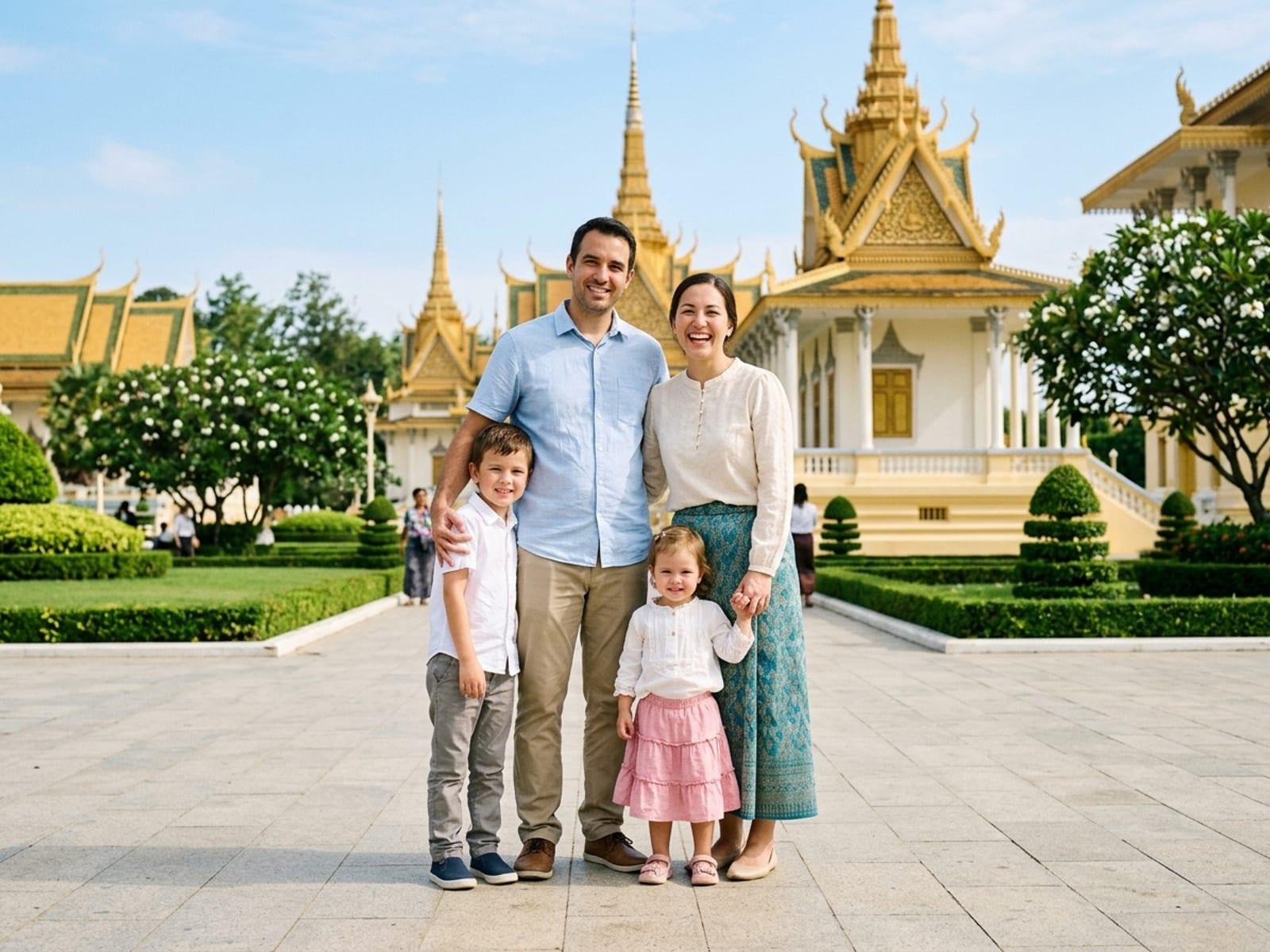
In Cambodia's capital, Phnom Penh, the Royal Palace is the first place to take the family. On the riverbank where the Tonle Sap meets the Mekong, buildings crowned with golden roofs and slender spires stand in rows, and in the southern part of the grounds is the Silver Pagoda, the royal temple whose floor is laid with silver tiles. Visiting hours are split into a morning and an afternoon session, with a closure at midday, and the dress code is strict. Get the timing and the clothes right, and half a day is plenty to see it comfortably with children.
A working palace where two rivers meet
The palace's history begins in 1866, when King Norodom moved the capital back to Phnom Penh. Many of the original palace buildings were torn down and rebuilt between 1912 and 1932. It's still a working palace where the king lives, and the royal residence and gardens, which take up about half of the grounds, are closed to the public.
What you can visit is the area around the Throne Hall and the Silver Pagoda compound. The Throne Hall is used for coronations, royal weddings and receiving guests, and its central spire is 59 meters tall. In front of it stands the Moonlight Pavilion (Chan Chhaya), used as a stage for classical dance and for state banquets. Within the grounds there's also the Napoleon Pavilion, a Western-style building assembled from an iron frame, which now serves as an exhibition hall.
The golden roofs are stacked in many tiers, and the shape differs slightly from building to building. Counting the tiers of each roof with your children as you walk helps them notice the differences between buildings that look alike at first, and keeps boredom at bay.
5,329 pieces of silver underfoot
The Silver Pagoda's formal name is Wat Ubosoth Ratanaram. It's also called Wat Preah Keo Morokat, the Temple of the Emerald Buddha, after the green Buddha image enshrined inside. The "silver" in its everyday name comes from the floor, laid with 5,329 silver tiles weighing 1,125 kg in total. Only a small part of it is visible as you walk in, though.
The small green statue enshrined in the main hall is the Emerald Buddha. It's a small crystal Buddha, and there are several theories about when and where it was made. Standing in front of it is a life-size gold Maitreya Buddha weighing 90 kg. Dressed in royal attire, it is set with 9,584 diamonds. It was made in the palace workshops in 1906–1907, during the reign of King Sisowath. On 31 July 1947, the future king Norodom Sihanouk was ordained as a monk at this temple. The grounds also hold the stupa of Princess Kantha Bopha, his daughter, which houses the remains of the late King Father Sihanouk. Photography is banned in some parts of the palace, such as the Throne Hall, so follow the signs and staff instructions.
The walls of the gallery surrounding the temple are painted with a mural of the Reamker, the Cambodian epic based on India's Ramayana. It was painted in 1903–1904 by around 40 Cambodian artists, and it's about 642 meters long and about 3 meters high. The lower parts have faded, but restoration work was carried out in 2015. Scene after scene of monkey armies, demon kings and flying warriors unfolds along it, so ask your children to look for "who seems the strongest," and the long gallery goes by much faster.
Dress code: shoulders and knees, plus hats and shoes
To enter the palace you must wear clothing that covers your shoulders and back and comes down below the knee. Simply draping a scarf or shawl over your shoulders isn't accepted, and sleeveless tops such as tank tops are out. Clothing is checked after you buy your ticket, and if it doesn't meet the rules, you won't be let in. To avoid a scramble at the gate, the sure approach is to get everyone's clothes sorted, children included, before you leave.
Some buildings require you to take off your shoes and hat. Shoes that slip on and off easily make looking after the children's footwear much simpler. Only small bags are allowed in.
According to a travel guide updated in October 2025, visiting hours are 8 to 11 a.m. and 2 to 5 p.m., and admission is 10 dollars per person, cash only. The palace can also close at short notice for royal events, so check the latest information before you go. There are also warnings about people outside the gates who say the palace is "closed today" and try to steer you somewhere else, so walk up to the gate and see for yourself whether it's open.
A family day built around the midday break
The midday closure actually works in your favor with children. Go in at 8 a.m. before it gets hot, see the Throne Hall and the Silver Pagoda before the gates close at 11, then have lunch and a nap somewhere cool. The palace grounds have little shade and the glare off the white paving is strong, so hats and water are essential (you take hats off inside the buildings).
Just north of the palace is the National Museum of Cambodia. The building opened on 13 April 1920 and was designed by George Groslier, based on relief carvings from old temples. It holds more than 14,000 objects spanning prehistory, the Khmer empire and the periods that followed, and it's known for pieces such as an 11th-century bronze Vishnu from Angkor and the statue known as the "Leper King." There are also stone statues of the elephant-headed Ganesha and of Garuda, the divine bird, so asking children to hunt for gods in animal form gives them something to aim for as you go from room to room. Seeing the sculpture here before you visit Angkor Wat makes it easier to recognize the same gods when you meet them at the temples. It's an easy indoor stop to fit in before or after the palace's afternoon session.
After your visit, take a walk along the river in front of the palace and look out over the wide water where the two great rivers meet. Phnom Penh also has sites that document the killings of the Khmer Rouge era. They're important places for understanding the country's history, but given what is on display, think carefully about whether to bring young children.
In November, the Water Festival comes to the palace riverfront
The palace is open year-round, but it can close at short notice for royal events and the like. During the Water Festival in November, dragon boat races are held on the river in front of the palace; see the Water Festival (Bon Om Touk) and its boat races. The gateway to Phnom Penh is Techo International Airport (KTI); check your own government's official information on entry requirements, which vary by nationality. The palace is on Sothearos Boulevard by the river, and a tuk-tuk from anywhere in the city is the easiest way there. For eating in the city, try the food stalls at the Central Market and Russian Market.
To see how a family photo in front of the golden roofs would turn out, try pokesta's AI photos before the trip ($1 per photo).
References