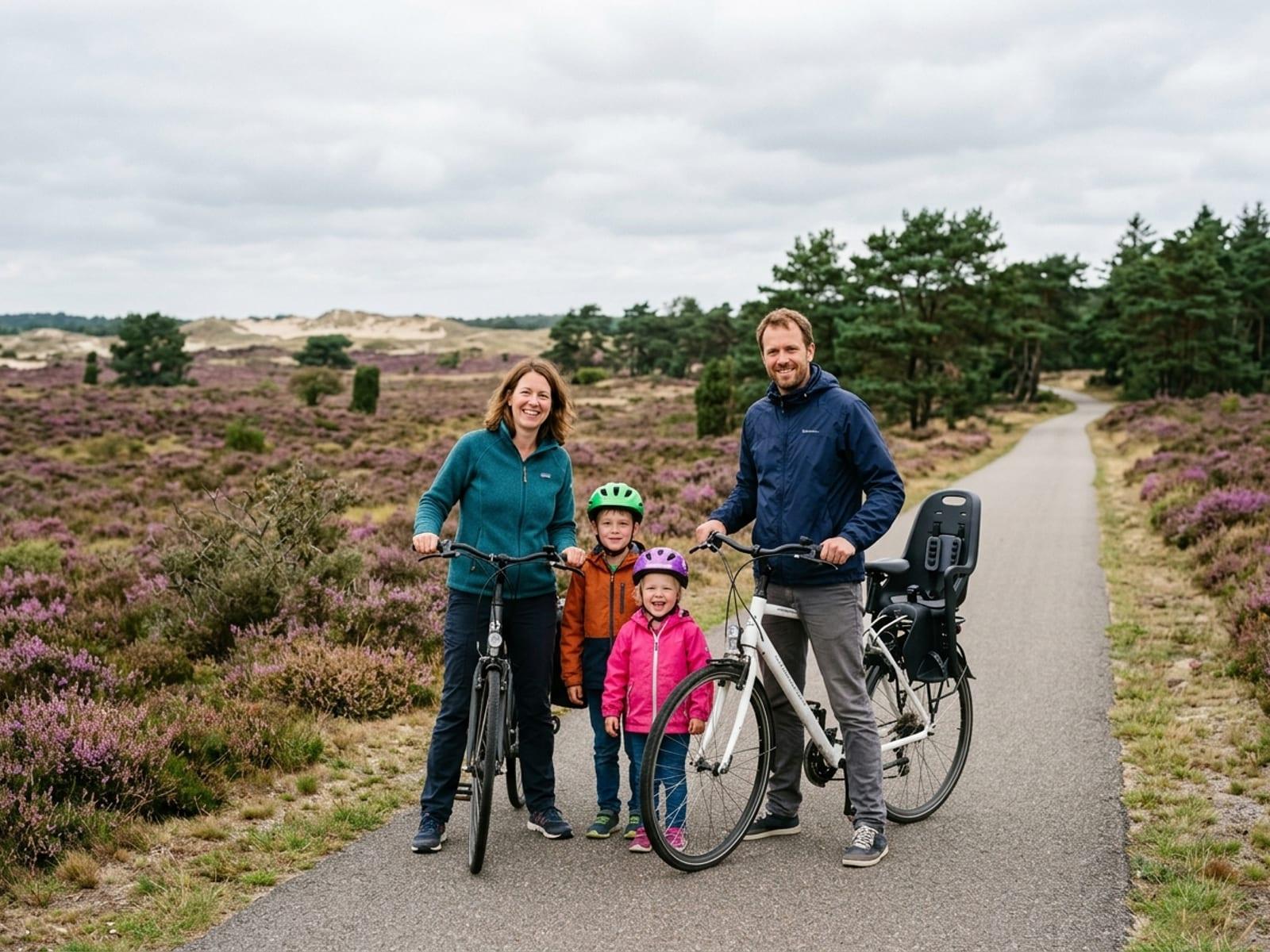
Deep in the woods of Gelderland, roughly in the middle of the Netherlands, is a national park that could only exist in a country of cyclists. At De Hoge Veluwe National Park (Nationaal Park De Hoge Veluwe), 2,000 white bicycles are left around the park, and your admission ticket (in 2026, €13.85 for adults, €6.95 for ages 6 to 12, free under 6) is all you need to ride one. Buses run to the park from Arnhem and Apeldoorn stations. Families can pedal along paths where the scenery keeps changing, from forest to heathland to sand dunes. There are children's bikes and bikes with child seats too, which makes it an especially good fit for families with primary-school-age kids. There are no bikes with training wheels, though, so how you get around depends on whether your child can ride on their own.
From a wealthy couple's estate to a national park
The park covers about 55 square kilometers. Surrounded by the towns of Ede, Wageningen, Arnhem and Apeldoorn, it's one of the largest nature reserves in the Netherlands. Its heath, dunes and woodland landscapes were shaped mainly during the last ice age.
The land was put together as a private estate in 1909 by the businessman Anton Kröller and his wife, Helene Kröller-Müller. In 1935 the couple donated their art collection to the state, the park passed to a foundation, and it became the second national park in the Netherlands. The Jachthuis Sint Hubertus, a hunting lodge designed by the architect Berlage, still stands in the park.
As of spring, the park is home to about 200 red deer, about 150 roe deer and about 50 wild boar. Only a few mouflon, a kind of wild sheep, remain, and a small pack of wolves has settled in the park. These are wild animals, so whether you see any is down to luck. If you do, don't approach them. Watch quietly from a distance.
The white bikes: no booking, no locks
The white bikes are spread between the central Marchantplein, the Kröller-Müller Museum, the Jachthuis Sint Hubertus and the bike racks at each entrance. They can't be reserved and they can't be locked. Once a bike is back in a rack, any other visitor is free to take it. If you stop at the museum or another attraction along the way, assume your bike may not be there when you come out.
For children, there are white kids' bikes (without training wheels) and bikes with a child seat on the back. If you want to be sure of keeping the same bike all day, you can rent a paid "blue bike" from the bike workshop next to the visitor center. E-bikes, cargo bikes with a box for carrying children, tandems and bikes you can ride while staying in a wheelchair can also be reserved and rented through the ticket website. Bringing your own bike costs nothing extra.
A map showing every cycle path in the park is on sale for 2 euros. The park is large, so narrowing your ride down to one or two destinations that match your children's stamina keeps things manageable.
An underground museum and a Van Gogh collection
Between rides, stop at Museonder, inside the visitor center. It bills itself as the world's first underground museum, with exhibits that lead you deeper and deeper below ground. You can see the entire root system of a 135-year-old tree, touch rocks and learn how they formed, try a water lab, and look at bones of animals that lived here thousands of years ago. It's included in park admission and open daily from 9:30 to 17:30.
The park is also home to the Kröller-Müller Museum, which holds the couple's collection, with works by Van Gogh as well as Monet, Picasso and Mondrian, and one of Europe's largest sculpture gardens, with about 200 sculptures. The museum needs a separate ticket from park admission and is open Tuesday to Sunday and on public holidays from 10:00 to 17:00 (closed on January 1; check the official website for opening days). The outdoor sculpture garden works well for children who are at the age when standing quietly in front of paintings is hard.
Opening hours and prices (2026)
Park opening hours vary by month: 9:00 to 18:00 from January to March and in November and December, and 8:00 to 22:00 in June and July. Last entry is one hour before closing. In 2026, admission is 13.85 euros for adults and anyone 13 or older, 6.95 euros for children aged 6 to 12, and free for children under 6. Bringing a car in costs an additional 9.80 euros per vehicle. Prices and hours can change, so check the official website for the latest information before you go.
For food, there's a restaurant and shop at the Park Pavilion in the center, and the Theekoepel tearoom near the Jachthuis Sint Hubertus (11:00 to 17:00 from April to October, until 16:00 from November to March). De Kemperberg, a café in the woods, opens only on weekends, school holidays and public holidays from April to October, and is closed in winter. Restaurant food orders close 30 minutes before closing time. With only a handful of places to eat in such a large park, decide where you'll have lunch before you set off, and you won't be caught out with hungry kids.
On the heath and the dunes there's little shelter from sun or wind. Bring hats and jackets for the children, and set off with water and snacks. If you'd like to see your family cycling along a heathland path on white bikes, you can try it with pokesta's AI-generated photos ($1 per photo, and your first one is free).
Getting there by train and bus
The main gateway is Amsterdam Airport Schiphol (AMS). By public transport, first take the train to Arnhem Centraal, Apeldoorn or Ede-Wageningen. According to the Kröller-Müller Museum, from Arnhem take bus 105, or from Apeldoorn bus 108, to "Otterlo, Rotonde," then change to bus 106 and get off at "Kröller-Müller Museum." On summer weekends there are periods when bus 106 runs directly from Ede-Wageningen station. From the Rotonde bus stop it's about a 20-minute walk to the park entrance. Timetables change from year to year, so check them with a Dutch journey planner such as 9292.
Pair the park with the tulip fields in spring or the windmills of Kinderdijk, built to pump water off the low land, and you'll see scenery nothing like this forest and heath, in the same flat country. Entry requirements for the Netherlands depend on your nationality, so check your own government's official information.
References