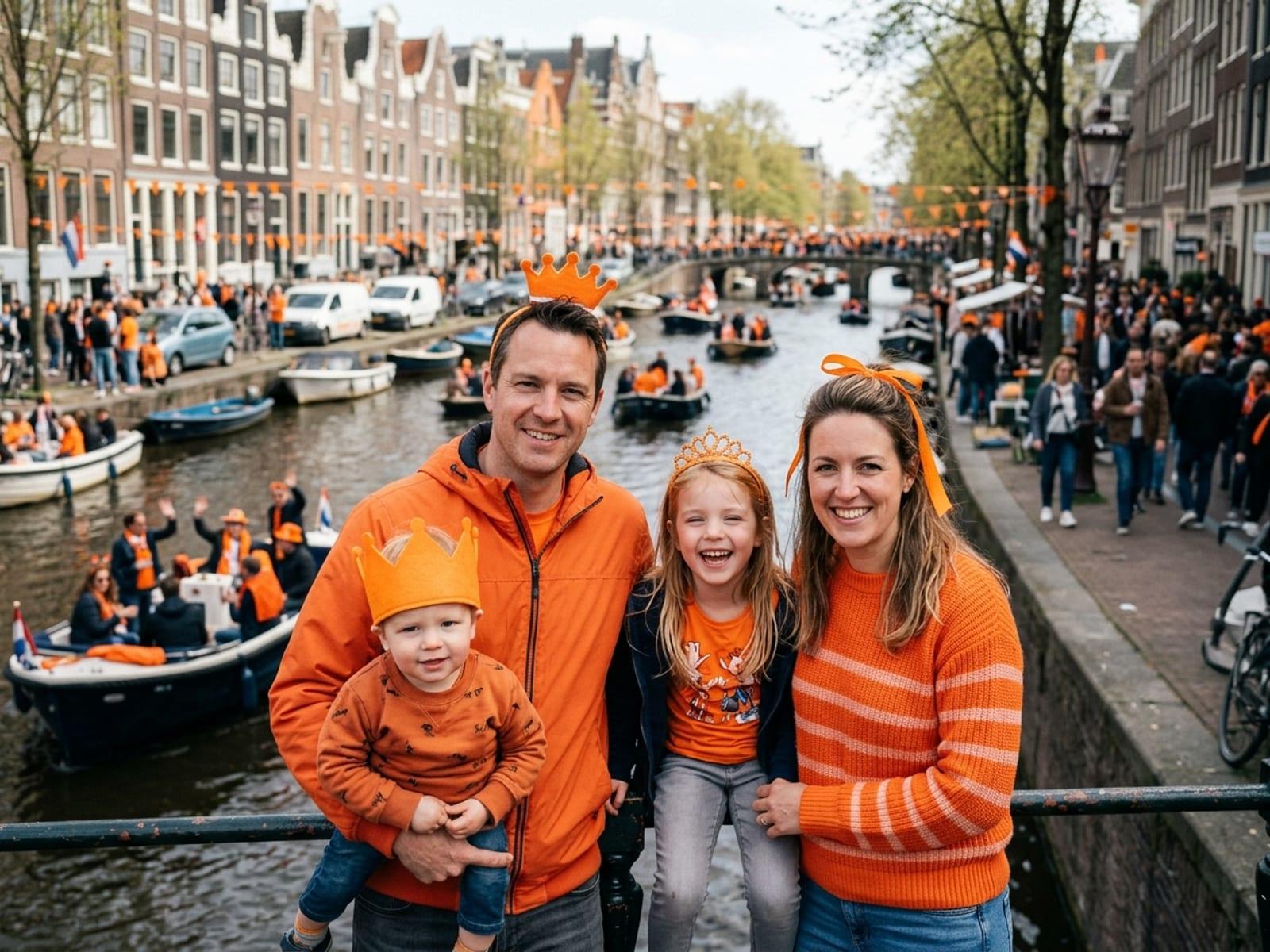
Koningsdag, or King's Day, is the Dutch national holiday for King Willem-Alexander's birthday, held every year on 27 April (or the 26th when the 27th is a Sunday), when towns across the country fill up with people dressed head to toe in orange. Boats decked out in orange cruise the canals, and the pavements turn into one long market of secondhand goods, where children can set up shop too. With kids, the easiest plan is the children's market in Amsterdam's Vondelpark in the morning, keeping well away from the packed central canals after lunch.
A national party for the king's birthday
The Netherlands has long had a public holiday for the monarch, previously known as Queen's Day. When Queen Beatrix abdicated in 2013 and her son Willem-Alexander took the throne, the holiday became King's Day from 2014, and the date moved to his birthday, 27 April.
There's one exception. When 27 April falls on a Sunday, the celebrations move to Saturday 26 April. The Dutch government's flag-flying instructions list the date as "27 (26) April" for exactly this reason. In 2026, the 27th was a Monday, so King's Day was held on the 27th. For any future year, just check whether 27 April lands on a Sunday.
Orange is the colour of the day because the royal family belongs to the House of Orange-Nassau. Oranje is the Dutch word for orange, and it's also the colour the national sports teams wear. When a royal baby is born, even the aniseed sprinkles Dutch families serve to celebrate a birth come out in orange.
Each year the King and his family spend the day in one Dutch town that serves as a regional centre. In 2026 it was Dokkum; in 2027 it will be Lelystad, on Tuesday 27 April. The host town shows itself off with a parade, music and performances by local clubs and organisations, and the royal family meets people along the route. The public broadcaster NOS shows the whole visit live.
The vrijmarkt: a street market from early morning
The signature event of King's Day is the vrijmarkt, or "free market", held all over the country. This is the one day of the year when anyone can sell things on the street without a permit or paying VAT, and people spread blankets outside their homes covered with old toys, books, clothes and crockery. According to Amsterdam's city tourism information, the city's vrijmarkt runs from about 6 am to 8 pm. Haggling is half the fun.
Families shouldn't miss the children's market in Amsterdam's Vondelpark, where the kids run the show. They sell their own toys, drawings and homemade cakes, play instruments, or challenge passers-by to small games. Even if your child doesn't speak a word of Dutch, hand them a few euro coins and send them off to buy one thing on their own; whatever they come back with tends to be the souvenir they remember best. Bring lots of small change.
In the city centre, party boats pack the canals and crowds gather on bridges and along the water. There are outdoor stages and bars playing music, and by early afternoon the atmosphere is very much aimed at adults. Most events start around midday, and nearly all outdoor events wrap up by 8 pm. The night before (usually 26 April, or 25 April in years when King's Day moves to the 26th) is Koningsnacht (King's Night), with parties at clubs and venues across the city, including the Westergasterrein in Westerpark.
The pastry that turns orange for one day
As King's Day approaches, Dutch bakeries and patisseries fill up with orange treats. The best known is the tompouce, a rectangular pastry with custard sandwiched between two layers of puff pastry and a layer of icing on top. The icing is normally pink, but around King's Day it turns orange. Supermarkets sell them too, so they're an easy thing to eat together in your hotel room or in the park.
Eating one takes a little technique. Press a fork in from the top and the custard squeezes out of the sides, so people have their own methods: tip it on its side before cutting, or lift off the top layer and eat that first. How to eat a tompouce is a running joke in the Netherlands, and working out a strategy with your kids is a game in itself.
For adults, there's also a tradition of toasting with Oranjebitter, an orange-coloured liqueur. Houses and bridges hang the red, white and blue Dutch flag alongside strings of orange bunting, so the whole streetscape dresses up for the holiday.
What to wear: orange, and lots of it
King's Day has no traditional costume. The only rule is that everyone in the family wears at least one thing in orange: T-shirts, hoodies, hats, crown-shaped headgear, flower hair accessories and face paint all count. On the day, vrijmarkt stalls sell orange hats, wigs, feather boas and necklaces, so you can stock up once you're there, and visitors only need to pack one orange top per person. For coordinating shades across the family and arranging a group photo, see our article on King's Day orange outfits and family photos.
To see how the whole family looks in orange before you go, you can try pokesta's AI-generated photos, at $1 per photo. Other families' orange King's Day photos are a good source of ideas too. Late April in the Netherlands can bring a cold wind even on sunny days, and sudden showers are common. Bring a windproof jacket you can wear over your orange outfit, and a folding umbrella.
Walking around Amsterdam with kids on King's Day
King's Day draws huge numbers of people to Amsterdam from across the country and abroad. The canals in the centre get so crowded by early afternoon that it's hard to move, and the Jordaan, especially around Westerstraat, is the busiest of all; Amsterdam's official tourism site advises families with children to stay away. Base yourselves around calmer spots such as the Vondelpark and limit your time in the centre to a short walk early in the morning.
The whole city centre is closed to cars from 7.30 am, and trams and buses only run as far as the edge of the centre. In recent years Nieuwmarkt and RAI metro stations have also been closed for the day. Arrangements change from year to year, so plan your journeys around the live service information on the day. A pushchair is hard going through the crowds and street stalls, so a baby carrier makes life much easier.
Most high-street shops close, larger supermarkets open for only part of the day, and smaller neighbourhood supermarkets are generally open. Most major museums close too, but the Anne Frank House, the Van Gogh Museum, the Stedelijk Museum and the Rijksmuseum traditionally stay open. For a break from the crowds, the Hortus Botanicus and Park Frankendael are also open on 27 April. Opening hours may differ from usual, so check each website beforehand.
King's Day is celebrated well beyond Amsterdam, with vrijmarkts and events in towns across the country; Utrecht still runs its vrijmarkt through the night from the evening before. Families who'd rather avoid the crush might spend the day in a smaller town nearby. Late April is also tulip season, so you can add a day in the tulip fields between Leiden and Haarlem before or after.
Book early and avoid travelling on the day
Amsterdam Airport Schiphol (AMS), one of Europe's major hub airports, has flights from all over the world. There's a railway station beneath the terminal, with several trains an hour to Amsterdam Centraal; the direct journey takes under 20 minutes. From nearby European cities, you can also arrive in Amsterdam by international train.
On King's Day itself there are no luggage lockers at Amsterdam Centraal, and the lockers at Schiphol's station are out of action too. Trains run to modified timetables from the evening before and on the day, so check the NS (Dutch Railways) website; Amsterdam's tourism site also suggests using a station other than Centraal.
Hotels in the city fill up and prices rise around King's Day, so book early, especially in years when the holiday falls next to a weekend. Getting around the centre takes much longer on the day itself, so schedule airport transfers and long-distance travel for the day before or after. Rules for entering the Netherlands vary by nationality, so check your own government's official information before you go.
References