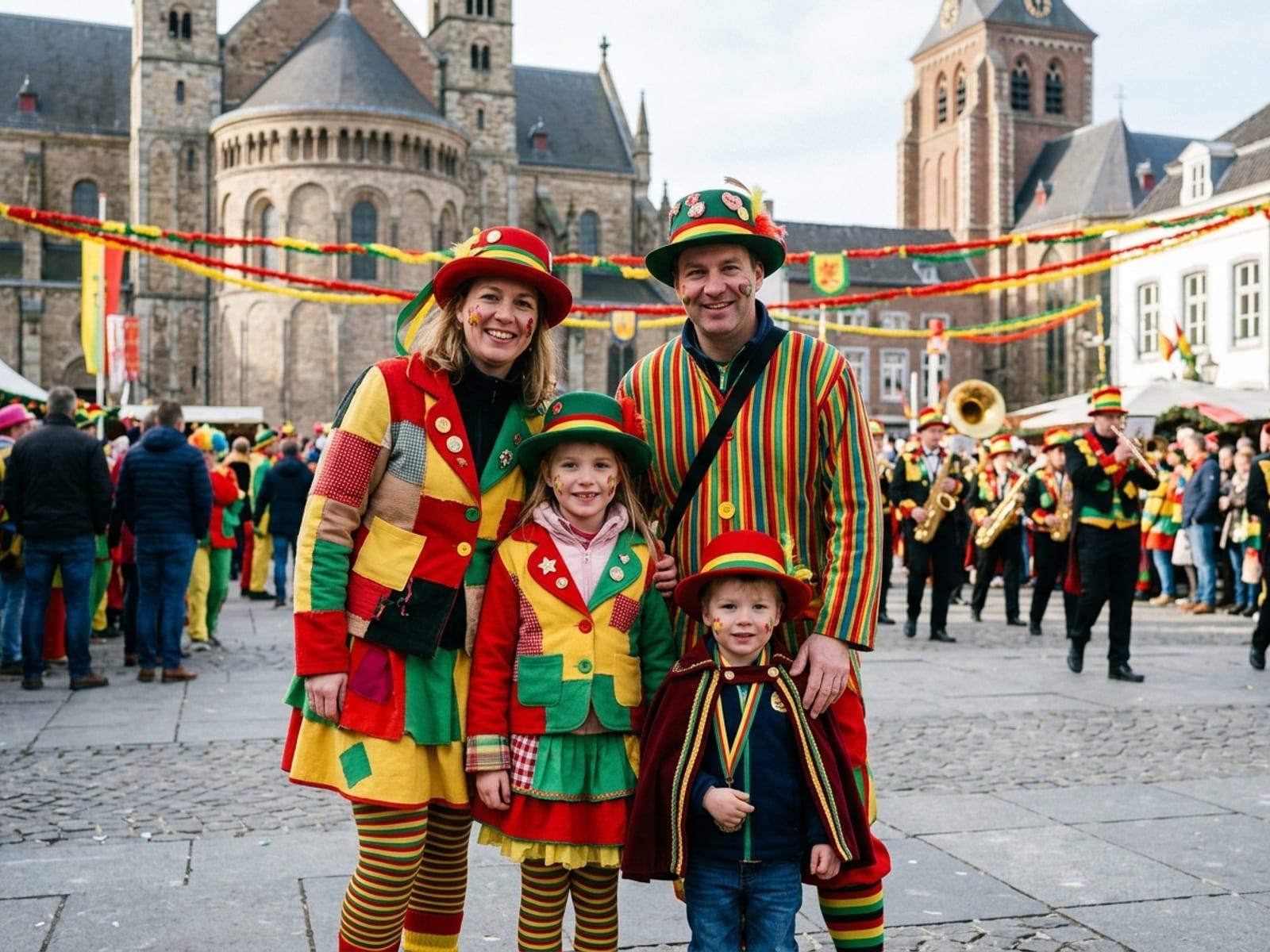
At 11:11 on a Sunday morning in February or March, the mood in Maastricht changes in an instant. The city sits at the southern tip of the Netherlands, squeezed between Belgium and Germany, and at that moment a figure is raised above its main square. For the next three days the city is given over to Vastelaovend, the local name for carnival. Most people you pass are in costumes they made themselves, bands play deliberately off-key as they wander the streets, and everyone from toddlers to grandparents dances together. In 2027 it runs from Sunday 7 to Tuesday 9 February. With children, the easiest way to enjoy it is to watch Monday's family parade and Sunday's big parade in daylight, and head back early once the evening crowds build.
Three loud days before Ash Wednesday
Carnival is held before Ash Wednesday, the start of Lent, the Christian period of restraint leading up to Easter. In the Netherlands it has traditionally been celebrated most in the southern provinces of Limburg and North Brabant, where many people are Catholic. Because Ash Wednesday is counted back from the date of Easter, carnival moves around between February and March from year to year. In 2027, Maastricht's carnival runs from Sunday 7 to Tuesday 9 February.
Momus, founded in Maastricht in 1839, is thought to have been the first carnival society in the Netherlands. Since 1945, after the war, the festival has been run by a society called De Tempeleers. The carnival season opens on 11 November of the previous year, and costumes and floats are prepared from then on. That date, St Martin's Day, also tells Dutch children that the arrival of Sinterklaas by steamboat is only days away.
It starts when a figure goes up, and ends when she comes down
Eleven is a special number at carnival. The season opens at 11:11 on 11 November, and in many towns the council that supports the carnival prince is called the "Council of Eleven". That's why the Sunday opening is at 11:11 too.
On the Saturday before carnival, that year's Prince Carnival, chosen in secret by the Tempeleers, is welcomed into the city and given the key to the city by the mayor. For three days, the prince "rules" the city. Turning everyday hierarchies upside down and laughing at them is the oldest spirit of carnival. In the Rhineland style of carnival, the prince usually wears a cap with three feathers and rides on a ship-shaped float at the end of the parade.
At 11:11 on Sunday, on the Vrijthof square, a figure called the Mooswief, modelled on a woman who sold vegetables at the market, is hoisted up a pole, and the festival officially begins. After the opening comes the grand parade, which starts in the Wyck district across the river, crosses the Sint Servaasbrug and enters the old town. Known in the local dialect as a "colourful storm", it's a noisy procession of floats, costumed groups and individuals, and bands.
Monday is the day for children and families. There's a family parade, which in 2026 went round the city centre twice, at 14:22 and 20:30. On Tuesday afternoon a band competition takes place on the Vrijthof, and when the Mooswief is lowered at midnight, carnival is over. People who can't quite let go gather to watch her come down.
The sound of the zate hermeniekes
The sound of Maastricht's carnival comes from informal brass bands of friends called zate hermeniekes. The name roughly translates as "drunken bands", and they play slightly out of tune on purpose as they wander from street to street. On Tuesday afternoon, many bars traditionally switch off their sound systems and give the floor to live brass bands. Carnival songs in the local dialect have been written every year since 1946, so the stock of songs everyone can sing along to keeps growing.
Costumes are made, not bought
In Maastricht, costumes are handmade as a rule. They're called pekske, and wearing one can come with a bit of acting or a small sketch to match the character, not just the outfit. The tradition is said to be linked to the city's past as a place where many people worked in factories. Face paint is more common than masks, apparently because it's easier to eat and drink with.
Visiting families don't need anything elaborate. A cape, hat or ribbons in the carnival colours of red, yellow and green, plus stars or hearts painted on the cheeks, are enough to fit right in. Sewing scraps of fabric onto a secondhand jacket or sticking feathers in a felt hat with your children before the trip is half the fun. If you like the idea of a festival where the whole family dresses in one colour, there's also King's Day in April, when the country turns orange. You can also see how the whole family looks in costume with pokesta's AI-generated photos ($1 per photo).
With children, plan for the cold and the night crowds
Maastricht in February is cold, with rain or even snow on some days. Layer thermal underwear or fleece under your costume, and bring gloves and waterproof shoes. Most of the festival is outdoors, and you'll spend a lot of time standing.
The best times for children are Monday's family parade and Sunday's grand parade in daylight. As the night goes on, the streets and bars fill with adults and the atmosphere becomes full-on carnival. With young children, go back to your hotel while it's still light, and keep any evening outing short. A baby carrier gets through crowds more easily than a pushchair, and putting your contact details in your child's clothes is a sensible precaution against getting separated.
It's worth remembering that this festival is rooted in the Catholic calendar. In front of and inside churches, tone things down even if you're in costume. Many shops and attractions change their opening hours during carnival, so check ahead for anywhere you want to visit.
When to go and how to get there
The dates depend on Easter: carnival covers the three days from the Sunday to the Tuesday before Ash Wednesday (7 to 9 February in 2027). The city is already in festival mood on the Saturday before.
From Amsterdam Airport Schiphol (AMS) by train, change in Amsterdam or Utrecht for the Intercity that runs via Eindhoven to Maastricht. Because the city is close to the border, you can also use nearby Eindhoven Airport or airports on the Belgian side. Hotels in Maastricht fill up early for carnival, so book as soon as you have dates. The city's tourism office advises drivers to look up parking in advance, and cyclists to use supervised bike parks. Late at night, the regional bus company runs extra night buses to get people home. Rules for entering the Netherlands vary by nationality, so check your own government's official information before you travel.
With children, keep the costumes to a few homemade touches, watch the daytime parades and Monday's family parade, and get back to the hotel early. That's plenty. About a month after carnival ends, the Netherlands moves into flower season, with the Bollenstreek tulip fields coming into colour.
References