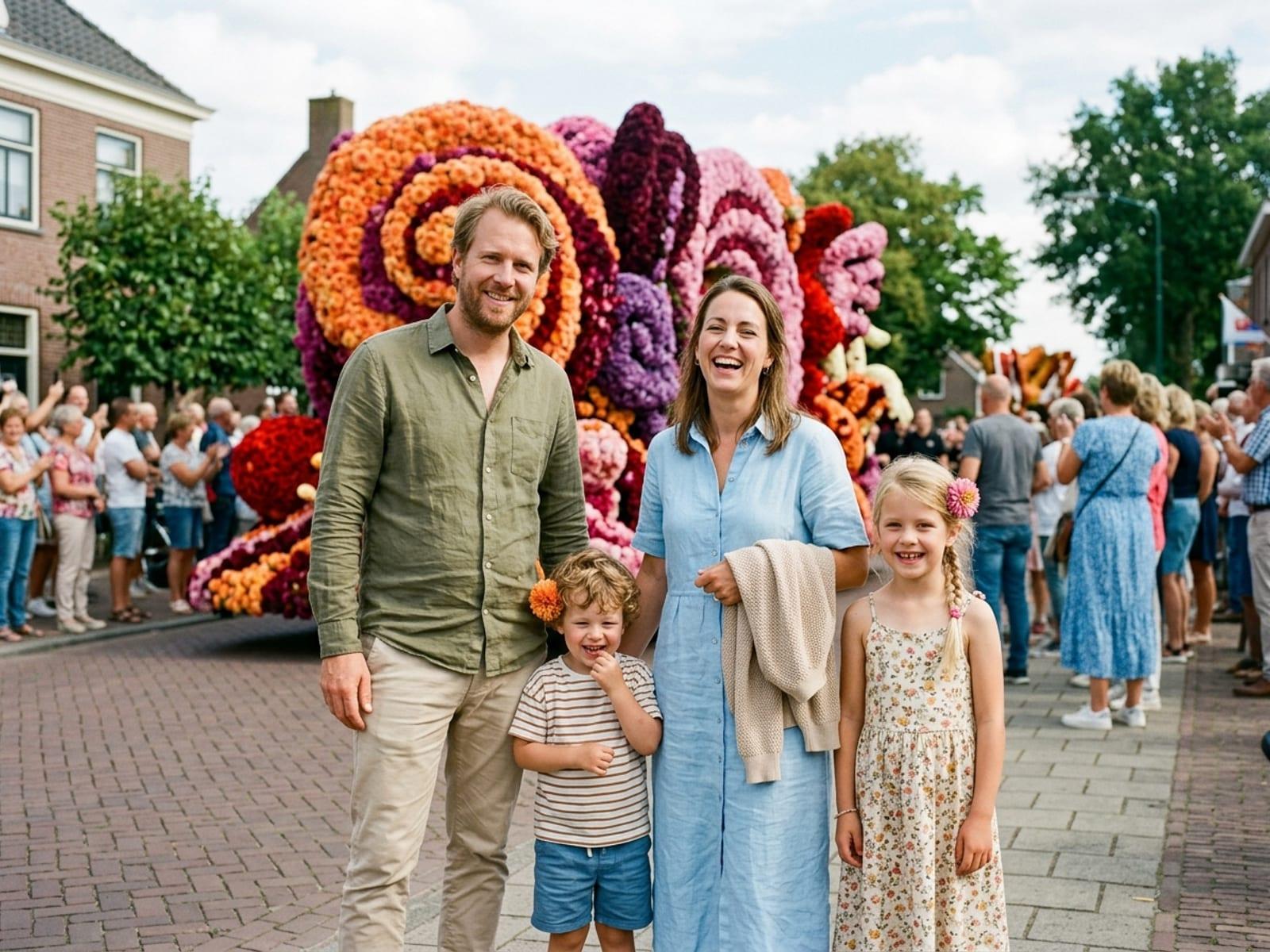
Every year on the first Sunday of September, enormous floats covered from top to bottom in dahlias roll through the streets of Zundert, a village in the south of the Netherlands close to the Belgian border. This is the Bloemencorso Zundert. The only flower allowed is the dahlia, most of them grown by villagers in their own fields, and the floats themselves are built by hand over the course of a year. In 2021 the Dutch tradition of flower and fruit parades was added to UNESCO's list of Intangible Cultural Heritage. The 2027 parade is expected on Sunday 5 September, and in 2026 children aged 12 and under got in free. With little ones, watch the floats go past once on Sunday and save the close-up look at every flower for Monday's display. It's also the village where Vincent van Gogh was born.
Twenty hamlets, a year of work, one winner
The parade began in 1936. It has run every year apart from the Second World War period, and its cancellation in 2020 because of the pandemic was the first since the war. 2026 marked the 90th edition, held on 6 September.
The floats are built by Zundert's 20 hamlets, known as buurtschappen. Each one enters a single float, and an independent jury picks the most beautiful. Work starts around May or June in a large tent belonging to each hamlet, where the frame and shape are built from steel wire, cardboard and papier-mâché. The tradition has been handed down with a natural division of labour: older residents grow and plant the dahlias, and younger people do the construction.
The flowers go on from the Thursday before the parade. Covering the floats takes around 8 million dahlias a year, of which roughly 6 million are grown in Zundert. Materials alone are said to cost around €15,000 to €20,000 per float. Using nothing but shades of petal colour, the builders render human faces, animal fur, light and shadow. Up close you can see that every dot is a single dahlia; step back and the whole thing reads like a painting.
Sunday afternoon on the move, Sunday night and Monday up close
On parade Sunday, the floats leave the exhibition grounds on Molenstraat at 13:30 and loop through the village centre. According to the 2026 guide from regional broadcaster Omroep Brabant, the floats passed twice in the afternoon, and the live broadcast was split into two parts, 13:30 to 15:00 and 17:00 to 18:30. In the early evening the winning hamlet is announced and the village switches into full party mode.
Looking up at the floats as they move past is the real thrill of the parade, but the best chance to study the details comes afterwards. On Sunday evening and the following Monday, the floats stand together at the Molenstraat grounds, and on Monday they're shown with lights, music and moving parts. With young children, one option is to watch a single pass from the crowded route on Sunday, then come back on Monday to look at the flowers one by one.
Two weeks later, on a Sunday, there's also a Kindercorso, a parade of floats made by children (20 September in 2026). They're nowhere near the size of the main floats, but work made from a child's point of view often feels more relatable to kids the same age.
Tickets, and walking around Van Gogh's village
You need a ticket to get into the parade route. In 2026, a Sunday route ticket cost €13 in advance or €16 on the day, and a ticket for the Sunday evening and Monday exhibition cost €6 in advance or €7 on the day. Children aged 12 and under and Zundert residents got in free. Grandstand seats were sold separately and still required a route ticket. Prices and sales arrangements change from year to year, so check the official website.
Zundert is where Vincent van Gogh was born, on 30 March 1853. His birth house no longer stands, but a plaque marks the spot, and in 2008 the Vincent van Gogh Huis opened to tell the story of his life. It's an easy stop before or after the parade. To see his paintings themselves, head for the Kröller-Müller Museum inside De Hoge Veluwe National Park, where you can ride the free white bikes.
Dress for walking, and pack for rain
There's no special costume. Early September in the Netherlands is usually pleasant during the day, but the weather turns quickly and evenings get cool. A thin jacket to throw over short sleeves and a packable rain layer will cover most things. The event takes place on village roads and the exhibition grounds, so wear flat, comfortable shoes.
If you're thinking about photos, quieter colours let the dahlias behind you stand out. Pick from off-white, beige, pale grey and denim, and maybe tuck a single small flower into a child's hair. You can also see how the family might look lined up in front of a giant float with pokesta's AI-generated photos ($1 per photo).
Things to watch for with children
On parade day, huge numbers of visitors from home and abroad converge on this small village. The front of the route fills up early, so if you want young children to see well, arrive with plenty of time before the start and settle on a spot. The floats are huge, and from a child's height you're looking straight up. Shoulder rides or a low folding step help (follow the event's rules).
From the early evening, music stages and parties start up in the streets and squares of the village centre. The organisers say they do not serve alcohol to anyone under 18, but the centre at night is a party mainly for adults. With small children, it's easier to see the exhibition in daylight and head off before dark. Check the event map for toilets and places to rest in advance.
Food and drink stands at the event take a dedicated token called the Corso Coin (€3.50 each in 2026). The coin machines accepted cards only. Coins from previous years can't be used, so it's best to buy a few at a time rather than end up with leftovers. Drinks are served by swapping a voucher you get at the entrance for a reusable cup. Details like these are reviewed every year, so a quick read of the official guidance before you go saves fumbling on the day.
When to go and how to get there
The parade takes place on the first Sunday of September every year, which in 2027 will be 5 September. The following Monday is the exhibition day. Zundert lies about 15 km southwest of Breda, and the Intercity Direct high-speed train links Breda station with Amsterdam Airport Schiphol (AMS) and Rotterdam. On parade day, extra buses on route 374 have run from Breda Centraal and central Breda to Zundert. Drivers are directed to temporary car parks (€5 per car in 2026).
Accommodation around Breda fills up for the weekend, so book early. Rules for entering the Netherlands vary by nationality, so check your own government's official information before you travel. Earlier in the flower calendar, April brings colour to the Bollenstreek tulip fields near Leiden. And for another festival in the south, Maastricht's carnival fills three days in February with homemade costumes and dancing.
References