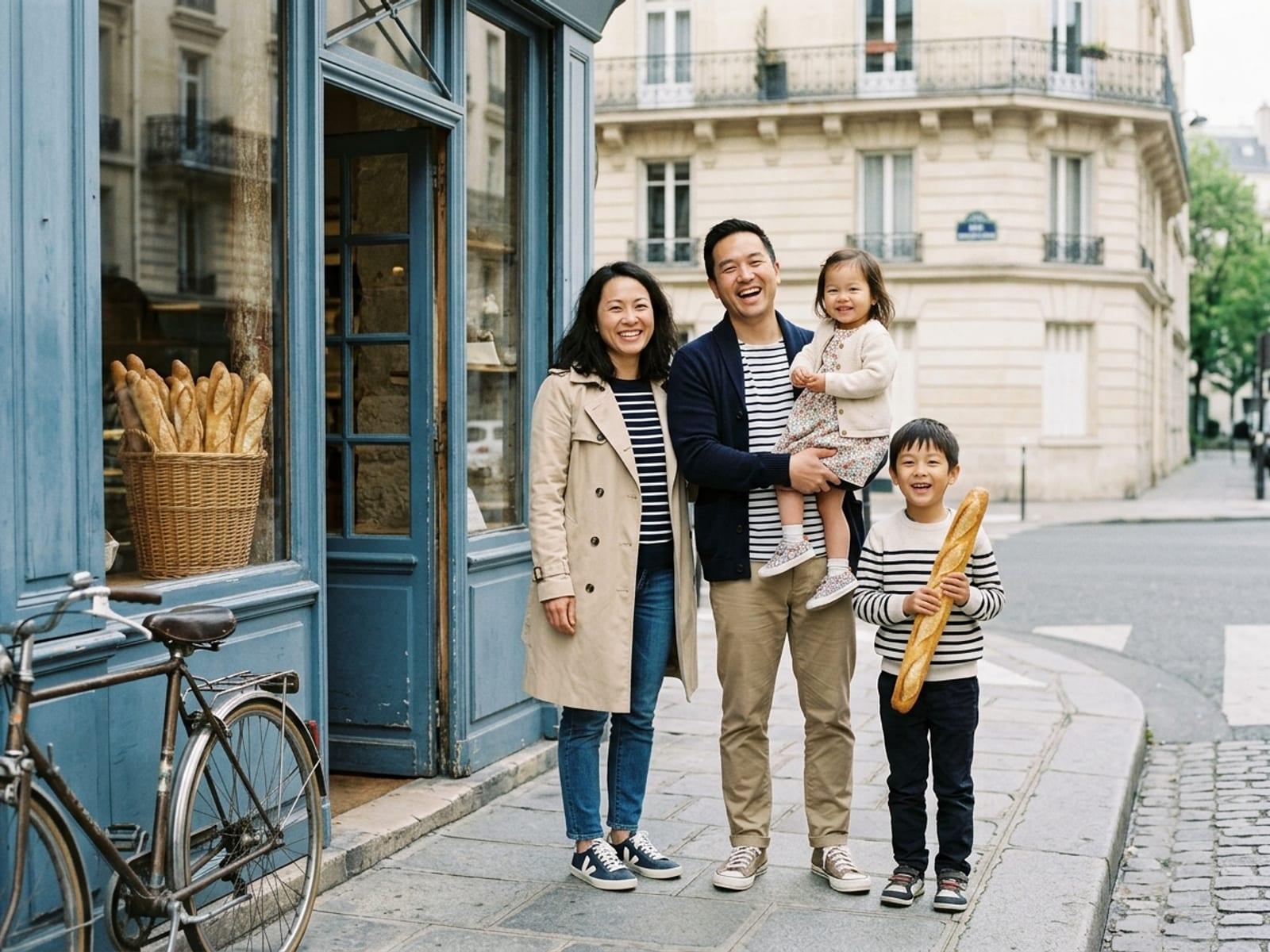
On a Paris morning, people line up outside the boulangerie for a warm baguette. In 2022, the craft of making this long, thin loaf, along with the everyday culture of buying and eating it, was added to UNESCO's list of Intangible Cultural Heritage. If you're in Paris as a family, try buying a baguette at a bakery one morning before you get to the museums and restaurants. If you let a child do the buying on their own, there are only three phrases to learn.
Four ingredients, nine steps
According to UNESCO, the baguette is the most widely eaten bread in France, and it's made from just four ingredients: flour, water, salt and yeast (or a sourdough starter). The process breaks down into nine stages: weighing and mixing, kneading, rising, dividing, resting, shaping by hand, a second rise, scoring the top with shallow cuts (the "coupe"), and baking. Each bakery scores its loaves in its own way, and the pattern is often described as the baker's signature. Temperature and humidity change the result too, so the same recipe tastes different from one bakery to the next, and from one day to the next.
Bakeries bake in several small batches through the day, and customers come back almost daily. Baguettes are served not only at home but in restaurants, workplaces and school canteens, and France is said to eat about 30 million of them a day.
Where the long shape came from isn't actually clear. Long loaves were popular from the 18th century, but the word "baguette" doesn't appear in writing until the 20th century. A story often told is that a law banning bakers from working before dawn gave rise to the thin loaf, but there's little evidence for it. In 1920, rules in the Seine department, which included Paris, set long loaves at a minimum of 80 grams and a maximum length of 40 cm, with a price cap as well. The baguette took on today's form, about 250 grams and around 60 cm long, toward the end of the 1950s.
How the craft is handed down was another thing UNESCO highlighted. Most bakers learn on the job, combining classes at school with training in a bakery. Figures from 2011 put the number of independent bakeries in France at about 32,000, and these neighborhood bakeries used around 60 percent of the country's bread flour.
Ask for a "tradition"
Most Paris bakeries sell two kinds of baguette: the regular baguette and the baguette de tradition, or "tradition" for short.
The tradition is the "traditional French bread" defined by a 1993 decree. It may contain only flour, water, yeast or starter, and salt, plus a very small amount of a few permitted extras such as fava bean flour. A regular baguette, by contrast, can contain additives within set limits. Shape and price vary by bakery, so if you can't decide, buy one of each and compare. You'll taste the difference in the crust and see it in the holes of the crumb.
Some bakeries also sell a ficelle ("string"), thinner than a baguette. At no more than 125 grams it's easy for small hands to hold, and just the right size for a snack when someone gets hungry.
Every year the City of Paris runs a competition for the best baguette de tradition. The 33rd edition, in 2026, had 143 entries, judged on five criteria, appearance, taste, bake, crumb (the "mie") and air holes, along with size and salt content. The rules call for a loaf weighing 250 to 255 grams and measuring 55 to 60 cm. The winner was a bakery on Rue Didot in the 14th arrondissement. Besides 4,000 euros in prize money, the winner supplies the president with daily bread for the year. Winning bakeries draw crowds, and for a bread-loving family, a walk between past winners makes a fun outing.
Taking the kids to the bakery in the morning
Buying bread takes only a few words. Say "bonjour" as you walk in, "une tradition, s'il vous plaît" (one tradition, please) when you order, and "merci" when you get it. Those three are all you need. You can also say how well-baked you like it. A child of elementary-school age can be handed the money and left to order alone; you'll see a nervous face turn into a delighted one.
A fresh loaf smells wonderful, and Parisians also tend to nibble the end on the way home. If eating on the street bothers you, hold off until the hotel room or a bench in a park such as the Luxembourg Gardens, known for its toy sailboats, and pick up butter, jam or cheese to make it breakfast. The kids will be happy. Cheese and fruit can come from Paris food markets like the Marché des Enfants Rouges.
Popular bakeries are busy in the morning and late afternoon. With children, the shop is calmer once the commuter rush has passed. A baguette is best eaten the same day and goes hard by the next, so buying one or two at a time to match the size and appetite of your family avoids waste.
What to wear, and taking photos
On a trip built around food, there's no dress code. Striped tops, cardigans and beige coats, colors that suit Paris's stone streets, make for calm photos. A child walking away with a baguette tucked under one arm is a picture on its own. Inside the bakery, other customers and staff will end up in your shots, so ask first or take your photos outside.
You'll be walking on cobblestones, so wear comfortable sneakers. You can also see what a family photo outside a bakery might look like with pokesta's AI-generated photos ($1 per photo, with your first one free).
In January, bakery windows fill with the galette des rois, a puff pastry cake with almond cream. If you're going then, the galette des rois family photos are worth a look. Families with a sweet tooth might also plan a trip around regional specialties, like canelés in Bordeaux.
Getting to Paris and finding a bakery
You can buy a baguette all year round, in every part of Paris. Most international flights land at Paris-Charles de Gaulle Airport (CDG), and RER line B takes you into the city.
To pick a bakery, look for winners of the city's competition, or simply walk around near your hotel in the morning and go into the one with a line. Each bakery has its own closing days, and some shut for longer during the summer holidays, so if you have a particular one in mind, check its opening days ahead of time. Entry requirements for France depend on your nationality, so check your own government's official information.
One baguette on the first morning of the trip, and another on the morning you leave. Even at the same bakery, your child's "s'il vous plaît" will sound much more confident the second time.
References