Winter brings black truffle season to the Périgord, in the Dordogne department of southwest France. Finding these fungi, which grow underground, is a job for dogs with a good nose. In cavage, as the French call the hunt, a dog paws at the soil and a black lump comes up out of it, simple enough for even small children to follow. For a family visit, aim for December to February. Above all, on a weekend in mid-January, the medieval town of Sarlat-la-Canéda holds its Truffle Festival, with truffle-hunting dog demonstrations in the town square.
The black treasure called the "Périgord truffle"
The black truffle's scientific name is Tuber melanosporum, and in French it's also known as the truffe du Périgord. It's a fungus that grows underground in partnership with the roots of trees such as oak and hazel. From forming in spring, swelling through the summer and ripening in autumn, it takes about nine months. Its scent is strong and distinctive, earthy and woody, and it's thought to come not only from compounds the truffle makes itself but also from bacteria and yeasts living on and inside it.
Black truffle production peaked in the last thirty or so years of the 19th century. Even in the early 20th century France as a whole produced more than 1,000 tonnes a year, but output fell sharply after that. Replanting efforts began in the 1960s, and today farmers plant truffle-friendly trees and tend truffle orchards (truffières). France's biggest producer is now the Vaucluse department in the southeast, but the Périgord truffle remains a specialty bound up with the name of its region.
Cavage: letting the dog find it
According to the Dordogne tourist board, truffles were traditionally hunted with pigs. Pigs are strongly drawn to the smell, but they sometimes eat what they find, so the hunter has to move fast. Today dogs are by far the most common. Trained from a young age, a dog follows the scent and signals where a truffle is by pawing at the ground or stopping dead. In parts of the Périgord there was also an old technique of watching flies hovering above the ground to find the truffle a few centimeters below.
The tourist board says many growers open their truffle orchards to visitors, offering cavage with their dogs, tours of the orchard and tastings. Learning in the field how soil, trees and fungi work together is a good chance for children to see for themselves that mushrooms grow alongside tree roots. When growers take visitors and whether children can join in vary from grower to grower, so check when you book.
Sarlat's Saturday truffle market and the January festival
From December to March, the Dordogne has 12 controlled markets where each truffle is checked before it's sold. Sarlat holds one every Saturday. Others include Monday mornings in Sainte-Alvère, the wholesale market at Sorges in the north, and Périgueux's winter market, where truffles are sold alongside foie gras.
Sarlat's Truffle Festival takes place every year on a weekend in mid-January. It's organized by the Périgord Noir truffle growers' association, the Sarlat tourist office and the town. In 2026 it was on January 17 and 18. A big truffle market fills the town square, with dozens of growers. The festival favorite is the croustou, a small, hot piece of toast topped with truffle and foie gras; up to 25,000 are said to be eaten each year.
The highlight for children will probably be the truffle-dog demonstrations, held twice a day on Place du Peyrou. In 2024 they were at 11 am and 3:30 pm. There are workshops for adults on learning to tell truffles apart by smell, as well as cooking classes for kids, chef demonstrations and guided walks on the town's history and food. At the Trophée Jean Rougié, a competition for high school cooking students from all over France, you can watch the final cook-off from the audience seats. Some events need booking, so check the latest program with the Sarlat tourist office.
Buying truffles, and a dish to share with kids
If you're buying, an official market where each truffle is checked is the safest place. The tourist board recommends choosing truffles that are firm, with a strong and even scent. Once home, put them in an airtight jar, wrapped in paper, in the fridge. Change the paper often and eat them within about a week of harvest, while the scent is strongest. Prices vary a lot with the time of year and the size of the harvest, so decide based on that day's prices at the market.
The simpler the dish, the more the scent comes through. The tourist board suggests truffle omelet, brouillade (soft scrambled eggs), mashed potatoes and fresh pasta. For children, start with an egg dish with just a little shaved on top. Some kids don't like the smell of mushrooms, so a bite shared from an adult's plate is about the right amount.
Winter clothes, when to go and how to get there
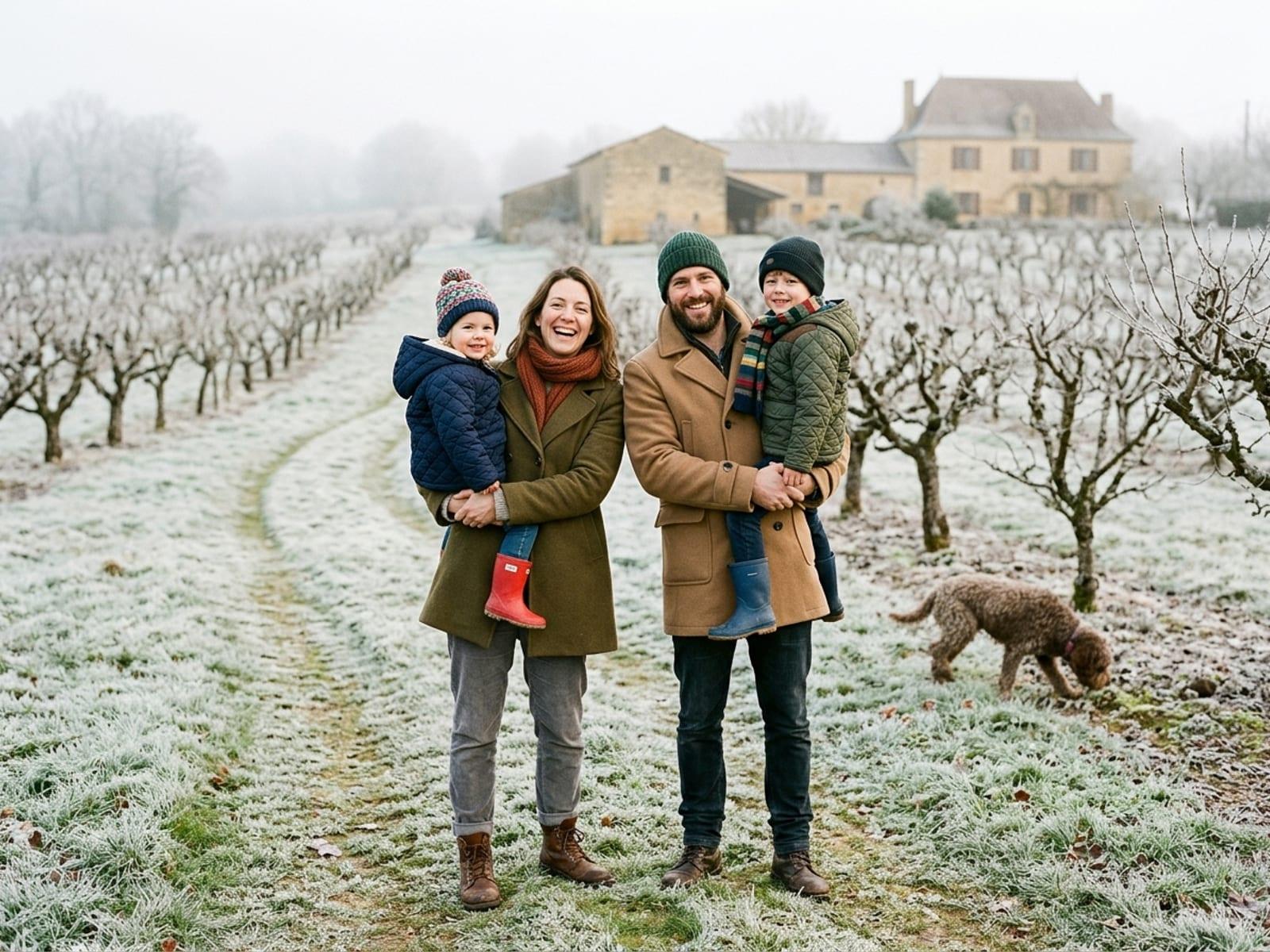
A truffle orchard means a country lane on a winter morning, sometimes across frosty grass. Wear a heavy coat and scarf, with rain boots or boots that can handle mud and frost. Earthy colors like olive or camel make for calm photos among the bare oak trees. Before you go, you can see what a photo of the family and a dog among the winter trees might look like with pokesta's AI-generated photos ($1 per photo, with your first one free).
The tourist board puts black truffle season at roughly December to March (some descriptions say mid-November to mid-March). Sarlat's Truffle Festival is on a weekend in mid-January. The nearest major airport is Bordeaux-Mérignac (BOD), and from there you continue to Sarlat by train or car. Truffle orchards are out in the countryside, away from town, so a car is handy for visiting them. If you spend a day in Bordeaux, add a few hours tasting canelés, the city's little cakes baked in copper molds, shop by shop. In December, you could also link the trip with Strasbourg's Christmas market, which dates back to 1570, over in Alsace. Entry requirements for France depend on your nationality, so check your own government's official information.
A dog digs, and a farmer lifts a black lump out of the soil. After watching that moment, the dish that follows will be more to your child than just an expensive ingredient.
References