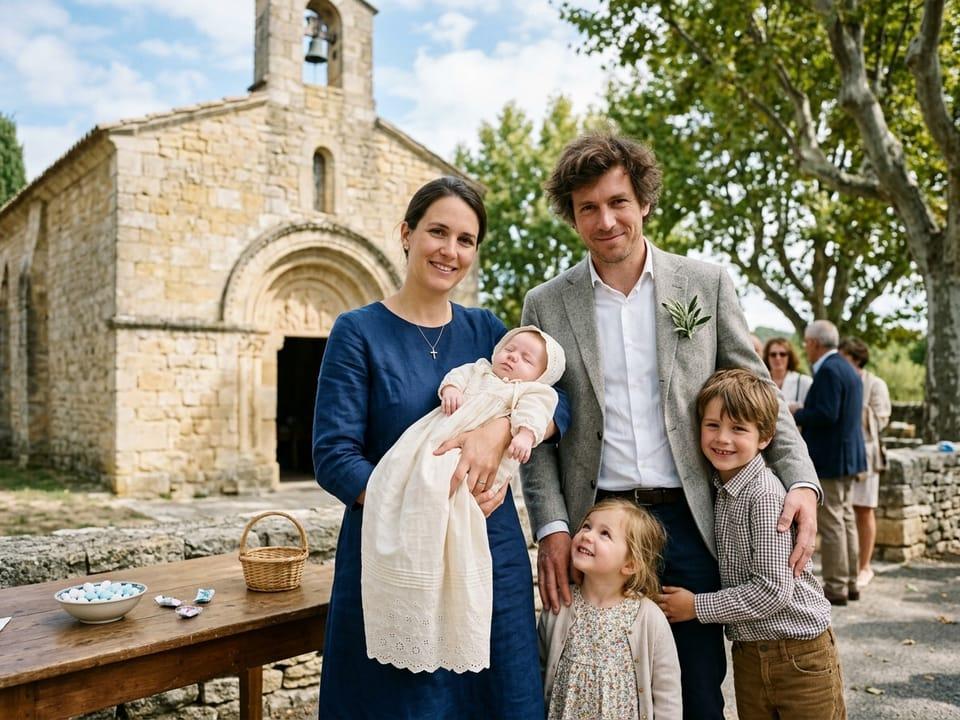
In France, a child's baptême can mean two quite different things: a Catholic baptism in church, or a non-religious civil baptism at the town hall. The church route starts with a call to the parish and preparation meetings, before any date is set. The town hall route has no basis in law, and whether it's offered at all depends on the commune. The choice shapes both the preparation and the photos you'll be able to take, so make it first.
For a church baptism, call the parish before picking a date
The Catholic Church in France asks parents to contact their nearest parish (paroisse) before fixing a date. For a child under two, parents are invited to one or more meetings, depending on the parish, to talk through why they're asking for baptism and what it means, and to prepare the celebration with a priest and lay volunteers. Children aged two to seven take part in the preparation themselves; from seven, it usually goes hand in hand with catechesis.
Infant baptism has fallen sharply over the past quarter-century. An Ifop study for the Observatoire français du catholicisme, reported by Euronews, counted about 150,000 in 2024, against 380,000 in 2000. Teenage and adult baptisms are moving the other way: according to the French bishops' conference, 13,234 adults were baptized at Easter 2026, up 28% on the year before.
Baptism is celebrated on a Sunday whenever possible, by a priest or a deacon, but many babies are baptized at communal celebrations outside Sunday Mass, with several families together. Fr Bruno Mary, who directed the French bishops' national liturgy service (SNPLS), has written that since many of those present are unfamiliar with church etiquette, it helps to set a few ground rules at the start: how many photos, phones off, no going into the sanctuary. The safest move is to ask about photography at your preparation meeting.
The godparents' moments: the white garment, the candle, the register
A child can have a godfather (parrain), a godmother (marraine), or one of each. Each must be a Catholic of at least sixteen who has received baptism, confirmation and the Eucharist, and cannot be the child's parent. They step forward only a few times in the rite, and those moments make handy markers for planning photos.
The first is the white garment, which the godmother or godfather puts on the child after the anointing with chrism. France's liturgy service recommends putting it on at this point rather than at the start, and suggests something roomy and easy to slip over the clothes underneath. Some godmothers like to give it themselves; some families bring out a christening gown worn by everyone from a great-grandmother to a little brother; some parishes have had small white albs made for the purpose.
So your baby won't necessarily arrive in white. Ask at the preparation meeting, and if the gown goes on mid-rite, dress the baby underneath in something easy to cover and softly coloured, so it won't jump out in photos.
Next, the lit candle, the light of faith, is handed to the parents or godparents. At the very end, the godparents sign the register. That signature is easy to miss, and years later it's the photo you'll reach for when you tell your child about their parrain and marraine.
The rite opens with the priest asking, "What name have you chosen for your child?" Fr Mary's guidance mentions starting on the parvis, the square in front of the church, and then going in. If your parish does that, it's a rare chance to photograph the rite in daylight. The water is poured three times over the head in a matter of seconds, so at least find out which side of the font the baby will be held on.
The engraved medal comes from the godparents
By long-standing French custom, the godfather and godmother give the child a baptism medal, the médaille de baptême. According to the Catholic outlet Aleteia, the Virgin or the Virgin and Child and angels are popular designs, while others choose the Paschal lamb, a cross or a dove for the Holy Spirit. The back is usually engraved with the child's first name and the date of baptism or birth. Less often, a cross is given instead of a medal.
A medal that small won't show up in the ceremony photos. Once you're home, lay it on the white garment or next to the baby's hand and take one shot at an angle where the engraving can be read.
Dragées trace back to Verdun
According to the Church in France, the dragées (sugared almonds) that godparents hand out grew from a tenth-century custom: the godfather threw handfuls of hazelnuts and almonds as he left the church. The almond in its shell stands for fertility and life.
As a confection, the dragée belongs to Verdun, in north-eastern France. French Wikipedia says it was created there in 1220 by an apothecary, and that Verdun's original recipe coated green aniseed in sugar. Henri IV was presented with dragées when he passed through the town in 1603. Then, in 1750, the Parisian confectioner Pecquet invented the smooth dragée, and Paris took over from Verdun as the capital of the sweet.
Today's dragées come in white, pink or pale blue, handed out in small containers called bonbonnières or drageoirs. A photo of the godparents passing them round catches a more relaxed side of the day than the ceremony shots.
Civil baptism at the mairie has no legal footing
The baptême civil, also called parrainage républicain, is held at the town hall to celebrate a child's birth, name godparents and pass on the values of the Republic. Like Bastille Day on 14 July, it has its roots in the French Revolution.
It's sometimes said to have been created by a law of 20 Prairial Year II (1794), but French Wikipedia states that no such law exists. One account credits Fouché with introducing it at Nevers during the Revolution; another places its birth at the 1790 Fête de la Fédération in Strasbourg, and Paris is said to have taken it up from 1794. It faded in the 19th century until the socialist council of Saint-Denis revived it in 1892. A clause giving it a legal framework was added to a bill in 2016, but the Constitutional Council struck it down on procedural grounds in January 2017.
Service-Public.fr, the government's information site, confirms that no legal text provides for civil baptism and that it creates no obligation. Only some town halls hold it, and none are required to. Requests usually go to the État civil or Vie citoyenne department, which may ask for the child's birth certificate, ID for the parents and godparents, and proof of address. The ceremony isn't entered in the civil registers, and any certificate you're given has no legal value. In 2015 Paris held 325 civil baptisms, but only 13 of its 20 arrondissement town halls offered them; Lyon held 181 and Nantes 135 that year. Ask your own mairie whether it offers the ceremony and whether photos are allowed.
Decide church or town hall, and the photo plan follows
At the mairie, you simply follow whatever the desk told you about photos. In church, expect to share the good spots at a communal baptism. If you hire a photographer, ask whether they've worked in that parish and where they'll stand during a communal celebration. Planning a family lunch afterwards? French restaurants generally serve lunch from about noon to 2:30 pm, so see eating out with children in France and book around the ceremony time.
If grandparents live far away or a godparent couldn't come, pokesta can create a photo of the whole family together in baptism clothes with AI, using each person's own phone photos ($1 per photo, first one free).
References
- Église catholique en France, "Comment faire baptiser son enfant ?" (French) https://eglise.catholique.fr/approfondir-sa-foi/la-celebration-de-la-foi/les-sacrements/le-bapteme/437369-faire-baptiser-enfant/
- Église catholique en France, "Quel est le rôle du parrain et de la marraine ?" (French) https://eglise.catholique.fr/approfondir-sa-foi/la-celebration-de-la-foi/les-sacrements/le-bapteme/425542-quel-est-le-role-du-parrain-et-de-la-marraine/
- Église catholique en France, "Pourquoi offre-t-on des dragées au baptême ?" (French) https://eglise.catholique.fr/approfondir-sa-foi/la-celebration-de-la-foi/les-sacrements/le-bapteme/437365-offre-t-on-dragees-bapteme/
- Liturgie & Sacrements, "Le déroulement de la célébration du baptême" (French) https://liturgie.catholique.fr/initiation-chretienne/le-bapteme/bapteme-des-petits-enfants/4226-le-deroulement-du-bapteme/
- Liturgie & Sacrements, "Le vêtement blanc du baptisé : histoire et sens" (French) https://liturgie.catholique.fr/initiation-chretienne/le-bapteme/questions-theologiques-et-pastorales/13312-le-vetement-blanc-du-baptise-histoire-sens-et-enjeu-pastoral/
- Liturgie & Sacrements, "Prendre en compte l'assemblée et les familles lors des baptêmes communautaires" (French) https://liturgie.catholique.fr/initiation-chretienne/le-bapteme/bapteme-des-petits-enfants/13298-prendre-en-compte-les-familles-lors-des-baptemes-communautaires/
- Aleteia, "Comment bien choisir sa médaille de baptême ?" (French) https://fr.aleteia.org/2018/03/19/comment-bien-choisir-sa-medaille-de-bapteme/
- Euronews, "France : les baptêmes en hausse malgré le recul du catholicisme" (French) https://fr.euronews.com/2026/09/25/france-les-baptemes-en-hausse-malgre-le-recul-du-catholicisme
- Service-Public.fr, "Quelle est la valeur juridique du baptême civil ?" (French) https://www.service-public.gouv.fr/particuliers/vosdroits/F1507
- Wikipédia, "Baptême civil en France" (French) https://fr.wikipedia.org/wiki/Bapt%C3%AAme_civil_en_France
- Wikipédia, "Dragée" (French) https://fr.wikipedia.org/wiki/Drag%C3%A9e