
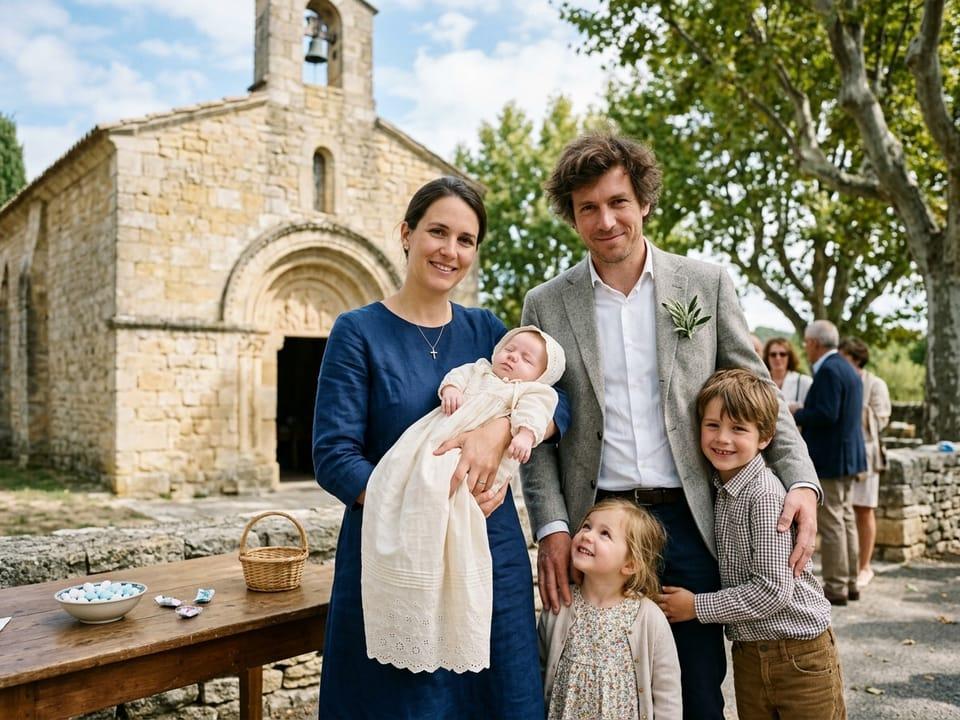
A baby who cries at the font does not hold up a Catholic baptism. The celebrant pours water over the head three times (or immerses the child), then moves straight on to the anointing with chrism, the white garment and the lit candle, and none of it waits for silence. What you can shape is the timing of the last feed and the nap, counted back from the parish's start time, and, for a child between two and seven, a small job to do. Plenty of good photos survive a red-faced baby.
Tears at the water are part of the day, not a sign it went wrong
Look at the rite from the baby's side. France's national liturgy service describes a welcome at the entrance with the question "What name have you chosen for your child?", a sign of the cross on the forehead, readings and prayers. Then everyone gathers at the font: water three times over the head, chrism on the forehead, and the white garment, put on by the godmother or godfather. The lit candle goes to the parents or godparents, and the celebration ends at the altar with the Our Father and a blessing.
For a baby, that means being passed between arms, undressed and dressed again, and having water run over the head in a cool, echoing building. Crying somewhere in that sequence is ordinary. Many infant baptisms in France are communal, held outside Sunday Mass. Fr Bruno Mary, writing as director of the French bishops' liturgy service (SNPLS), says experience suggests not going beyond three or four baptisms in one celebration, so expect other babies to cry as well. Whoever holds the camera should keep shooting, and a muslin to dry the baby's head does more good than any shushing.
Count the feed and the nap back from the parish's start time
The Church in France asks parents to contact their parish before fixing a date, and for a child under two you'll be invited to one or more preparation meetings. Use that meeting for practical questions: the start time, whether the baptism is during Sunday Mass or a separate celebration, roughly how long it lasts, and where you can feed the baby quietly beforehand.
Then plan backwards. Aim for a full feed that ends shortly before you go in, rather than one an hour earlier that you hope will last. If the start time lands in the usual nap, bring the nap forward that morning, or let the baby doze in a carrier on the way and wake slowly in the pew; waking a baby from deep sleep at the church door is a reliable recipe for tears. If the baby sleeps through the readings, let them. A drowsy baby in a white garment makes a gentle photo.
The garment needs a plan too. The liturgy service recommends putting it on at that point in the rite rather than at the start, with a table and a changing mat nearby so the child can be dressed easily. Ask whether your parish sets one up, and dress the baby underneath in something that opens with snaps instead of pulling over the head. Our guide to choosing a baptism outfit without overspending goes through what works.