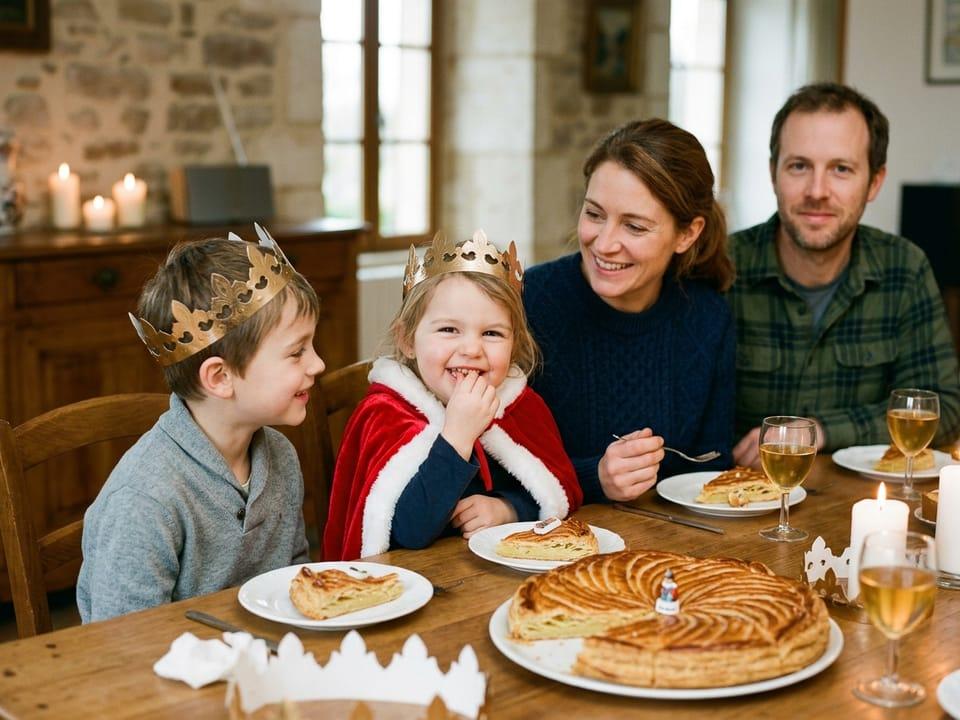
In January, families in France share a galette des rois, and whoever finds the fève, a tiny figurine hidden inside, becomes king or queen for the day. By tradition, the youngest person present crawls under the table while the galette is cut and calls out who gets each slice. With one story playing out on top of the table and another underneath, decide in advance where you'll shoot from, or the moment will be over before you've found your angle. It also helps to know how a broad bean turned into a porcelain figure, and why the one galette in France that never hides a fève is the president's.
Epiphany falls on the first Sunday of January; puff pastry in the north, a brioche crown in the south
The galette belongs to Epiphany, which celebrates the visit of the Magi to the infant Jesus. Epiphany falls on 6 January, but in France it has been celebrated since 1802 on the first Sunday after 1 January. In 2027 that's Sunday 3 January.
The northern half of France eats the puff-pastry galette filled with frangipane. In the south, the gâteau des rois is more common: a crown-shaped brioche scented with orange-flower water, topped in the south-east with brightly coloured candied fruit. The southern version goes by local names, too: couronne bordelaise in Bordeaux, royaume in Montpellier, coque des rois around Toulouse. One way of making it hides two things in the dough, a dried bean and a porcelain figure; the bean makes a king, the figure a queen. These days it's less a religious occasion than a reason to get together, and galettes are shared at town halls and workplaces too.
The name can trip you up. Ask for a galette in Brittany and you'll get a savoury buckwheat crêpe, which has nothing to do with Epiphany. Spain marks the same feast with a ring-shaped sweet bread, the roscón de reyes; for photographing that table, see our guide to Three Kings' Day in Spain.
The child under the table is there so the cutter can't choose
The youngest decides who gets each slice so that, even if the person cutting spots the slice with the fève, they have no say in where it goes. The custom is old. The sixteenth-century historian Étienne Pasquier described a small child placed under the table and addressed as "Phébé", a name for Apollo; the child answered with the Latin word "Domine" ("Lord") and then named the guests as they came to mind, regardless of rank. Very little has changed at today's family tables.
The galette is cut into one more slice than there are people. The extra slice, the part du Bon Dieu, part de la Vierge or part du pauvre, was traditionally kept for the first poor person to come to the door, and some households still set it aside. In a 2014 survey, 68% of people admitted to cheating so that the youngest child would get the fève.
From broad bean to porcelain, and the Élysée galette with no fève at all
Fève simply means broad bean in French. One theory traces it to the Roman Saturnalia, when a "king for a day" was chosen at the banquet, and for centuries the galette held a real bean. From around 1870 porcelain figurines took over, and some of the earliest were baigneurs, little baby dolls. Plastic fèves appeared in the 1960s, and gold-coloured metal ones circulated in the 1980s and 1990s before fading out as microwave ovens spread. Collecting fèves even has a name, fabophilie, and some collectors chase complete series.
The crown has a long history as well. By the late fifteenth century, whoever found the fève was being handed a paper crown, and since the second half of the twentieth century, bakeries have handed out a gold or silver paper crown with each galette.
A cake for crowning kings had a rough time during the French Revolution: a decree of December 1794 recommended sharing a "galette of equality" instead. The same idea lives on at the Élysée Palace. Every year since 1975, when Valéry Giscard d'Estaing was president, a giant galette has been delivered there, and it never contains a fève, because a republic has no king. In January 2026 there were two frangipane galettes, each about 1.2 metres across and weighing 7 kilograms.
Window light lasts until about 5pm
In early January the sun sets around 5pm in Paris. If you want window light, cut the galette at goûter time in the afternoon, while the table is still bright. If it's after dinner, don't rely on the ceiling light alone: put one warm lamp beside the table so both the golden pattern on top and the faces come out well. Lights of different colours make skin tones look odd, so keep them matched. Shoot the galette from a slight angle rather than straight down, and the scored pattern on top looks far more three-dimensional.
Baking at home gives you pictures you'll never get at the table: small hands brushing on the egg wash, the knife scoring the pattern, the pastry puffing up behind the oven door. Photograph the fève going into the filling while the kids aren't looking, then show them that picture once the king or queen is crowned, for a second round of excitement. If you buy it from a bakery, set the paper crown that comes with it beside the galette and take one picture before it's cut. For January bakery windows and how to order, see our piece on the Paris baguette and the boulangerie.
Under the table, the fève, the crown: each at its own height
First, the child under the table. Get down on your knees so you're at their eye level. It's dark under there, so let a white tablecloth hang low; it bounces light back onto the face. If you want the hands cutting above and the child calling out names below in one frame, step back and shoot from the side.
Second, the moment the fève turns up. You won't know who'll find it, so once the slices are handed out, have burst mode ready. Get a close-up of the fève in someone's palm as well; it ties the sequence together later.
Third, the crowning. Find a spot where you can see both the hands placing the crown and the face underneath it. When the new king or queen has to choose a partner, you'll often catch a shy grin.
Take the whole-family picture after that, with the crowned person in the middle. Use the same seating and the same angle every year, and one day the series will show the year a child got too big to fit under the table.
Small children and the fève
A porcelain fève is small and hard. Check little ones' slices before handing them over, and take the fève out as soon as it's found. When warming up a shop-bought galette, you can't tell what the fève is made of, so the oven is a safer choice than the microwave. A homemade crown means the children who didn't find the fève can wear one in the photos too. Write the child's name and the year inside, store it with that year's fève, and years later you'll know exactly which photo each crown belongs to.
If grandparents can't be at the table this year, pokesta can create a photo of the whole family around the galette with AI, using each person's own phone photos ($1 per photo, first one free).
References