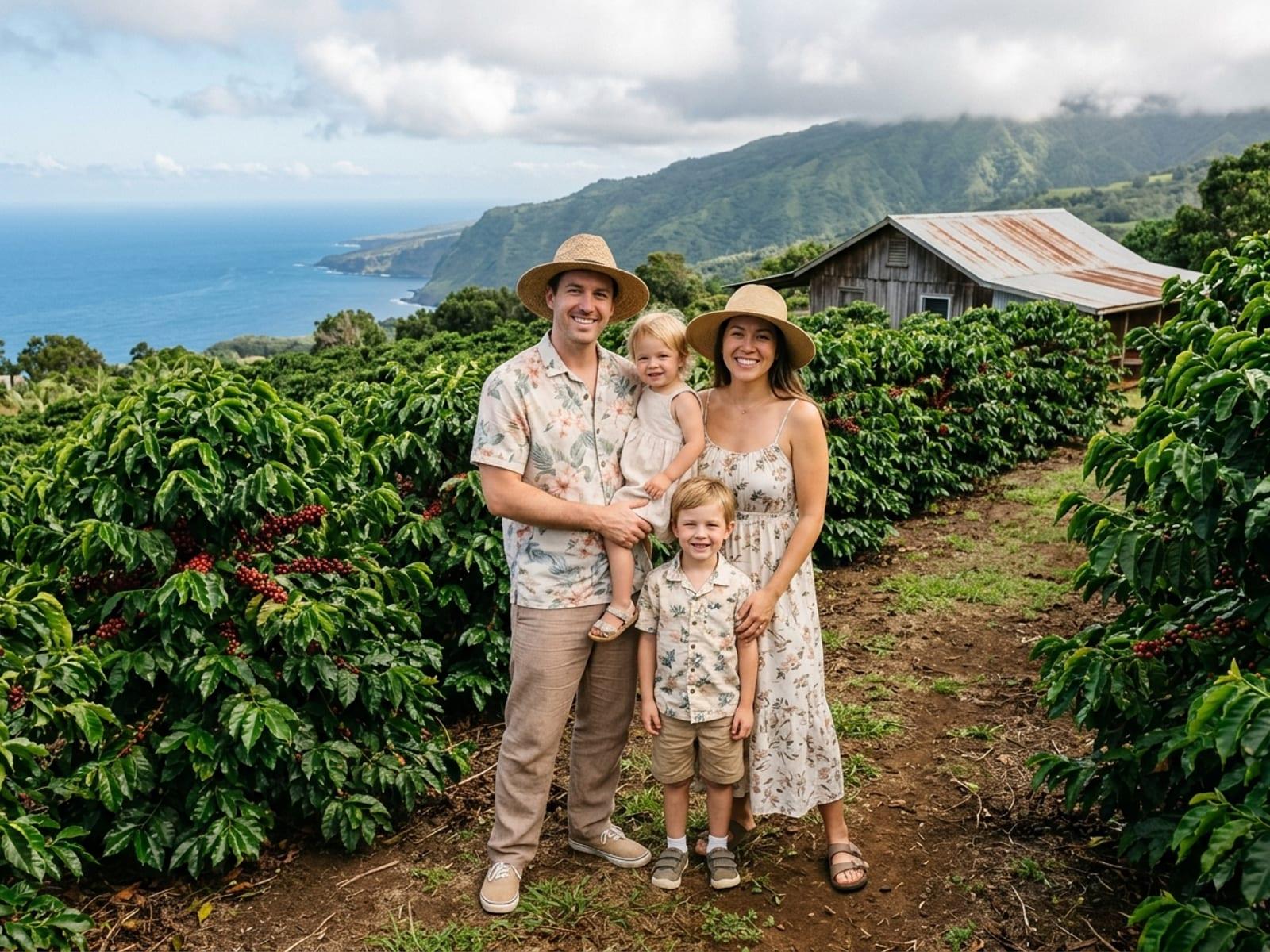
On the west side of Hawaii Island, small coffee farms dot the slopes that climb from the ocean up the sides of the volcanoes. This is where Kona coffee grows. There are about 800 farms, most of them family-run and smaller than 5 acres (about 2 hectares). From around September to January, the ripe red fruit is picked from the trees by hand. Adults who drink coffee every morning and children seeing it for the first time are both likely to be surprised that a cup of coffee starts out as a fruit like this.
Volcanic slopes and afternoon clouds
Only coffee grown in the North Kona and South Kona districts of Hawaii Island can be called Kona. The farms sit on the slopes of two volcanoes, Hualālai and Mauna Loa, in a band roughly 150 to 1,000 meters above sea level known as the Kona Coffee Belt.
What makes the coffee here is the weather. Mornings are usually sunny; in the afternoon clouds gather over the mountain, softening the sun and bringing rain. Winds are light and nights are calm. Combined with well-drained volcanic soil, that gives arabica coffee trees just the conditions they like. If you visit a farm, sunny mornings are the easiest time to walk around and give you the brightest photos.
Fields kept by Japanese immigrant families
Coffee came to Kona in 1828, when the missionary Samuel Ruggles planted cuttings of Brazilian origin. In the later 19th century, Henry Nicholas Greenwell, who had settled in the area, helped build Kona coffee into a recognized name; his store still stands as a museum. The big turning point came in 1899, when coffee prices crashed. Large plantations could no longer pay their way, and landowners split their land into small plots and leased them to workers. Many of those workers were Japanese immigrants, who farmed small plots as families and kept Kona coffee growing.
In Captain Cook, South Kona, the Kona Coffee Living History Farm is a museum farm that shows what life was like in that era. A 1920s farmhouse still stands, and interpreters in period dress demonstrate farm work, crafts and daily life. You can also see the kuriba, where farmers removed the pulp from the fruit, and the hoshidana, a drying rack for spreading out the beans. The Japanese word hoshidana, still in use here, says a lot about the families who worked this land.
According to the Kona Historical Society, the farm is open Tuesdays and Fridays from 10 a.m. to 2 p.m., and admission is $20 for adults, $10 for ages 7 to 17 and free for children under 7. Days and prices can change, so check before you go.
Red fruit, white flowers and the road to roasting
Coffee trees bloom in February and March. When small white blossoms cover the trees, people call it "Kona snow." The fruit starts ripening to red in late August and is picked by hand several times through about January, a little at a time as it ripens. One tree gives about 15 pounds (about 7 kg) of fruit, which works out to about 2 pounds (about 900 g) of roasted coffee.
Within 24 hours of picking, the fruit goes through a machine that separates the pulp from the beans. The beans ferment overnight in a tank and are then washed. Next they are dried for 7 to 14 days on a drying deck with a roof that can be rolled over it when it rains, stored in their thin husk (the parchment), and hulled just before roasting. Once you know how much work goes into turning red fruit into brown beans, a cup of coffee looks a little different. The beans are graded by size and shape. Most fruit holds two flat beans, but occasionally there is just one round bean, which is graded separately as "peaberry."
Some Kona farms welcome visitors. You can walk among the coffee trees and see up close how the fruit grows, and during the festival some farms hold events where you can try picking. Ripe coffee cherries really do look like small cherries and are easy for small hands to pick. Remember that the field is the farmer's workplace, though: don't pick fruit on your own, and follow your guide. Coffee isn't a drink for children, so tastings are for adults; it's worth asking whether the farm has fruit or juice for the kids.
The Kona Coffee Cultural Festival in November
In November, in the middle of harvest, the Kona Coffee Cultural Festival takes place. Started in 1970, it is considered Hawaii's oldest food festival. In 2026 it is the 55th festival, running from November 6 to 15. On the opening night a lantern parade sets off from Kailua Pier and makes its way along the street. Over the following days there are farm tours you can join by buying a festival badge, a market of handmade Hawaiian goods, a coffee competition and a latte art contest. In Holualoa, an upland village inside the Coffee Belt, there is also a stroll through the village with coffee and art. Dates and events change from year to year, so check the official website.
What to wear, what to buy, and travel details
The farms are on slopes, with dirt paths and rocky ground. Wear comfortable shoes, a sun hat and sunscreen. Clouds can bring rain in the afternoon, so a light rain jacket is a good idea. Bright prints like aloha shirts and muumuus stand out nicely against the dark green coffee trees and red fruit. You'll see plenty of families dressed this way on May 1 for Lei Day in Hawaii, when flower lei are given across the islands.
When you buy coffee beans to take home, read the label. Products labeled "Kona Blend" may contain only 10 percent Kona beans, and Hawaii law allows them to be sold as long as the percentage is shown. If you want to take home the true taste of Kona, choose beans labeled 100% Kona.
A family photo among the coffee trees is something you can mock up beforehand with pokesta's AI photos ($1 per photo).
The gateway airport is Ellison Onizuka Kona International Airport (KOA), about 11 km from the town of Kailua-Kona. It is a breezy, open-air airport, with seasonal flights to and from Canada as well. The farms are spread along the roads, so a rental car is the easiest way to get around. Go from September to January for the red fruit, or in February and March for the white "Kona snow," depending on what you want to see. U.S. entry requirements depend on your nationality, so check your own government's official information before you go.
The coffee in the cup was once a red fruit. Remembering the one they picked with their own fingers is a souvenir a child keeps for a long time.
References