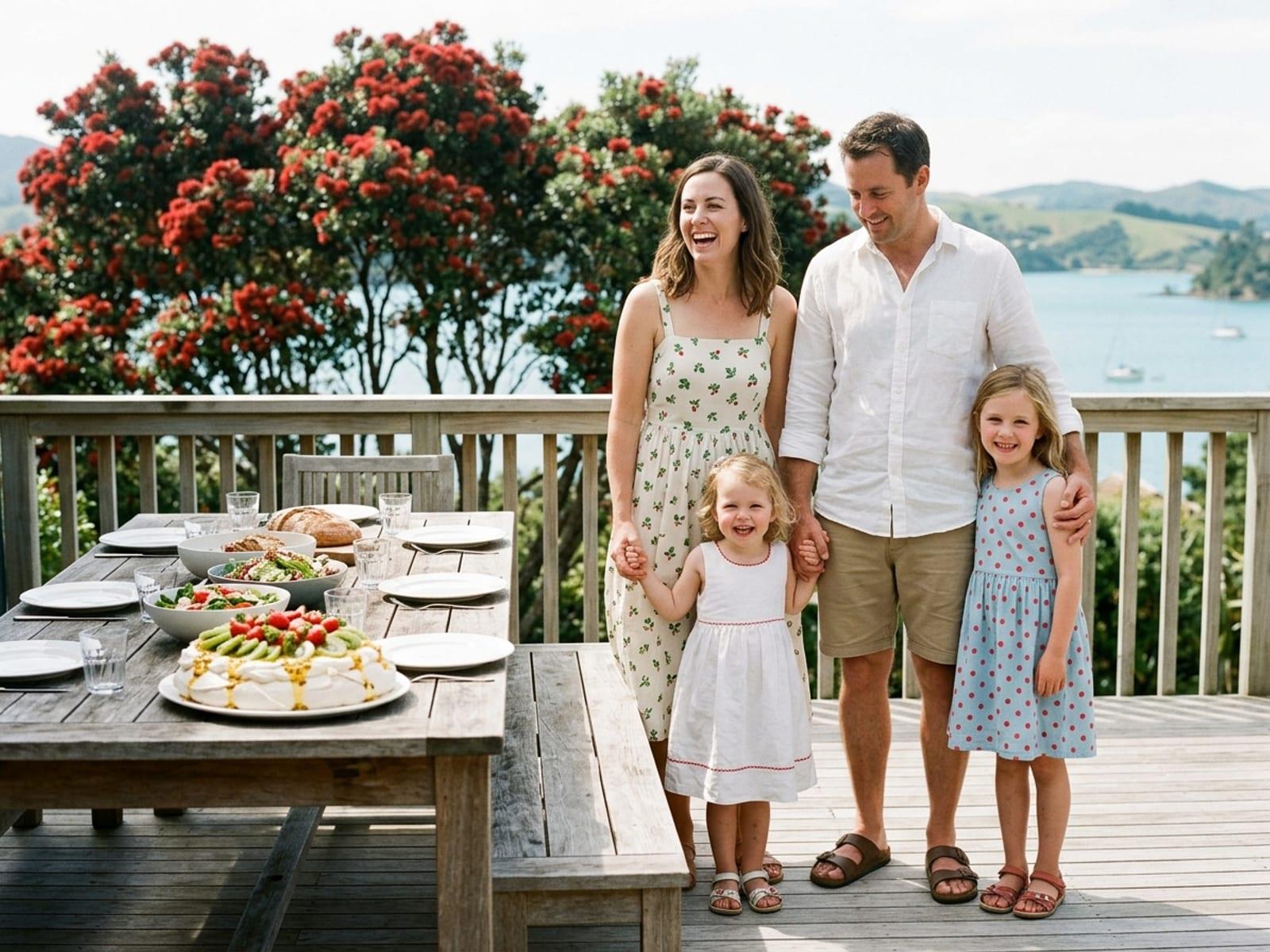
Pavlova is a meringue cake, crisp outside and soft as marshmallow inside, topped with whipped cream and fruit such as kiwifruit, and in New Zealand it's the essential dessert at a December Christmas held in the southern midsummer. It's named after the Russian ballerina Anna Pavlova, and New Zealand and Australia still haven't settled which of them invented it. To enjoy one as a family while traveling, buy a ready-baked base at the supermarket and add the cream and fruit at your accommodation, keeping egg, dairy and kiwifruit allergies in mind.
A ballerina's tour and a Wellington hotel
In 1926, Anna Pavlova toured Australia and New Zealand. According to the National Portrait Gallery in Australia, her biographer Keith Money wrote that the pavlova was created by the head chef of a hotel in Wellington. Her New Zealand visit that year was billed as the chief event of 1926.
Follow the paper trail, though, and the story gets messier. A "strawberry pavlova" printed in a New Zealand newspaper in 1911 was something like a sorbet, and a pavlova recipe published in Sydney in 1926 was a multi-layered jelly. The researcher Helen Leach believes the first recipe for a meringue "pavlova cake" appeared in 1929, in a New Zealand annual for dairy farmers. On the Australian side, the best-known claim is that Bert Sachse, a hotel chef in Perth, created it in 1935.
Other researchers trace its roots to the Spanische Windtorte, a meringue confection from Austria-Hungary, and some think it has no single birthplace at all. In 2010, the Oxford English Dictionary gave its origin as "Australia and New Zealand". Which country got there first is probably best saved as a conversation starter with locals on your trip.
Egg whites and sugar, plus vinegar and cornflour
A pavlova's base is meringue made by beating egg whites to stiff peaks while gradually adding fine caster sugar. What sets it apart from ordinary meringue is the vinegar or lemon juice, cornflour and vanilla folded in, which give it a moist, soft center. It's baked at a low temperature, 120 to 150°C, for about 45 to 60 minutes, then left to cool slowly in the oven and usually to dry out overnight.
Whipped cream and fresh fruit go on just before serving. Kiwifruit is said to be the usual choice in New Zealand, passionfruit in Australia and strawberries in Britain. Put red strawberries and green kiwifruit on top and you have Christmas colors without any other decoration.
When the pavlova was born, kiwifruit was still called the "Chinese gooseberry". After an American buyer warned that the name might cause trouble at quarantine, a New Zealand company started using the name "kiwifruit" and registered it on 15 June 1959. The green slices on a pavlova are a fruit that changed its name and went out into the world.
The Christmas table, and buying a pavlova ready-made
December is the start of summer in New Zealand. Christmas is often a lunch in the garden or at the beach, and a chilled pavlova rounds it off. Some families bake their own and some buy one; supermarkets widely sell ready-baked bases. If you're assembling one where you're staying and there's a kitchen, you can even hand the fruit cutting over to the kids.
At Te Papa, the national museum in Wellington, a giant 45-meter pavlova nicknamed "Pavzilla" was made in 1999 and cut by the prime minister of the day. In 2005, students at the Eastern Institute of Technology in Hawke's Bay made a 64-meter "Pavkong", and in 2010 a 50-square-meter rugby-themed pavlova was made at Christchurch's cathedral. For how to explore the museum itself, see our family guide to Te Papa.
Eating and baking it with kids
Pavlova is made of egg whites and cream, so it isn't suitable for children with egg or dairy allergies. Some of the fruit deserves care too. Kiwifruit contains an enzyme called actinidin, which can cause anything from an itchy mouth to, rarely, a severe allergic reaction. If a small child is trying kiwifruit for the first time, offer a little at first or choose fruit they already know, such as strawberries. Passionfruit seeds are crunchy, and some children don't like the texture.
It's very sweet. For little ones, a thin slice with extra cream and fruit is plenty. Outdoors in midsummer the cream softens quickly, so cut it just before eating.
If you bake one at home, beating the egg whites and arranging the fruit are good jobs for kids. Opening and closing the oven makes the meringue more likely to crack, so "no peeking" while it bakes and cools may be the hardest part for children. If the top does crack, don't worry; the cream and fruit will cover it.
Ready-made bases from the shop are very fragile. Carry the box flat, and in the car, secure it on a level surface rather than on a seat. Cream and fruit go on just before eating, so you only need to keep those in the fridge where you're staying.
December is the season; pack a jacket for Windy Wellington
Pavlova is around all year, but it's most at home at Christmas in December. Wellington's gateway is Wellington International Airport (WLG), about 5.5 km southeast of the city center, with international flights to and from Australia and Fiji and domestic flights from around the country. December days in Wellington are long, good for a picnic on a waterfront lawn, but the city is nicknamed "Windy Wellington" for a reason, so bring a light jacket.
For more on how New Zealanders celebrate Christmas, see our article on the Auckland Santa Parade. To see how a family photo around a pavlova on a summer deck might look, you can try pokesta's AI photos ($1 per photo, and your first one is free). Entry requirements for New Zealand depend on your nationality, so check the official information from your own government and Immigration New Zealand.
Whichever country it came from, the fun of gathering around a big white cake on a Christmas afternoon is the same. Let the youngest child choose where the first slice comes from.
References