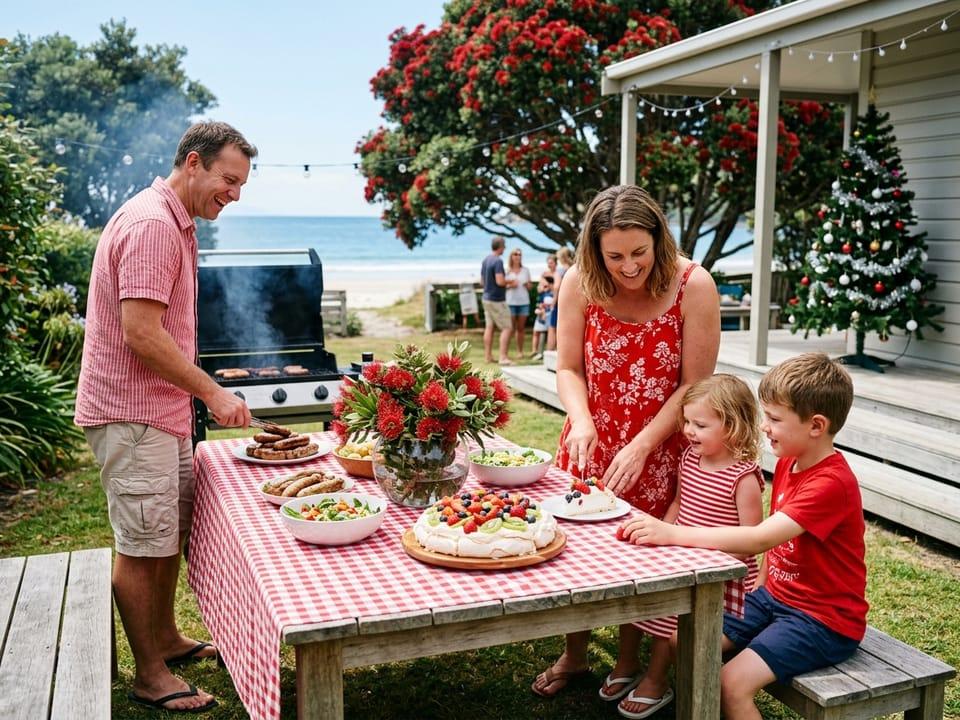
In New Zealand, Christmas falls in the middle of summer and is often celebrated outdoors with barbecues, picnics and trips to the beach. That turns the usual photo problem on its head: instead of too little light, there's too much. The summer UV Index climbs to around 12, and thanks to daylight saving the sun doesn't set until 8:41pm in Auckland on Christmas Day. The plan that suits a Kiwi Christmas is simple: shoot in the shade during the day, and save the photo with everyone in it for the hour after dinner.
The season starts with the Santa parade in late November
In Auckland, the Farmers Santa Parade makes its way through the city centre at the end of November. In 2026 it sets off at 1pm on Sunday 29 November, running down Mayoral Drive and Queen Street to finish at Britomart Place, with Sunday 6 December held in reserve in case it has to be postponed. Dates and routes change from year to year, so check Auckland's official visitor site before you go. Our guide to Auckland's Santa Parade covers where to stand and how to get there.
From behind a wall of spectators you won't get the kids' faces. Either arrive early and claim a spot near the front, or give up on stills and take video of the floats and the cheering instead. Auckland and Christchurch also usually hold big outdoor concerts known as Christmas in the Park.
Holidays on 25–26 December and 1–2 January, and five or six weeks off school
Christmas Day and Boxing Day are both public holidays, and on Christmas Day all but the most essential businesses and services have to close. In 2026, Christmas Day falls on a Friday and Boxing Day on a Saturday. If you don't normally work Saturdays, your Boxing Day holiday moves to Monday 28 December. The same happens in the new year: New Year's Day 2027 is a Friday, and 2 January lands on a Saturday, so for anyone who doesn't usually work Saturdays, that holiday moves to Monday 4 January.
Schools finish Term 4 no later than Friday 18 December 2026, and the summer break runs for five or six weeks. Each school picks its own start date for Term 1 of 2027, somewhere between 28 January and 3 February.
Some families spend that long break at the bach. A bach is a small, modest holiday home, often a beach house; in the southern half of the South Island it's called a crib. Baches took off in the 1950s as roads improved, and families tended to return to the same beach every year. If yours does too, pick one spot, such as the deck or the front step, and take the same shot from the same angle every summer. Line the years up later and nothing shows how the kids have grown quite like it.
The UV Index peaks around 12, so take daytime photos in the shade
According to NIWA, New Zealand's summer UV Index generally peaks at about 12 and can go above 13 in the far North. Anything from 10 up counts as "extreme". Forecasts and news reports describe the hours when the clear-sky UV Index is above 3 as the Sun Protection Alert period. SunSmart, run by the Cancer Society, advises protecting yourself outdoors from September to April, especially between 10am and 4pm.
Because of daylight saving, the sun isn't highest at noon either. On 25 December 2026, solar noon is at 1:21pm in Auckland and Wellington and 1:38pm in Dunedin. Light from directly overhead carves deep shadows into faces and has the kids squinting.
Take daytime photos in the shade of a leafy tree, a gazebo or a shade sail. These are the places SunSmart suggests for getting out of the sun, and they're also where light wraps softly around faces. Skip dappled spots where patches of sun land on someone's cheek, and look for even shade. A white tablecloth bounces light back up onto faces like a reflector. Ask everyone to take their sunglasses off just before you shoot and put them straight back on afterwards. In good shade, wide-brimmed hats can stay on without hiding anyone.
Sand and water reflect the sun, and SunSmart recommends protection all year round on the water and around reflective surfaces, not only from September to April. On a bright beach your phone tends to darken the whole picture, so tap on a face to set the exposure, and keep the phone in the shade between shots so it doesn't overheat. Kids in their togs are a classic summer Christmas picture; if you post them online, limit the audience to family and close friends.
Sunset is close to 9pm, so take the group photo after dinner
New Zealand puts its clocks forward an hour at 2am on the last Sunday in September and back at 3am on the first Sunday in April. For summer 2026–27, New Zealand Daylight Time (NZDT) runs from 27 September 2026 to 4 April 2027, which is part of why Christmas evenings stay light for so long. Here are sunrise and sunset times for 25 December 2026, as calculated by the U.S. Naval Observatory.
| City |
Sunrise |
Sunset |
End of civil twilight |
| Auckland |
6:00am |
8:41pm |
9:12pm |
| Wellington |
5:46am |
8:55pm |
9:29pm |
| Christchurch |
5:46am |
9:12pm |
9:48pm |
| Dunedin |
5:46am |
9:30pm |
10:08pm |
In the hour before sunset the light is low and soft, and you're well past the 10am–4pm window SunSmart singles out. Take the Christmas group photo after dinner, in the garden or at a nearby beach, when everyone is fed, the heat has gone and the light falls across every face from the side. The kids will be tired after a full day, though, so pick one spot and plan to be done in ten minutes. For 30 to 40 minutes after the sun goes down, colour lingers in the sky, which is the time for a silhouette of the family lined up along the water's edge.
Early risers get a second chance: the light is gentle for a while after sunrise too, and the beach is quieter.
Pōhutukawa bloom from mid to late December
The pōhutukawa (Metrosideros excelsa), known as the New Zealand Christmas tree, flowers from November to January and peaks in mid to late December, when crimson blossom covers the branches. The first published reference to it as a Christmas tree dates from 1857, in a newspaper report of a feast held by Eruera Patuone.
The tree grows naturally in the upper half of the North Island, mostly along the coast but also around the Rotorua lakes, where the trees produce pink-shaded flowers. Planted trees can be found right across the country.
Māori regard the pōhutukawa as a chiefly tree, a rākau rangatira. Near Cape Reinga, at the top of the North Island, a small, wind-beaten pōhutukawa said to be around 800 years old clings to the cliff. According to Māori tradition, it guards the entrance to a sacred cave through which the spirits of the dead pass.
For photos beneath one, dress the family in white, navy, green or light blue, and both the flowers and the faces will stand out. Dressed all in red, the family disappears into the blossom. A big coastal tree also makes a handy patch of shade for midday photos.
Window light in the morning, shade at lunch, the beach after dinner
Put it all on the clock and the day goes like this: open presents near a window in the morning (Brighter indoor photos: how to use window light), shoot in the shade around lunchtime, and take the photo with everyone in it after dinner. The table fills with summer fruit and vegetables, local meat and seafood, and some families cook in a hāngī, umu or lovo, using heated stones. Photograph the pavlova whole before anyone cuts it. If the photographer wants to be in the picture, prop up the phone and use the self-timer (Whole-family photos with a tripod and self-timer).
If family overseas or in another city can't be with you this Christmas, pokesta can create a summer Christmas family photo with AI from each person's own phone photos ($1 per photo, first one free).
References
- Wikipedia, "Christmas in New Zealand" https://en.wikipedia.org/wiki/Christmas_in_New_Zealand
- Wikipedia, "Metrosideros excelsa" https://en.wikipedia.org/wiki/Metrosideros_excelsa
- Department of Conservation, "Pōhutukawa" https://www.doc.govt.nz/nature/native-plants/pohutukawa/
- SunSmart, "Be SunSmart" https://sunsmart.org.nz/be-sunsmart/
- NIWA, "UV index information" https://niwa.co.nz/atmosphere/uv-and-ozone/uv-index-information
- New Zealand Government, "Daylight saving" https://www.govt.nz/browse/recreation-and-the-environment/daylight-saving/
- U.S. Naval Observatory, "Complete Sun and Moon Data for One Day" https://aa.usno.navy.mil/data/RS_OneDay
- Ministry of Education, "School terms and holidays dates" https://www.education.govt.nz/school-terms-and-holidays-dates
- Employment New Zealand, "Public holidays and anniversary dates" https://www.employment.govt.nz/leave-and-holidays/public-holidays/public-holidays-and-anniversary-dates
- Wikipedia, "Bach (New Zealand)" https://en.wikipedia.org/wiki/Bach_(New_Zealand)
- Auckland NZ, "Farmers Santa Parade Auckland" https://www.aucklandnz.com/events/all-events/farmers-santa-parade-auckland