The big building facing Wellington's harbor is Te Papa Tongarewa, the Museum of New Zealand. Its Māori name means "container of treasures", and true to that, nature, history, Māori and Pacific culture and art, all the country's treasures, are gathered under one roof. It's open every day, so it's a place a family can spend a whole day even when it's raining or blowing a gale. Museum in the morning, then the cable car up to the botanic garden on the hill in the afternoon, is a combination that lets even small children enjoy Wellington without wearing out.
A treasure box on the waterfront
Te Papa was established in 1992 by merging the former National Museum and National Art Gallery, and it opened in its current building on Cable Street on 14 February 1998. It stands on land reclaimed from the harbor and welcomes more than a million visitors a year; in 2017 it had about 1.5 million. Its collections go well beyond what's on display: about 70,000 bird specimens and about 250,000 pressed plant specimens, among others, are carefully kept for research.
It's open every day from 10 a.m. to 6 p.m. and closed only on Christmas Day, 25 December. Entry is free for New Zealanders and people living in New Zealand. Tickets for international visitors are for those aged 16 and over and cost NZ$35 (as of October 2026; some special exhibitions cost extra; check the official website for the latest). A free multilingual smartphone guide is also available.
A giant squid and a shaking house
What lights children up first will probably be Te Taiao | Nature, the exhibition devoted to the natural world. It's a 1,400-square-meter gallery that opened on 11 May 2019, and one of its stars is the colossal squid, said to be the largest specimen in the world: 495 kg and 4.2 m long. Even adults stop in their tracks at the size of this deep-sea creature.
The same gallery has a house where you can feel what an earthquake is like. New Zealand has a lot of earthquakes, and the museum building itself is protected by base isolation, which keeps ground shaking from passing up into the structure. Down in the basement at the "Quake Breaker", you can see part of the isolation system that holds up the building. After the shaking house gives them a fright, show the kids the bearings and explain that this building is designed not to shake, and it will click for them.
Outside, there's also Bush City, with native plants grouped by habitat. When you're tired of walking around indoors, it's a good spot to get some fresh air.
A marae, and the war exhibition
Inside the museum is a marae, a Māori meeting place, with a carved meeting house called Te Hono ki Hawaiki. It's an important place for Māori, so when you go in with children, no running or shouting, and follow the signs and the staff's guidance. If you'd like to learn more about Māori culture, consider adding Rotorua in the North Island to your trip.
Since April 2015, the museum has been running an exhibition on the First World War Gallipoli campaign, created with Weta Workshop, famous for its film effects, and about 4 million people had seen it by 2023. It faces the harshness of war head on. With small children, an adult may want to look first and then decide whether to go in. With older primary school children, you might introduce it as an important part of this country's history and go through it together.
Spaces for small children
For kids who need to move, the museum has Discovery Centres, where families can learn through hands-on displays, play and books. For preschoolers and their caregivers there's StoryPlace, where children can play, sing and listen to stories with staff. Times and age ranges vary by day, so check that day's information. There are parents' rooms, coin lockers and two cafés in the building, so you can take breaks as you go.
It's a big museum, so don't try to see everything in a day. Pick two or three exhibitions that match your children's interests. Before you go in, skim the layout on the free smartphone guide so you can talk with the kids about where to start. Leave jackets and souvenirs in a locker and walk around light. After the visit, ask your child to draw their favorite thing, and you'll have one memory of the trip on paper. Museum in the morning, lunch at a café or along the waterfront, outdoors in the afternoon: that's about the right balance. On a rainy day, add another exhibition after lunch and head for the cable car once the sun comes out, and the day isn't wasted.
In the afternoon, take the cable car up the hill
Walk from Te Papa along the waterfront toward the center, and on Lambton Quay, the main shopping street, you'll find the cable car terminal. The Wellington Cable Car opened on 22 February 1902 and climbs 120 m over about 600 m of track to the hillside suburb of Kelburn, taking about five minutes each way. With about a million trips a year, it's one of the city's icons.
Right next to the top station is the Wellington Botanic Garden, and riding up and walking down through the garden is a popular outing with locals too. At the top station there's also the Cable Car Museum, housed in the old winding house, which opened in December 2000. In 2023, the cable car welcomed its millionth passenger of the year on 30 December. Ride it back down too, and tired little legs get an easy return to the city.
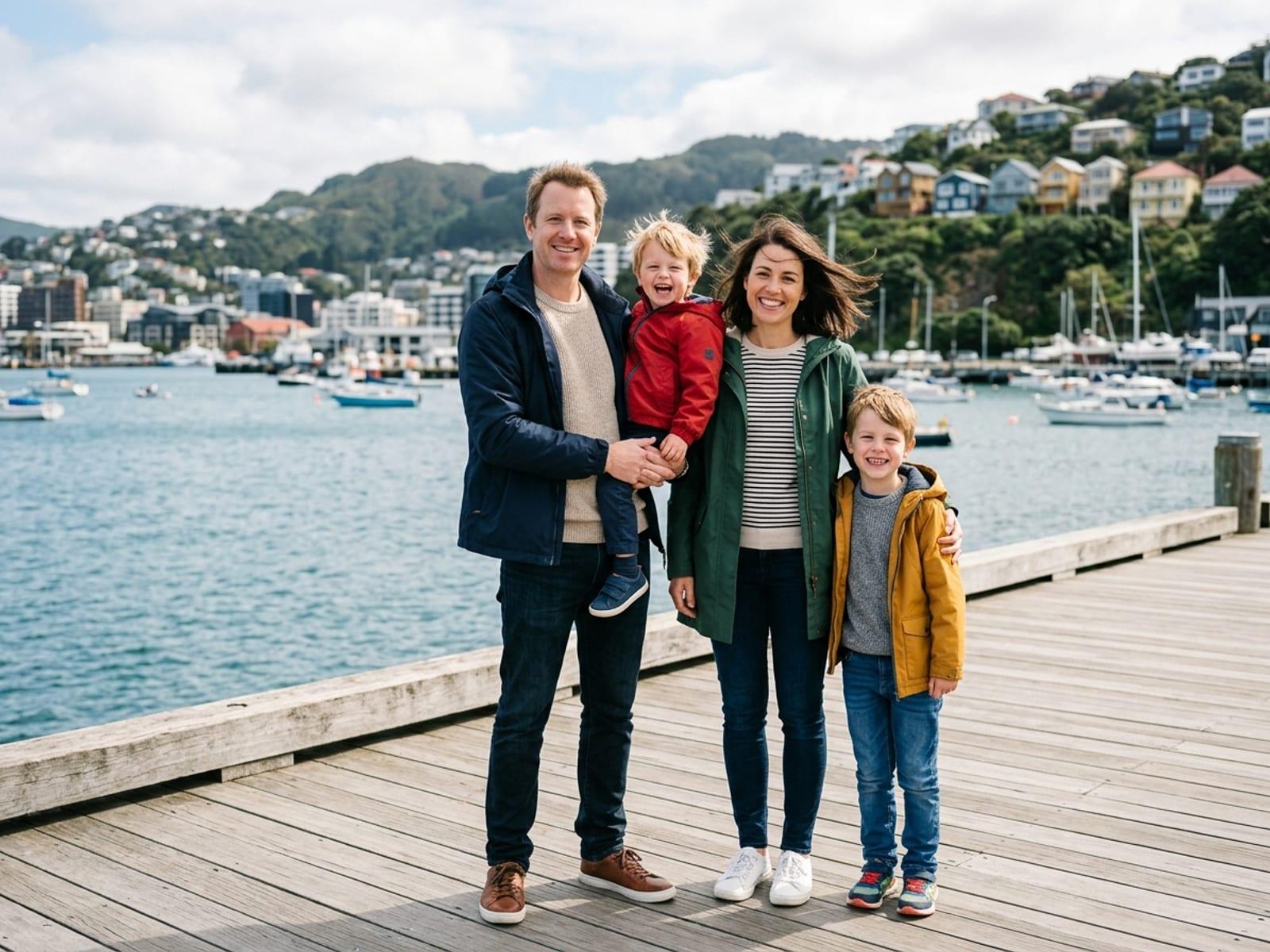
To see how a family photo with the harbor behind you might look, you can try pokesta's AI photos ($1 per photo, and your first one is free).
Open all year; bring a windproof layer
Te Papa is open all year, so any season works. Wellington has a lot of windy days, so bring a windproof jacket whatever the time of year. The gateway is Wellington International Airport (WLG), about 5.5 km southeast of the city center, with international flights to and from Australia and Fiji. The Airport Express bus runs directly between the airport and the city center.
If you're choosing a season, December is pavlova season at Christmas (in 1999 a giant 45-meter pavlova was made right here at Te Papa), and midwinter brings Matariki, the season of fire and light. Entry requirements for New Zealand depend on your nationality, so check the official information from your own government and Immigration New Zealand.
Choose two exhibitions, keep the cable car for when the sun is out, and let the children decide what you see last.
References