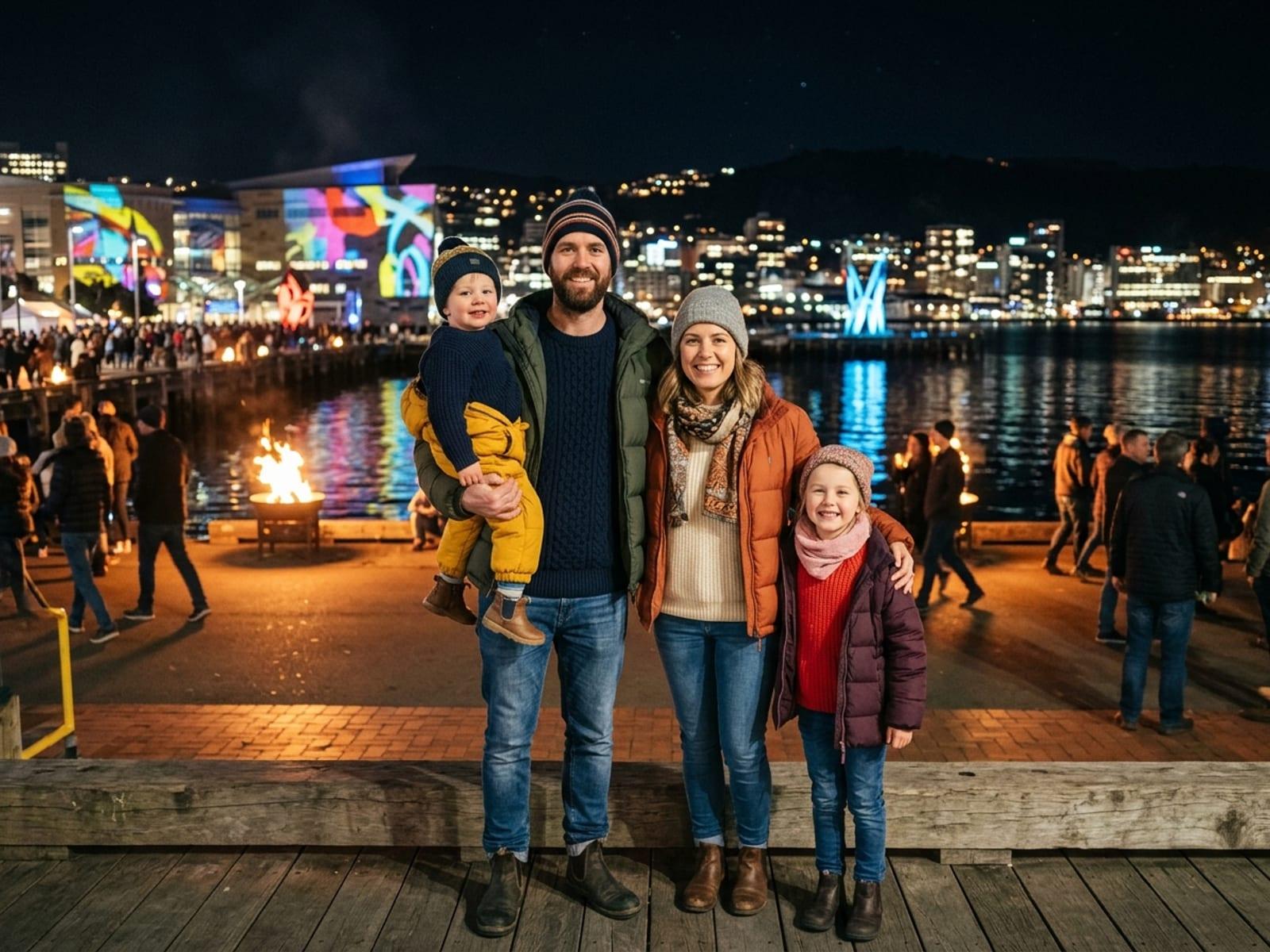
In New Zealand, from late June into July, a small cluster of stars rises in the eastern sky just before dawn. Māori call it Matariki, and its reappearance has long marked the start of a new year. Since 2022 it has been a national public holiday, and in Wellington, the capital, the city holds a free waterfront event called Matariki Ahi Kā. The holiday falls on a different Friday each year, 25 June in 2027. As a family, dress for a cold harbour wind right down to gloves, and lower the camera during the ceremony that remembers those who have died.
A new year that begins when the Pleiades rise
Matariki is the Māori name for the star cluster known in English as the Pleiades. The name is a shortened form of words meaning "the eyes of the god Tāwhirimātea." According to tradition, Tāwhirimātea, god of the winds, was so enraged when his parents, sky and earth, were pulled apart that he tore out his eyes and threw them into the heavens.
In the past, when the cluster reappeared in the winter dawn sky, people celebrated over several nights. They read the stars to predict the coming harvest, mourned those who had died in the past year, offered food to the stars by cooking it in a hāngī, an earth oven, and welcomed the new year with song, dance and feasting. In some regions and among some iwi (tribes), the rising of Puanga (Rigel, in Orion) marks the new year instead of Matariki.
The practice faded during the 20th century, but from the early 1990s it was revived around the country, and schools, libraries and local councils began to celebrate it. In 2022 a law establishing the Matariki public holiday was passed, and the first holiday was observed on 24 June that year.
The holiday is a Friday that moves each year
The Matariki holiday isn't fixed to a calendar date. It falls on the Friday closest to the Tangaroa period, around the last quarter of the moon, in Pipiri, a winter month of the Māori lunar calendar. The dates are set in law through to 2052. According to the list published by Te Papa, the national museum of New Zealand, the holiday falls on 10 July in 2026, 25 June in 2027 and 14 July in 2028. Each one is a Friday, giving a three-day weekend.
The Matariki cluster is counted as either seven or nine stars, each with its own role. Among them, Pōhutukawa is the star connected with those who have died, and Hiwa-i-te-rangi, the youngest, is the star people send their wishes to.
If you want to see the stars themselves, go out before dawn around the holiday. Matariki appears low in the eastern sky before sunrise in winter. You'll be waiting on high ground or by the sea, away from city lights, with something warm to drink, so with a small child only go on a morning when you can carry them out wrapped in a blanket without fuss. A year when the stars don't show is a story in itself. People mark Matariki in many ways, and in recent years councils and communities around the country have held their own events. Simply sitting down to a family meal at home and looking back over the year is a perfectly good way to celebrate.
Matariki Ahi Kā, a free walk along the waterfront
Matariki Ahi Kā, run by Wellington City Council, is a free event that you explore at your own pace along the harbourside waterfront. In 2026 it ran over four nights, 9 to 12 July, from 6 p.m. to 9 p.m. each evening. In 2025 it was held from 19 to 22 June; both years it covered four nights that included the public holiday.
In 2025 the site was divided into three zones, past, present and future, each with a gateway at its entrance. There are fire installations, large projections on buildings and open spaces, singing and music on stage, storytelling, traditional Māori games and food stalls. The council's 2025 guide described it as an event for the whole family. The stars of the show are fire, light and people's voices, not fireworks.
Each night there is a ceremony linked to two stars, Pōhutukawa and Hiwa-i-te-rangi. In 2026, between 6 and 7:30 p.m., visitors could write down the name or a memory of someone dear to them who had died in the past year, along with wishes for the new year, and from 7:45 p.m. the ceremony began beside the waterfront sculpture Solace in the Wind. The written messages are released into the flames.
During the ceremony, lower the camera and watch
Some of the people sending names into the fire will have lost family members only this year. During the ceremony, don't point cameras at strangers or use a flash. It helps to tell children in advance, "This is a time for remembering people who have died, so let's be a little quiet."
Writing a wish is an easy way for children to take part. If they're too young to write, a drawing is fine. If you'd like a family photo, take it before the ceremony, with the projections or fire installations in the background, so you don't have to worry about the people around you. To see how winter evening clothes come out, try a Matariki family photo, or look through the Matariki photos other families have shared.
Midwinter wind off the harbour: dress warmly, gloves included
June and July are midwinter in Wellington. The wind cuts along the harbour, and between 6 and 9 p.m. it gets cold. The council also asks people to come dressed warmly. Wear a knit jumper under a puffer jacket, plus a hat, scarf and gloves. For small children, an extra blanket in the stroller is a good idea. Avoid clothing that imitates Māori ceremonial cloaks or adornments; your own winter clothes are the natural choice.
Fire gives off more heat than you'd expect, so hold children's hands and stay outside the barriers and ropes. Since it's an evening event, grab a light meal at the food stalls before anyone gets hungry, and you'll be able to wait calmly until the ceremony. Te Papa, the national museum, is nearby, so you can spend the day indoors there and head out to the waterfront in the evening.
Confirm Ahi Kā dates with the council before you book
The public holiday dates are fixed as listed above, but the dates and hours of Ahi Kā and the order of the ceremony change from year to year. Wellington City Council posts details on its official website shortly before the event, so confirm your plans once that's out.
The gateway is Wellington International Airport (WLG), which has international flights from Australia and elsewhere. You can also fly in on a domestic flight from Auckland and other cities. The area around the event gets busy with people on foot, so the council recommends walking or taking public transport. Entry requirements for New Zealand depend on your nationality, so check the official information from your own government and Immigration New Zealand.
To see more of Māori culture, Rotorua in the central North Island offers Māori life and geothermal landscapes all year. If you're traveling in winter, look up that year's Friday on Te Papa's list first, and give that weekend to Wellington.
References