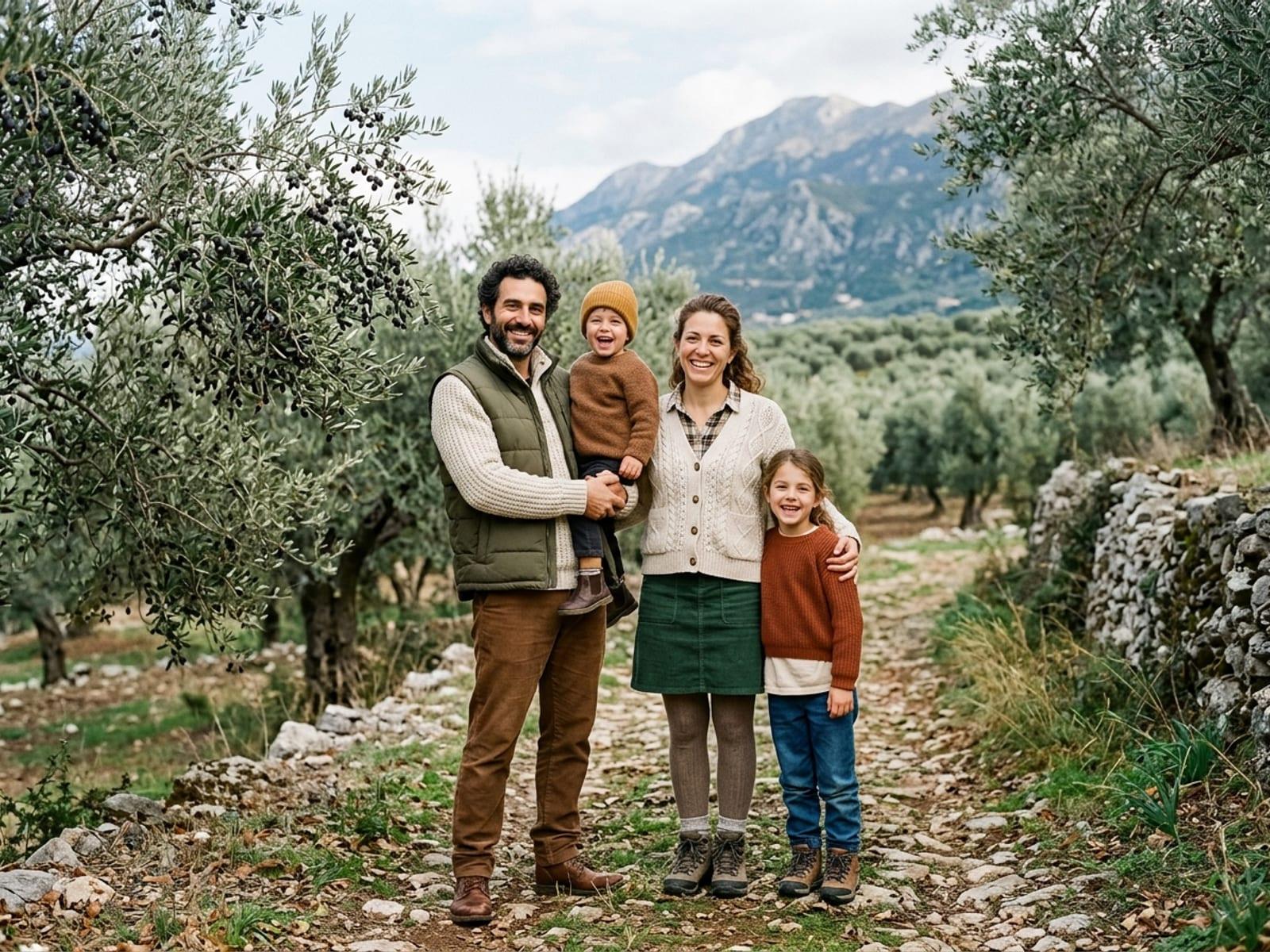
Kalamata is a port town at the head of the Messenian Gulf, in the southwestern Peloponnese, and its name is familiar from grocery shelves around the world as the Kalamata olive: almond-shaped, purplish black and plump with flesh. Not every jar labeled "Kalamata" comes from here, though. In the EU, only table olives from Messenia may use the registered name Ελιά Καλαμάτας (Elia Kalamatas) and the PDO logo, and the oil has its own "Kalamata" designation; the same olive variety is grown widely elsewhere in Greece and abroad. The harvest runs from late autumn into winter, from November to February in Messenia. Most groves are private farms, so watch from outside, check the label when you buy, and for small children, pit the olives and hand them over a few at a time.
Look for the name Ελιά Καλαμάτας and the EU logo
Two separate products are registered under the EU's Protected Designation of Origin (PDO) scheme. The table olive, Elia Kalamatas, must come from the Messenia region. The olive oil designation "Kalamata" was registered in 1997 and originally covered only the former province of Kalamata; in 2015 the area was extended to the whole of Messenia. Five objections were lodged against the change, but the European Commission approved it, finding that oils from the two areas have broadly the same sensory and chemical characteristics.
The variety name is where it gets confusing. According to a 2021 letter from the European Commission to the mayor of Kalamata, the olive was known and sold as "Kalamon", with "Kalamata" as a synonym, before the PDO was registered. Within Greece, production of the variety outside the PDO area far exceeds PDO production, and it is grown outside Greece too. Under EU rules, non-PDO olives may still use the variety name as long as they really are that variety, consumers aren't misled, and a few other conditions are met. Only PDO olives, however, may use the registered name "Ελιά Καλαμάτας / Elia Kalamatas" together with the official EU PDO logo. If you want olives from Messenia, look for both on the jar or bag.
Kalamon for eating, Koroneiki for oil
Kalamon, or Kalamata, is a large, black table olive with a smooth, almost meaty texture, usually preserved in wine, vinegar or olive oil. Look closely and you'll see the fruit is almond-shaped and slightly lopsided. Put a few next to green olives and jet-black olives and the purplish color and shape stand out, so "which one's the Kalamata?" makes an easy game with children.
Messenia's oil comes mainly from Koroneiki, along with Matsolia and, to a lesser extent, Mavrolia. Koroneiki is a small olive that nonetheless gives a high yield of excellent oil, and it covers 50 to 60% of the olive acreage grown for oil in Greece. It originated in the southern Peloponnese around Kalamata and the Mani peninsula, and one of its other names is "Koroni", the same as the Messenian port town mentioned further down. Even within one region, some trees are grown to be eaten and others to be pressed.
Never picked green, always picked by hand
Kalamata table olives can't be harvested while still green, and they are picked by hand to avoid bruising. According to Visit Peloponnese, the Messenian harvest runs from November to February: tarps are spread under the trees and the branches are beaten with sticks, or these days shaken with handheld electric tools, so the ripe fruit drops onto the tarps. Family members who live elsewhere often come home to help.
Freshly picked olives are too bitter to eat. In the short method, they are soaked in water or weak brine, changed daily, for about a week to remove the bitterness, then packed in brine and wine vinegar and topped with olive oil and lemon slices. They are often slit to speed things up. In the long method, slit olives sit in strong brine for up to about three months. Either way, a little bitterness remains, and that is part of what gives Kalamata olives their character.
Pit them for small children, and buy a little at a time
If the olives still have pits, take them out before giving them to small children, who can choke on them. They are tangy with wine vinegar and salty, so sharing a single olive is plenty for a first taste. At shops that sell by weight, buy small amounts of pitted, unpitted and slit olives to compare. For ordering olives and salads as meze, see our guide to Greek taverna manners; for buying jars in Athens and what to know about luggage and import rules, see Athens' Varvakios Central Market.
Most olive groves are private farmland. During the harvest people are working in them, so admire them from outside, and don't walk in or pick olives. If you'd like to walk through a grove, ask your hotel or the local tourist office whether any farms accept visitors, and book before you go.
Over the mountains to Sparta's olive museum
Even without stepping into a grove, you can see the whole history of olives and oil in one place. Kalamata and Sparta both sit beneath the Taygetus range, whose highest peak, Profitis Ilias, reaches 2,405 m, and National Road 82 crosses the mountains between them. In Sparta, the Museum of the Olive and Greek Olive Oil, part of the Piraeus Bank Group Cultural Foundation (PIOP) network, opened at the end of 2002 in the former Sparta Power Company building. Exhibits include fossilized olive leaves from Santorini dated to 50,000 to 60,000 years ago, replicas of 14th-century BC Linear B tablets, and reconstructions of prehistoric, Hellenistic and Byzantine presses. Large working models of water-, steam- and diesel-powered presses are easy even for small children to follow.
From 16 October to the end of February it is open 10:00 to 17:00 (until 18:00 from 1 March to 15 October), closed on Tuesdays and on several holidays, including 1 January, 26 November (the town's patron saint's day) and 25 and 26 December. Admission is €6 for adults and free for children up to 17. Prices and hours can change, so check the official website before you go. The educational programmes and materials for schools and groups are in Greek only.
In Laconia, the region around Sparta, a plaque was unveiled in October 2025 on an olive tree in the village of Apidea, in the municipality of Evrotas, marking it as the oldest olive tree in the Peloponnese. It is estimated to be more than 2,000 years old, has a trunk circumference of 14.10 m, and is a Myrtolia, a variety traditionally grown in Laconia.
From Kalamata town, and via Athens in winter
Kalamata is the capital and largest town of Messenia. It sits where the Nedon River flows into the Messenian Gulf, and it is considered the first town to be liberated in the Greek War of Independence, on 23 March 1821. The castle overlooking the town was built in the 13th century. Kalamata is also known as the home of the kalamatianos, a circle dance performed all over Greece, and at the town's Kalogreon Monastery a silk-weaving workshop makes Kalamata's silk scarves. Bring clothing that covers shoulders and knees for the monastery. The Messenian lowlands are a little warmer than Athens, and winter snow falls mostly in the mountains, above all on the peaks of the Taygetus. During the harvest you may get a day when snowcapped peaks rise beyond the green groves.
A family photo under the olive trees is something you can mock up before the trip with pokesta's AI photos ($1 per photo).
Kalamata International Airport (KLX) lies between Kalamata and the town of Messini. In summer there are many flights from around Europe, and there are also domestic flights from Athens. In the winter harvest season there are few direct international flights, so connect in Athens or travel overland from Athens. Domestic schedules also change with the season, so check the airlines' timetables. To the west, the town of Pylos faces Navarino Bay, near which the Battle of Navarino was fought in 1827, a decisive moment for Greek independence. Nearby are the remains of the palace of Nestor, the king who appears in Homer's epics, and Methoni and Koroni, Venetian ports in the Middle Ages, still have their castles. Heading on to the northeast of the Peloponnese, you can add the wine country of Nemea or the port town of Nafplio with its hilltop fortress. Entry requirements for Greece depend on your nationality, so check your own government's official information before you travel.
References