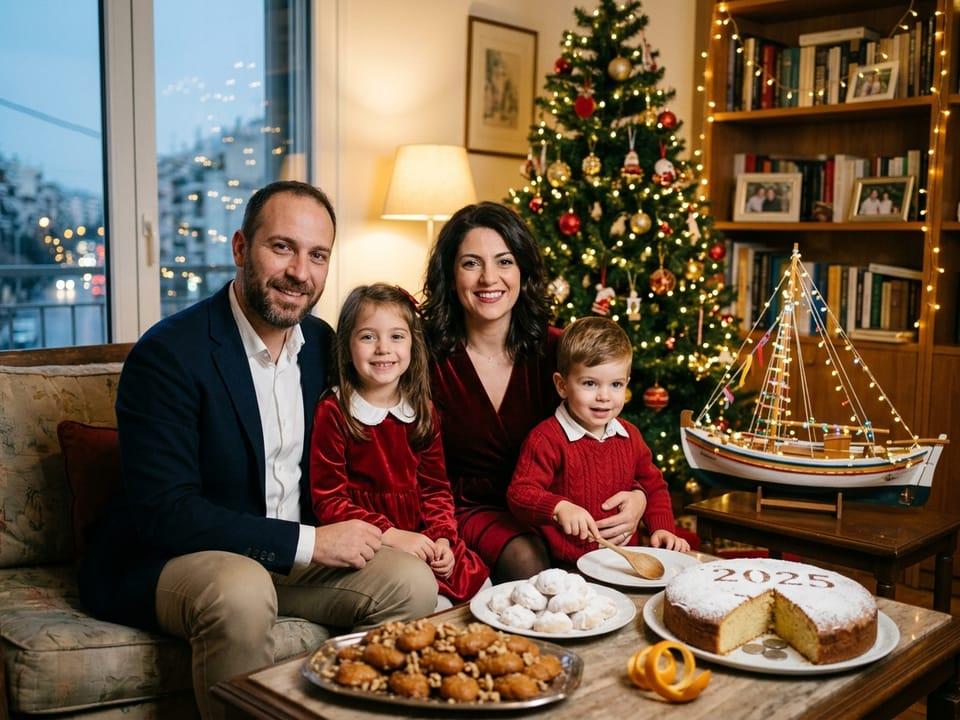
You don't have to keep a toddler awake until midnight to share the vasilopita. Most Greek families cut the New Year cake as the year turns, but the custom has never belonged only to the clock: it is also cut on other days of the Twelve Days of Christmas, and schools, offices and associations keep cutting theirs into January and even February. If your youngest is asleep by eight, cutting it at lunch on 1 January, the feast of Saint Basil, gives you the coin moment at a bright table with a child who is awake enough to enjoy it.
Midnight is the custom, not a rule
The midnight version usually runs like this. Just before twelve the lights go off and everyone counts down from ten. When they come back on, the head of the household marks a cross on the cake with the knife and wishes everyone "Chronia polla". The first slices are set aside for the house, for Christ and for the Virgin Mary; then the cake is shared out by kinship and age, with a last piece for the poor or for the house. Somewhere inside is the flouri, a coin that is said to bring luck for the year to whoever finds it.
Households and regions do it differently. The order of the symbolic slices changes from family to family, the cake itself may be a sweet bread or, in western Macedonia, often a cheese pie, and in older times the coin could be a gold sovereign. That looseness is what lets a family with small children move the moment without feeling they have broken anything.
Why the midnight photo usually comes out wrong
Three things work against you at twelve. A child kept up for the countdown is often past the point of sitting still. The lights go off just before the cutting, and even when they come back on, a living room at night is dim, so the phone slows its shutter and the knife, the hands and the faces all smear. The third problem is the table: when the flouri turns up, every adult leans in, and the child who found it ends up behind someone's shoulder.
If you keep midnight anyway, set up before the countdown. Put a lamp on a side table close to the cake, so faces are brighter than the room behind them. Seat the children on the side of the table nearest the camera, and decide in advance who holds the phone. That person films the whole cutting as video instead of chasing stills; you can pull a frame from it later, and you keep the sound of the wishes. Leave the flash off, since it flattens faces and glares off the sugar on top.
Talk about the coin before the knife comes out. Children who don't find it can be crushed, so agree beforehand what the finder gets and whether there is a small treat for everyone else. A child who knows the plan is more likely to greet the coin with a laugh than with tears.
A daytime cutting: 1 January at the lunch table
In Athens the sun rises at about 7:41 and sets at about 17:15 at the turn of the year, so a New Year's Day lunch between one and two o'clock gets the best light of the day. Move the cake next to a window, with the light falling from the side rather than from behind the family.
Then photograph the steps instead of waiting for one big moment: the knife marking the cross, each slice lifted onto its plate, small fingers pressing through the crumb, and the finder holding the flouri up beside their face. Cut before the meal, while clothes are still clean. If grandparents are there, seat them at the head of the table with the youngest grandchild next to them. A one-year-old is far easier to keep happy at noon than at midnight, and that alone is a good reason to choose lunch.
Kalanta on 31 December are the other easy photo
Children in Greece go door to door singing the kalanta on Christmas Eve, New Year's Eve and the eve of Epiphany, usually tapping a small metal triangle. They were once given nuts, eggs or sweets; today it is mostly money. In the coastal towns of Asia Minor, children also carried little boats they had decorated themselves.
For a small child, the kalanta can be two doors: their grandparents' and a neighbour's. Photograph the first one while it is still light and before the excitement builds. A child on the doorstep with a triangle, and a grandparent's hand reaching out with a coin, makes a picture that needs no flash.
Photographer, studio or your own phone at New Year
|
Studio session in early December |
Photographer at home over the holidays |
Your own phone |
| What you pay for |
Session time and the number of edited images |
Their time and travel; ask about holiday dates |
Nothing extra |
| A tired or sick child |
Another December day, if the studio's terms allow |
Hard, because 31 December can't move |
Cut the cake at lunch instead |
| Result |
Polished portrait, but no cake |
Group photos at your own table |
Real moments; the light is up to you |
| Suits |
Families who want a card photo |
Big gatherings that happen once a year |
Most families with small children |
A professional earns the fee when the whole extended family is together only at New Year, for example when grandparents fly in from abroad, and you want one group portrait with nobody missing behind the camera. Book them for a daylight hour, not the countdown, and ask before you pay a deposit what happens if a child is ill on the day. For the tree and the decorating weeks, our comparison of Christmas photos at home or with a photographer goes into more detail.
When the coin moment didn't make it into a photo
Some years the baby sleeps through the cutting, or half the family spends New Year in another city. pokesta can turn the phone photos you already have into a New Year family portrait at a vasilopita table, made with AI, for $1 per photo, and the first photo is free. It is a created picture rather than a record of the night, so keep your real snapshots beside it. Before you book anything, try it with a recent photo of your child.
References