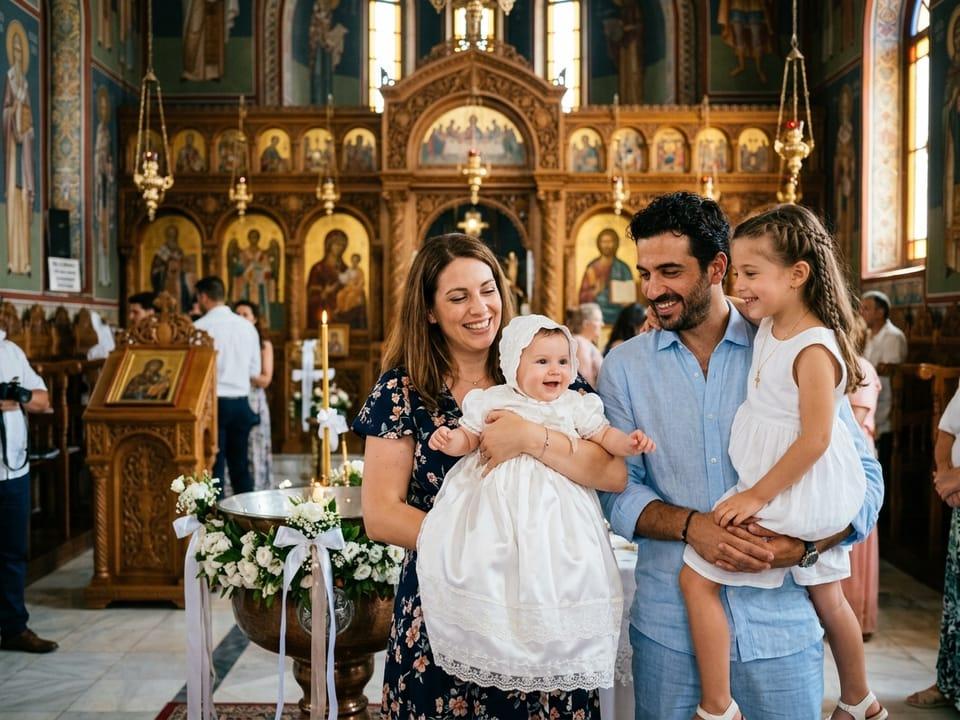
In a Greek Orthodox baptism (vaptisi), full immersion in water, anointing with holy chrism and the speaking of the child's name all happen in one continuous service. Parish guides put the service itself at roughly 35 to 45 minutes. The two moments to plan around are the few seconds when the priest lowers the baby into the font three times, and the candle procession once the baby is dressed in white. Knowing what belongs only to this service, from the godparents' white bundle to the martyrika pins for guests, tells you what to photograph.
Set the date with the church; the name may come from a grandparent
By church tradition, baptism takes place on the 8th or 40th day after birth, but today the date is usually worked out between the family and the parish. Baptisms are not held during Holy Week, and some parishes also avoid the stretch from Christmas to Theophany (January 6), Great Lent, and major feasts such as the Exaltation of the Holy Cross on September 14. One US parish asks families to call at least two months ahead and to fix the date with the church before booking a reception venue.
The name matters as much as the date. Orthodox tradition is to give a Christian name, usually that of a saint. Greece also has a custom, going back to antiquity, of naming the first and second sons after the paternal and maternal grandfathers and the first and second daughters after the grandmothers. It has loosened in the cities but still holds across much of the country.
During the immersion the priest says the name aloud: "The servant of God [name] is baptized..." If your baby is carrying on a grandparent's name, catch that moment on video, and after the service photograph the baby alone with the grandparent whose name they now share; it's a picture only your family can take.
What the godparents (nonos and nona) bring to church
The central figures in the service are the godparents, not the parents. The godparent receives the baby at the entrance, recites the Creed on the child's behalf, and anoints the baby with oil after the priest. That's why godparents must be Orthodox Christians; one parish states plainly that it does not permit "honorary" godparents who aren't Orthodox.
By tradition, the godparent buys the white outfit the baby wears after the baptism, along with the cross. Guides from Greek Orthodox churches in the US and UK list roughly the following:
- A complete white outfit (cap or bonnet, undershirt, socks and shoes, all white) and a gold cross
- A large white sheet to wrap the baby in, called the ladopano ("oil cloth"), plus a white bath towel and a small hand towel
- A small bottle of olive oil (one cathedral asks for 500 ml) and a bar of white soap
- A large white candle (lambada), which you may decorate with a bow
Photograph this white bundle laid out before the service; once it starts, the cross, clothes and candle go to different hands and won't share a frame again. Children holding decorated lambades are also part of Easter night in Greece, and the advice on lighting faces by candlelight in our Greek Easter family photo guide works just as well here.
Oil, three immersions, chrism: the scene changes every few seconds
The service begins at the church door. Holding the baby, the godparent receives the priest's prayers and recites the Creed, and then everyone moves to the font in the middle of the church. The priest blesses the water, then the oil, and anoints the baby's whole body; the godparents anoint the baby too. It recalls ancient wrestlers oiling themselves before a bout, readying the child for the struggles of life.
The immersion is the shortest part and the most important. The priest lifts the baby high over the font and immerses them fully three times, saying, "The servant of God [name] is baptized in the name of the Father, and of the Son, and of the Holy Spirit." In Orthodox tradition the whole body goes under, rather than water being poured or sprinkled, and the three immersions stand for Christ's three days in the tomb and his resurrection. It's over in seconds: shoot in bursts, and have a second person film so the priest's words are kept.
Lifted from the water, the baby is laid on the white sheet in the godparent's arms, and the priest straight away marks the forehead, chest, hands and feet with holy chrism (myron). This is chrismation, and it follows the baptism immediately, within the same service. The priest then snips a few small locks of hair as a sign that the child is dedicated to God. The baby is dressed in white, and the godparent puts on the gold cross.
Finally the priest, godparents and parents circle the font with the lit lambada, singing "As many of you as have been baptized into Christ have put on Christ." The candle is usually carried by a child, and some parishes welcome extra small candles so other children can join the procession. With an older sibling or cousin in the line, the baby in white and a child holding a flame share one frame, the most family-centered picture of the day.
Before you shoot: settle things with the priest and the family
Rules on flash and on where photographers may stand vary by church, so ask the priest beforehand, and never step between the priest and the font. The parents and godparents are taking part, so someone else has to hold the camera. If you hire a professional, first ask whether they have shot Orthodox baptisms; one who knows the order will already be in position for the immersion.
From the anointing until the white outfit goes on, the baby is undressed. Agree as a family beforehand how much of this to photograph and what can be shared; a rule like "only photos after the white outfit go online" saves second-guessing later.
After the service: martyrika, bombonières, and three Sundays
When the service ends, guests wish the child and parents "Na zisei" (may the child live long) and the godparents "Panta axioi" (may you always be worthy), and receive a bombonière filled with koufeta (sugared almonds) and sweets. Some families also hand out martyrika, small "witness" crosses or pins with a ribbon, which can be personalized with the baby's name and the date of the baptism.
The best time for the group photo is right after the service in front of the church, when the baby is in white and you have daylight. Get close-ups of the martyrika on guests' clothes and the table of bombonières; they record who came to witness the day. For an evening party at a taverna, note that Greek dinners usually start around 8 p.m. (see taverna etiquette). The baby will tire long before the adults, so get the photos with godparents and grandparents early.
Missed a shot? By custom, the godparent brings the child to Holy Communion on three Sundays in a row after the baptism, baptismal candle and all. At home, one parish asks families to hand-wash the towel, sheet and white outfit in a basin and pour that water, with the water from the baby's first bath after the baptism, onto plants so the holy oils don't go down the drain. Some families invite the godparent over for that first bath.
For family who can't be there, match the white-outfit moment
Relatives abroad can't always make it to the baptism. With pokesta, you can create an AI family photo in baptism outfits and settings from each person's own phone photos. Your first photo is free after signing up, and after that it's $1 per photo. The most natural scene to recreate is the baby in white with the cross on. You can create a baptism family photo or browse everyone's baptism posts.
References