
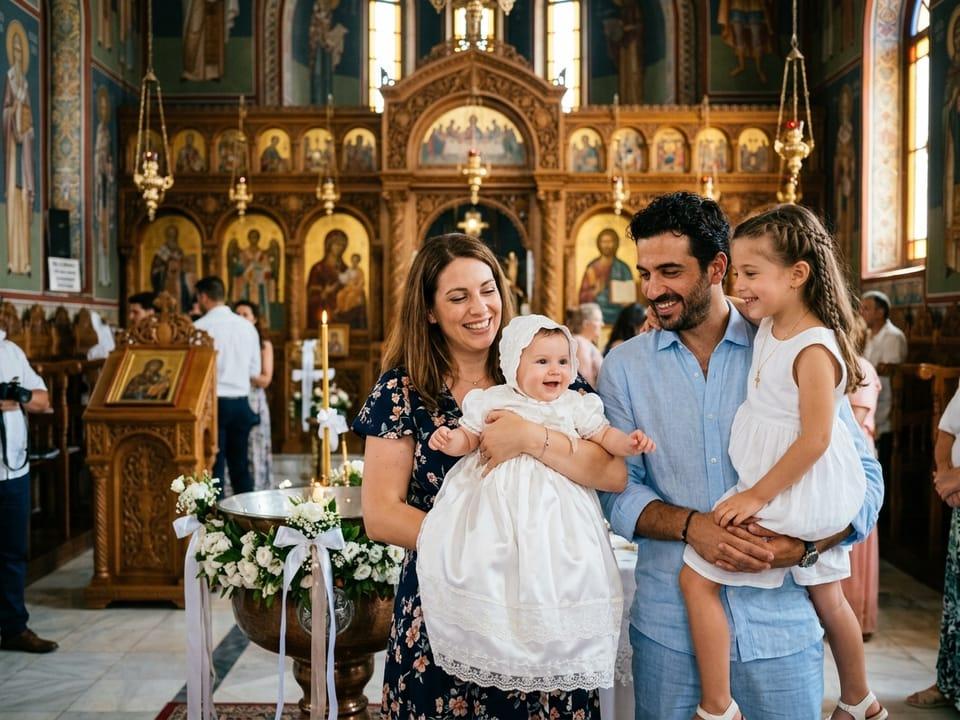
Expect some crying, and plan the photos so it doesn't matter. In a Greek Orthodox baptism the baby is undressed, anointed with oil over the whole body and fully immersed three times, so tears during that stretch are normal and say nothing about how the day went. Parish guides put the service at around 35 to 45 minutes. The calmer, more photogenic moments come afterwards, when the baby is dressed in white, the candle procession circles the font, and the family gathers in front of the church.
Where the tears usually come, and why
It helps to know the order. The godparents receive the baby at the church entrance, where the priest reads prayers and the godparent recites the Creed. Everyone then moves to the font (kolymbithra). The priest blesses the water and the oil and anoints the baby's whole body, and the godparents anoint the baby too. Then come the three immersions, chrismation with holy myron straight afterwards, the snipping of a few small locks of hair, the white clothes and the cross, and finally the procession around the font with the lit lambada.
From a baby's point of view, the hard part runs from undressing to dressing. Clothes come off in a church that may be cool, slippery oil goes everywhere, unfamiliar hands pass them around, and then there's water over the head. Crying there is a reasonable reaction, not a sign that something is wrong. Once wrapped in the dry towel and held close, a baby has a much better chance of settling, which is one more reason to keep the most important posed photos for later in the service.
Time the service around feeds and sleep
You can't control the rite, but you can choose when it starts. When you agree the date with the parish, ask about the time too, and pick a slot when your baby is usually awake and content rather than one that cuts into the longest nap. A baby who has just slept and eaten copes far better with being handled than one who is overdue for both. If the baby is unwell in the days before, read postponing a baptism when the baby is sick first.
Feeding is about timing. A full feed in the last few minutes before the oil and the water can make an unsettled baby more uncomfortable, so it can help to feed a little earlier and keep a short top-up in reserve. Ask the church where you can feed and change in private. One US parish, for example, points families to its baby changing room, which is also where the baby is undressed and dressed. The same guide expects one parent to stay close to the baby in case they get upset, even though the godparent does most of the holding. Agree on that in advance, so a parent can step in quietly without anyone feeling sidelined.
A few things worth having within reach: a dummy if your baby uses one, a soft blanket for after the immersion, a spare nappy, and a muslin for the godparent's shoulder. Arrive in good time. St Sophia Cathedral in London asks families to arrive no more than 15 minutes before the start, and warns that a baptism may be cancelled if they're more than 5 to 10 minutes late, so check your own parish's rules.