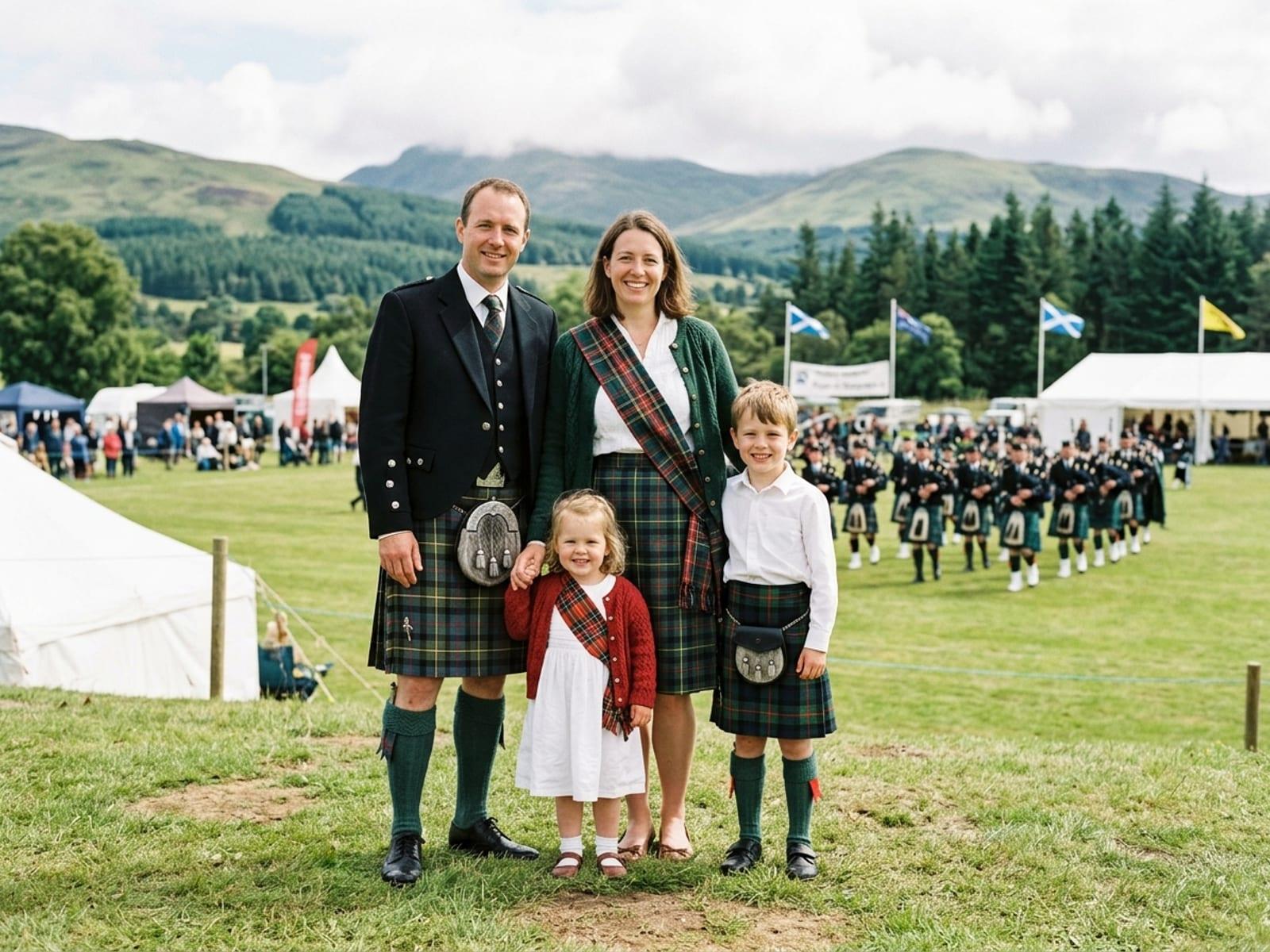
Highland games are traditional sporting gatherings held on weekends from May to September in towns and villages across Scotland, with kilted strongmen tossing the caber, Highland dancing and pipe bands filling the day. The most famous is the Braemar Gathering in Aberdeenshire, held on the first Saturday of September and often attended by members of the royal family. The fields are open grass, so families should bring waterproofs and a blanket and plan to spend the day on the grass the way local families do.
Said to have begun with a king's footrace
There are several theories about where Highland games began. VisitScotland, the national tourism organisation, tells the legend that in the 11th century King Malcolm III held a race up a hill near Braemar to find the fastest runner to serve as his royal messenger. The games lived on as a place where clansmen tested their strength and speed, but they went into decline from the 18th century. They regained their popularity in the 19th century, after Queen Victoria attended the gathering at Braemar and gave it royal patronage, and from there they spread across the country.
Today Highland games are held all over Scotland, not just in the Highlands: on the islands, in Aberdeenshire, in Perthshire and down in the Borders. The season runs from May to September, and in July and August there's a games somewhere almost every weekend.
Caber tossing, hammer throwing, dancing and pipes
The highlight of any Highland games is the "heavy events", the feats of strength. The most famous is the caber toss. Competitors cradle a log 5 to 6 metres long and weighing around 40 to 70 kg upright, run with it, and throw it forward so it flips end over end. The aim isn't distance but accuracy: judges score how close the caber lands to a dead-straight twelve o'clock position. Other events include the stone put, in which a heavy stone is thrown; the hammer throw, in which a long-handled hammer is swung and released; and the weight over the bar, where a weight is tossed above a bar overhead.
The other stars of the day are the music and dancing. Pipe bands in matching tartan play and march, there are solo piping competitions, and the stage hosts a steady stream of Highland dancing contests. Dancing competitions are divided by age, with some sections for children as young as four to six. Tiny dancers in tartan kilts and waistcoats spring about on their toes, faces set in fierce concentration. The sword dance, in which dancers step between two swords laid crosswise on the ground without touching them, is one of the best-known Highland dances. Some games also include a tug-of-war, a hill race up a nearby slope and back, or cycle races.
The Braemar Gathering, where royalty comes to watch
The most famous of all the Highland games is the Braemar Gathering, held in the Aberdeenshire village of Braemar on the first Saturday of September every year. Since Queen Victoria's visit in 1848, the reigning monarch and other members of the royal family have often attended. The gathering runs from 9 am until around 5 pm, with massed pipe bands marching before midday and again in the afternoon.
Because it's so popular, tickets are sold in advance, and the release date is announced on the official website. Among the other big events, the Cowal Highland Gathering in Dunoon, Argyll, held in summer, is known as a venue for Highland dancing and pipe band championships. Village games, on the other hand, may be smaller, but you sit much closer to the action, and some include races for children. Whether you can buy tickets on the day varies from one games to the next, so check each event's website. To find one near your route, check the list of dates on VisitScotland's website.
A touch of tartan, or a full kilt
Not everyone in the crowd wears traditional dress. Most people come in comfortable outdoor clothes with one touch of tartan, such as a stole, a scarf or a hat. Some do turn up in a full kilt.
Tartans are known for being tied to particular clans, but it's common for people with no family connection to Scotland to pick a pattern they simply like. If you do go for a clan tartan, ask in the shop about its history before you choose.
If you want Scottish cloth beyond tartan, a hat or scarf in Harris Tweed, handwoven in island homes in the Outer Hebrides, also makes a good keepsake.
Children's kilts and tartan skirts are sold in souvenir shops and specialist stores in Edinburgh and other cities. A proper kilt is measured and made to order and doesn't come cheap, so for a holiday keepsake, a simple skirt-style kilt is plenty. In winter, a piece of tartan is just as welcome at a Burns Night haggis supper on 25 January. It can be fun to see beforehand how the whole family would look in tartan using pokesta's AI-generated photos, at $1 per photo.
What to pack for a full day with kids
Most games take place on open grass fields with no cover. Even in summer, Scottish weather changes fast, and bright sunshine can turn to cold rain in no time. For a full family day out, waterproof jackets with a fleece or other layer underneath are essential, and so are wellies or waterproof shoes, because the grass turns muddy after rain. Bring a picnic blanket or folding chairs to sit on. When the sun does come out it can be strong, so pack sunscreen and hats too, and carry some cash and a card for the food stalls and children's rides.
There's a generous safety distance between the crowd and the caber and hammer areas, but keep an eye on children so they don't duck under the rope. The massed pipe bands are very loud, so ear defenders can help noise-sensitive children enjoy the show.
Reaching the games and the UK's ETA
Scotland's main gateways are the airports at Edinburgh (EDI), Glasgow and Aberdeen. From London, you can also take the train to Edinburgh. Braemar is a village in the Cairngorms National Park, about 90 km west of Aberdeen. You can drive there along the A93 through Deeside or take a bus from Aberdeen. Games overlap across the country on summer weekends, so decide which one you want to see first and book accommodation in a nearby town early.
What you need to enter the UK depends on your nationality. Some nationalities need an Electronic Travel Authorisation (ETA) before travelling, and if so, every traveller, including babies and children, needs their own application. You apply through the UK government's official website or official app. Eligibility, fees and procedures can change, so look at GOV.UK and your own government's official information before you go.
References