Harris Tweed is a wool cloth handwoven by islanders on treadle looms in their own homes in the Outer Hebrides, off north-west Scotland, and the Harris Tweed Act of 1993 makes that the legal definition. You can watch a loom at work in Gearrannan Blackhouse Village on the west coast of Lewis, and the islands can be reached all year by air from Glasgow and elsewhere or by ferry from Ullapool. With a family, sort out meals and travel by Saturday, because most shops and attractions close on Sundays.
Defined by law as cloth woven by islanders at home
The Harris Tweed Act of 1993 defines the cloth this way: handwoven by the islanders at their homes in the Outer Hebrides, finished in the Outer Hebrides, and made from pure virgin wool dyed and spun there. In other words, cloth woven off the islands or in a mechanised factory can never be called Harris Tweed, no matter how similar it looks.
The proof is the Orb, a mark showing a globe topped with a cross. It was registered as a trademark in 1909. Today the Harris Tweed Authority in Stornoway manages the mark under the Act. It inspects the mills and the weavers' sheds, checks the cloth every 50 metres, and then stamps the Orb by hand on each length. If you see it on a label or on the back of the cloth, the fabric was made on the islands.
The story begins in the mid-19th century. In 1846 the Countess of Dunmore, widow of the laird of Harris, had island weavers make cloth in the Murray family tartan and had it tailored into clothing for the estate's gamekeepers. She then recommended the cloth to her aristocratic friends, and that is how the islands' handwoven tweed became known in the wider world.
Nine stages, from dyeing to stamping
According to the Authority, making Harris Tweed involves nine stages: dyeing, blending, carding, spinning, warping, weaving, finishing, inspection and stamping, and every one of them happens on the islands. The wool is first dyed colour by colour at a mill on the islands, then several colours are blended together before being spun into yarn. That is why a cloth that looks like a single colour from a distance turns out, up close, to be a scatter of tiny flecks of green, purple and brown.
The yarn goes to the weavers' homes, where it is woven on treadle looms. The looms use no electricity; the weaver keeps them going by pedalling with their feet. Three mills still operate on the islands: Kenneth Mackenzie in Stornoway, and the Carloway Mill and Harris Tweed Hebrides at Shawbost, both on the west coast of Lewis. Each supplies yarn to the weavers, collects the finished cloth, and washes and finishes it. Many weavers who take work from the mills use a newer type of treadle loom that can weave double-width cloth, while many independent weavers who design their own patterns still use the old single-width Hattersley loom. Either way, it is human feet that drive the loom.
The steady clack of the loom, the pedalling feet, the shuttle flying from side to side: in person a loom is louder and faster than any photo suggests.
Watching a loom demonstration in a thatched village
One of the easiest places for visitors to see weaving is Gearrannan Blackhouse Village at Carloway, on the west coast of Lewis. A blackhouse is the region's traditional dwelling, with thick walls of stacked stone and a thatched roof. The last residents moved out in 1974, but a local trust began restoring it in 1989, and today the house in the middle of the village is a museum. At one end, a living room and bedroom from the mid-20th century have been recreated; at the other, Harris Tweed weaving is demonstrated.
The village has a shop and a café, and you can even stay overnight in a restored blackhouse. The row of low houses beside an Atlantic cove is beautiful enough to be a reason for the trip on its own. Demonstration times and opening seasons change from year to year, so check the village's official website before you go.
Elsewhere on the islands there are mill shops, and weavers who sell cloth and small items from shops beside their own weaving sheds. Whether they welcome visitors varies, so it's polite to ask before turning up. Nearby you'll also find the Callanish standing stones, raised in prehistoric times, and Dun Carloway, an Iron Age stone tower, so you can trace a long stretch of island history in a single day.
Buying with children? Start small
A Harris Tweed jacket is expensive, but smaller items such as hats, scarves, pencil cases and key rings can come at friendlier prices. If your child is choosing, ask to see several swatches laid out and let them pick a favourite colour. Check together whether the cloth carries the Orb label.
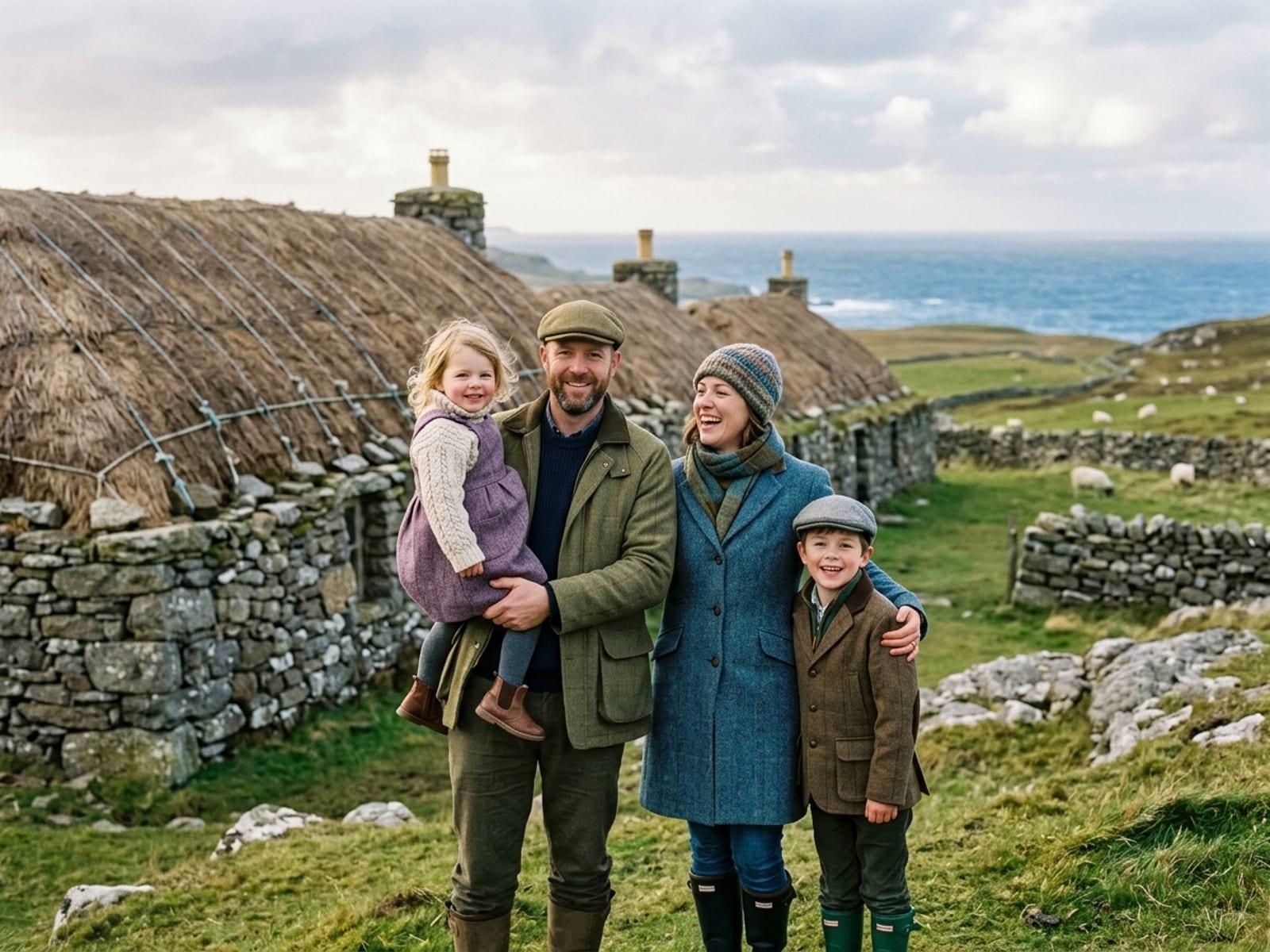
Dress for the island weather. The wind off the Atlantic is strong all year, and sudden rain can arrive even on a sunny day. Even in summer, layer a waterproof jacket over a fleece or knit, and wear shoes that don't mind getting wet. Pick up a tweed hat or scarf along the way and you'll look right at home in the landscape. You can see what your family would look like in tweed in front of a thatched house with pokesta's AI-generated photos ($1 per photo).
Sunday is the islands' day of rest: plan by Saturday
If you're travelling on Lewis and Harris, Sundays are something you must know about. The custom of keeping Sunday as the Sabbath is still strong here, and many shops, petrol stations, cafés and attractions are closed. In recent years Sunday ferries and flights have begun to run, but it is safer to sort out meals, shopping and travel arrangements by Saturday.
For islanders this is an important religious practice. Treat Sunday as a quiet day for walks on the beach or relaxing at your accommodation, and it becomes a welcome rest day on a family trip.
Open all year; arrive by ferry or small plane
You can visit the home of Harris Tweed at any time of year. Long summer days make outdoor sightseeing easier, while winter brings short days and rough seas, so leave slack in your travel plans.
By air, Loganair flies to Stornoway Airport on Lewis from Glasgow Airport (GLA), Edinburgh and Inverness. By sea, Caledonian MacBrayne (CalMac) runs ferries from Ullapool in the north-west of the mainland to Stornoway, about twice a day all year round, taking about 2 hours 40 minutes. If you're bringing a car, CalMac strongly recommends booking ahead. Ferries from Uig on Skye also arrive at Tarbert, the main village on Harris.
For a summer festival in Scotland, read about the Highland games, and for a winter festival on the northern isles, see Up Helly Aa. Entry requirements for the UK vary by nationality, so check your own government's official information before you travel.
References