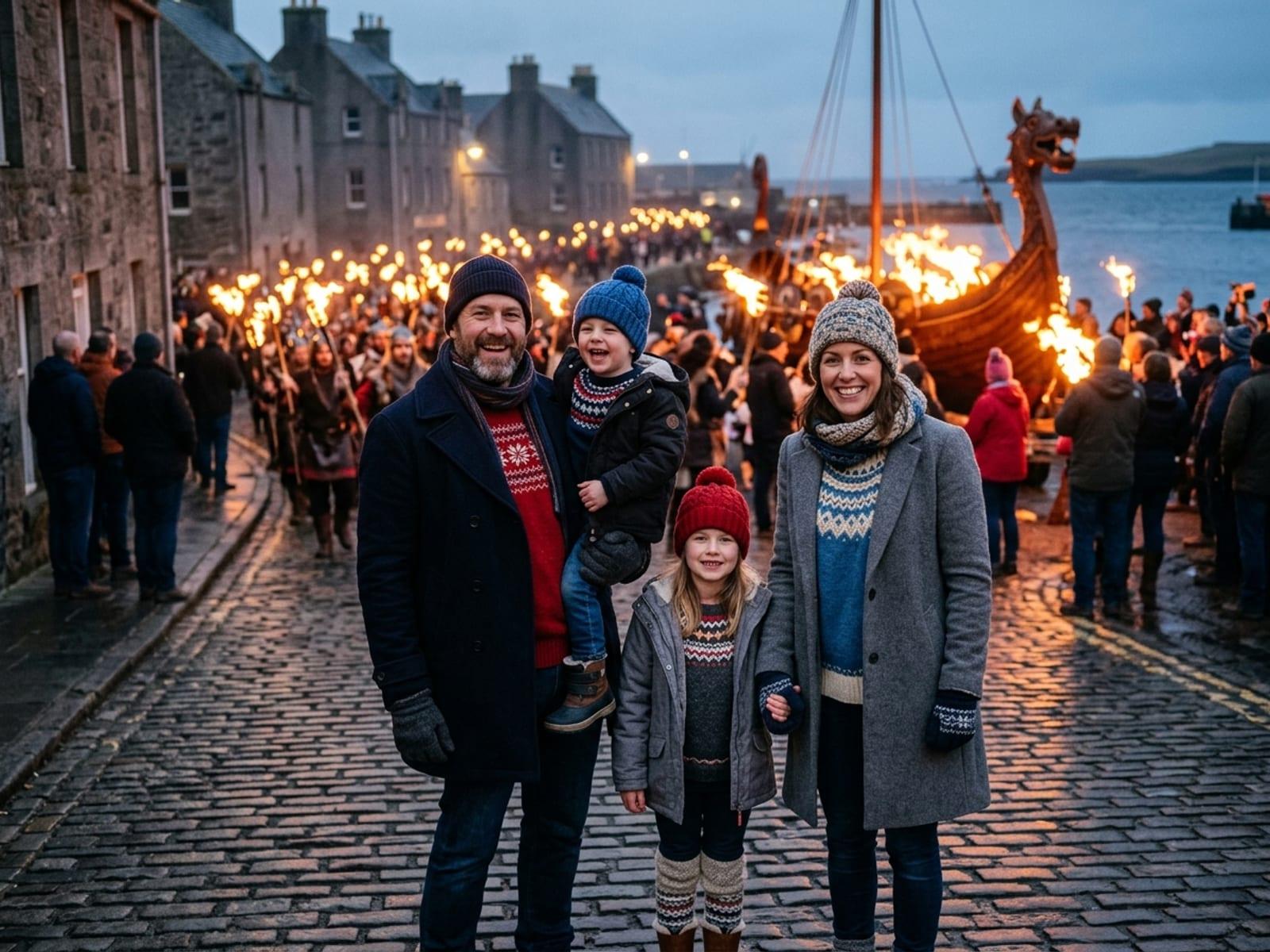
Up Helly Aa is a fire festival held on the last Tuesday of January in Lerwick, the main town of Shetland, north of mainland Scotland; the next one is on January 26, 2027. After dark, nearly a thousand torchbearers led by a squad in Viking costume march through the streets and then hurl their torches into a wooden Viking galley. There are daytime processions and events at the museum too, and at about 17:30 secondary-school pupils hold their own junior procession. With small children, watch the daytime events and the junior parade before deciding on the night, and dress for the cold in a heavy coat and grippy waterproof shoes.
Younger than it looks: a festival from the 1880s
Viking costumes and a burning longship suggest a ritual a thousand years old. In fact it dates from the 19th century. Young people in Lerwick used to drag barrels of burning tar through the streets at Christmas and New Year. Once that dangerous habit was stopped, a torchlight procession took its place. The first procession under the name "Up Helly Aa" is dated to 1881, and the first galley, a Viking longship, was burned in 1889. The Viking theme itself settled in later still.
The festival is said to mark the end of Yule, the midwinter festive season. Shetland was once ruled by Norway, and it helps to see Up Helly Aa as the islanders' own way of giving shape to that Nordic link. Besides Lerwick, smaller Up Helly Aas take place around the islands from January to March, in Scalloway, Bressay and on Unst in the far north, among others. The rural festivals are smaller and feel more like community gatherings. Lerwick's is the biggest, and the easiest for visitors to plan a trip around.
At the centre of it all is the Guizer Jarl, the festival's chief, and his Jarl's Squad. Becoming Jarl means years of service on the organising committee, and the squad spends a whole year making its costumes and preparing the galley. For a long time the squads were men only, but from the 2023 festival women and girls have been able to take part in Lerwick too.
A day that runs from 6 am to breakfast the next morning
According to Shetland's tourism site, the day goes roughly like this. Times can change from year to year, so check the official information shortly before you go.
At 6 am, while it is still dark, the Bill, a proclamation poking fun at local goings-on, is carried by torchlight to the Market Cross and put up for the day. At about 8:15 am the Jarl's Squad sets off with a pipe band to collect the galley. Around 10 am they sing at the Market Cross, then march along Commercial Street to the area by the ferry terminal, where the galley is left on display for photographs. Through the day the squad visits schools, care homes and other places, and turns up at the Shetland Museum at about 3:30 pm.
The main event begins after dark. At about 7:30 pm the streetlights go out, and nearly 1,000 guizers carry their torches through the town for around 30 minutes. They end up at the King George V playing field, where they circle the galley, sing, and then throw their torches into it one after another. The flames shoot up, and the outline of the dragon-headed ship stands out in the fire. Parties then carry on through the night in 11 halls around the town, finishing at breakfast time on Wednesday. The halls run on invitation and tickets, and these go quickly.
The children's Junior Up Helly Aa
The first thing families should know about is the Junior Up Helly Aa. Secondary school pupils choose their own Junior Jarl, spend the day visiting schools and other places, then march with torches at about 5:30 pm and burn a small galley, the "peerie galley", at the playing field. Peerie is the Shetland word for small.
It finishes well before the adult procession, so young children can get a feel for the fire festival while they are still awake. The torchbearers are teenagers, only a few years older than many of the children watching.
Spectators wear winter gear, not Viking gear
The Viking helmets and chain mail are costumes the squads spend a year making, and there is no tradition of spectators dressing the same way. If you visit the museum in the afternoon, there is a chance to meet the squad, who may let children hold a helmet or an axe. That is the closest most children will get to being a Viking for the day.
Your priority is staying warm and dry. In January the northern isles have short days, and wind, rain and snow are all possible. The festival goes ahead in any weather. Layer up under a heavy coat, and bring hats, gloves and waterproof shoes with good grip. Knitwear with the fine, colourful patterns named after Fair Isle, just south of Shetland, is a local speciality and looks right at home in holiday photos. For island cloth from elsewhere in Scotland, a hat or scarf in Harris Tweed, handwoven in the Outer Hebrides, suits a winter trip just as well.
With young children, pick your times and your spot
The evening procession is popular, and the best places along the route fill up early. You can see the galley burning from the streets around the playing field, but the crowd is packed tight and there are sparks and smoke. With small children, skip the front row and stand a little further back where you can take in the whole scene. Some children find the roar of the fire and the crowd frightening, so watch the daytime parade and the junior procession first, then decide about the evening.
The museum is busy in the afternoon, but it is also a welcome place to warm up indoors. For families, the realistic plan is to watch the evening procession and then head back to your accommodation.
For photos, the daytime is your best chance. While the galley sits near the ferry terminal, you can take your time over the dragon-headed prow and the carved hull in daylight. At night, torchlight alone often leaves children's faces almost invisible, so take family photos in the day and save the evening for the river of flames and the burning ship. Tripods get in the way in a crowd; steady yourself against a railing or a wall instead. If you want to see how your family might look gathered around the fire on a winter island, you can try it with pokesta's AI-generated photos ($1 per photo). For a summer festival in Scotland, there are also the Highland games.
The last Tuesday of January, and crossing to the islands
The festival is held every year on the last Tuesday of January; in 2027 that is 26 January. The day before, 25 January, is Burns Night, so you could join a haggis supper on the Scottish mainland before crossing to the islands. NorthLink Ferries sails to Shetland from Aberdeen on the Scottish mainland in about 12 hours (14 to 15 hours via Orkney). Sailings leave in the evening and arrive in the morning, and private cabins are available. By air, Loganair flies from Aberdeen (ABZ), Edinburgh and Glasgow to Sumburgh Airport at Shetland's southern tip, about 40 km from Lerwick, with buses and taxis into town.
Accommodation fills up early around the festival, so book transport and a place to stay as soon as your dates are set. Ferry timetables can change in winter for maintenance. Entry requirements for the UK vary by nationality, so check your own government's official information before you travel.
References