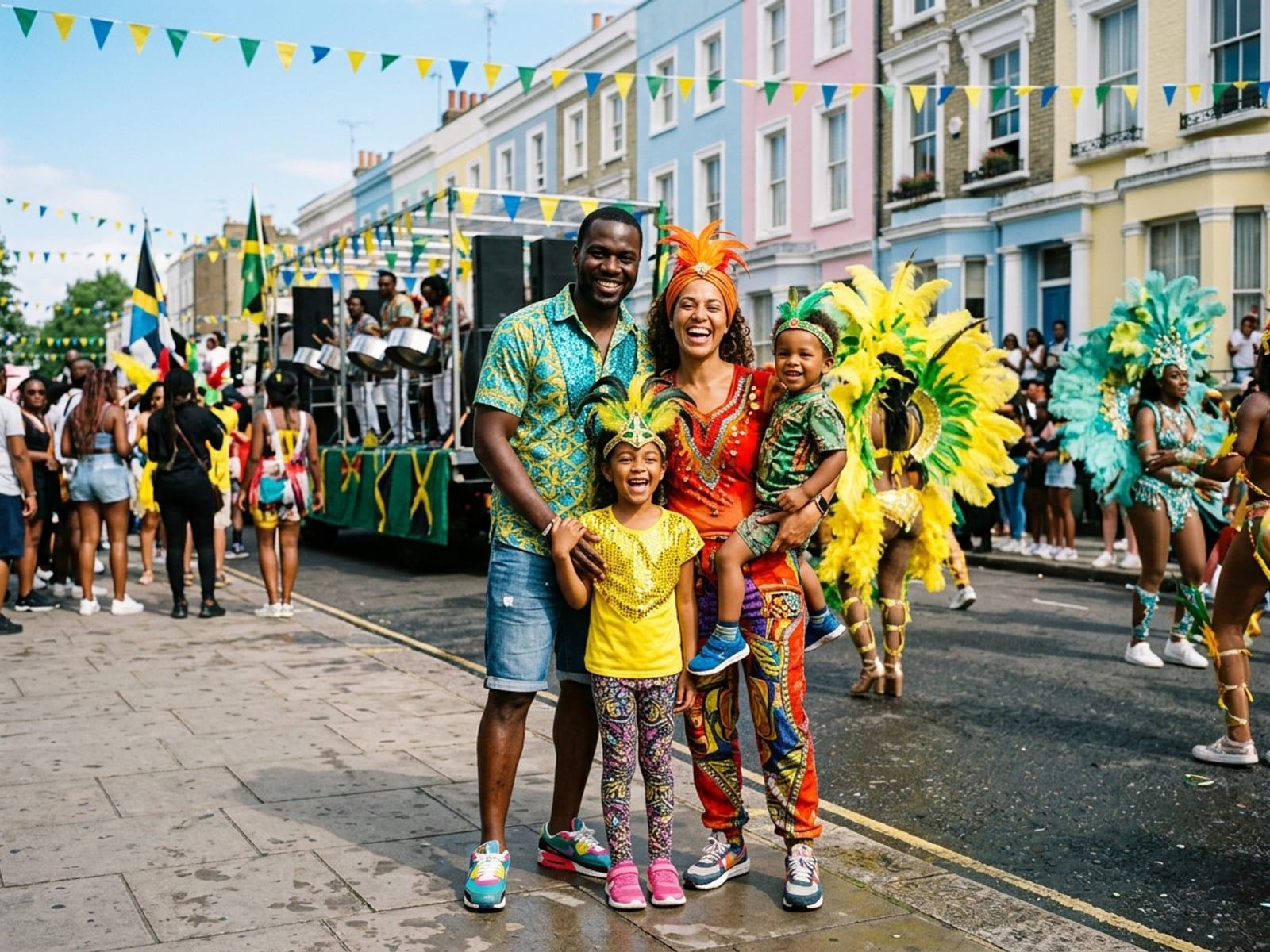
Over the long weekend that ends with the UK's last bank holiday Monday in August, the streets of Notting Hill in west London turn into a flood of feathers and colour. Notting Hill Carnival, built up over the decades by people who came from the Caribbean islands, is said to draw around two million people a year. If you are bringing children, set your sights on Sunday's Family Day, go in daylight and leave early. That is the plan with the fewest headaches.
From an indoor event to a celebration that takes over the streets
The carnival's roots go back to 1959, when Claudia Jones, an activist from Trinidad, held an indoor "Caribbean Carnival" at St Pancras Town Hall in London. At the time, discrimination and violence against Caribbean migrants were serious problems in the city, and creating a space to celebrate the culture they had brought with them was also a way of bringing people back together.
The first event on the streets of Notting Hill came in 1966. Local community activist Rhaune Laslett organised a street party for children, and a steel band joined in and paraded through the streets. That is often told as the beginning of today's parade. The fact that it started as a children's festival carries through to the present, with Sunday given over as Family Day.
Today's carnival is shaped by five elements: mas (masquerade), calypso and soca music, steel pan (the percussion instrument born from oil drums), and sound systems stacked with enormous speakers. Each band taking part spends months making costumes and rehearsing its dancing and music for the day.
Saturday, Sunday and Monday each have their own character
The three days of the long weekend have different roles. Taking the 2026 schedule as an example, Saturday afternoon and evening brought Panorama, the national steel band competition, held in a park and requiring a ticket.
Sunday is Family Day. From 6 am until about 9 am there is J'ouvert, when people dance through the dawn streets covered in paint, powder or mud. The opening ceremony was at 10 am, and the children's parade ran from around 10:30 am until late afternoon. Monday is the adults' parade, bigger in every sense, with far more people. On both days the sound systems are switched off at 7 pm. Times shift a little each year, so check the official announcements shortly before you go.
The parade moves slowly around a fixed circuit, starting from Great Western Road. On that road is the judging point, where costumes and dancing are assessed, and every band saves its best moment for it. Paid grandstand seating is sometimes set up in front of the judging point; being able to sit down is a real help with small children. If you watch from the roadside, the nearer you are to the start, the earlier the parade reaches you; bands arrive later the further along the route you go.
Steel pan is the sound of the carnival children should hear. It is an instrument from Trinidad, made by hammering the bottom of an oil drum into notes, and when a truck carrying dozens of players rolls past, a clear metallic ring fills the whole street. It is light and bright, nothing like the deep bass of the sound systems.
At 3 pm there is a moment of reflection for the victims of the Grenfell Tower fire, which happened in this area in 2017. In the middle of all the noise, it is an important time for local people. Stop talking when it comes, explain the reason to your children in a sentence or two, and stay quiet together.
Children's costumes, and what spectators wear
The stars of Sunday's parade are children in huge feathered headdresses and sequinned costumes. Watching primary school children with enormous pieces strapped to their backs dancing along with serious faces is reason enough to come on Family Day.
Spectators have no dress code. Many people along the route wear the colours of Caribbean flags such as Trinidad and Tobago's or Jamaica's, and adding just a feathered headband or something sequinned makes your photos look much more carnival. Wear comfortable shoes, without exception. You will be on your feet for hours and moving through crowds, so trainers are safer than sandals.
Late August in London can be hot in the sun, but showers are possible too. Bring sunscreen, hats and a light raincoat. The food stalls fill the streets with the smell of Caribbean cooking, from jerk chicken to grilled corn. Some dishes are spicy, so let children try a bite first. On a day when you'd rather choose street food away from the crowds, Borough Market by London Bridge is a better fit. Carry a little cash in case a stall doesn't take cards.
With kids: arrive before noon, leave before evening
The crowds swell after midday and get heavier as evening approaches. A pushchair can get stuck in the crush, so a baby carrier is more practical for little ones. Roads around the area are closed, and on some streets pedestrians can only walk one way. In case your child gets lost, put a note with your contact details in their clothes, and tell them to go to a steward or police officer if they get separated.
Knife attacks still happen: in 2024, two people died in separate incidents. Most people enjoy the day peacefully in daylight, but with children it is wise to leave before it gets dark.
In front of the big speakers the volume is enough to shake an adult's body. Give small children ear defenders, and don't linger near the sound systems. Watch the parade from a quieter street a little away from the action, and rest in a park outside the area when the kids get tired. That kind of distance suits most families. Head south and you reach Kensington Gardens, with the free Natural History and Science Museums beyond, a good plan for the day before or after the carnival. You can try picturing your family lined up in carnival costume with pokesta's AI-generated photos ($1 per photo).
The August bank holiday: watch for exit-only stations
The carnival takes place every year over the long weekend at the end of August and runs through the bank holiday Monday. In 2026 it was 29 to 31 August. Watching the parade from the street is free.
From London Heathrow Airport (LHR), the Elizabeth line and the Underground take you into central London. Stations near the carnival have restrictions on the day. In 2026, Ladbroke Grove was closed on both Sunday and Monday, and Notting Hill Gate, Westbourne Park and Holland Park were exit-only at certain times. Fewer stations are open for the journey home, so plan on walking to one a little further away, and check Transport for London's latest updates.
In June, central London also hosts Trooping the Colour, the parade for the King's official birthday. Entry requirements for the UK vary by nationality, so check your own government's official information before you travel.
References