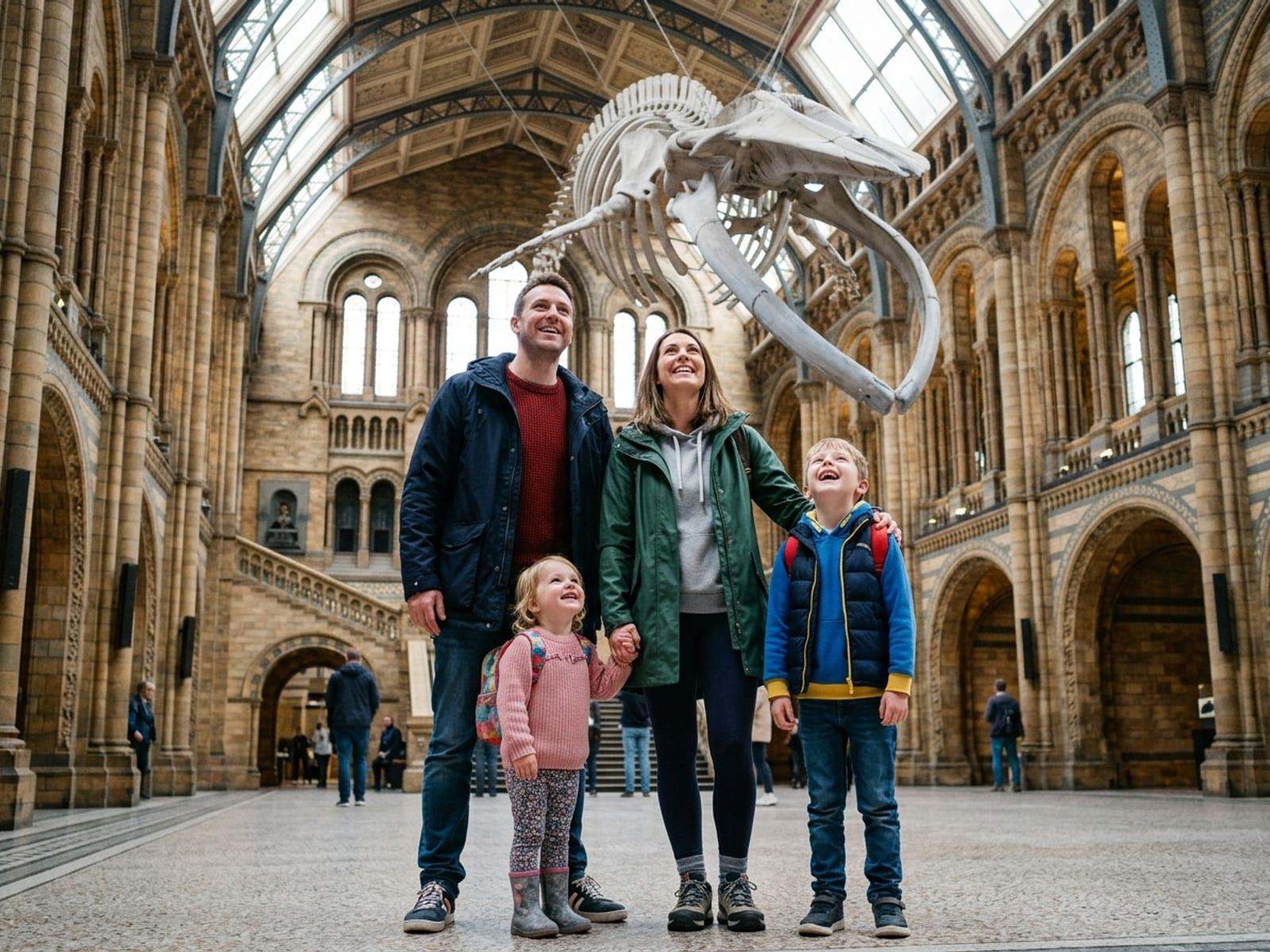
In South Kensington, west London, a cluster of major museums lines the street they're named after, Exhibition Road. For families, the two that matter most are the Natural History Museum, famous for its dinosaurs and blue whale skeleton, and the Science Museum, where you can see real spacecraft and locomotives. Both have free entry to their permanent galleries. To do both in one day without wearing everyone out, go into one first thing in the morning, then move to the other after lunch.
At the Natural History Museum, the building is a sight in itself
The Natural History Museum opened on 18 April 1881. Its main front faces Cromwell Road, and the building, with exterior designed by the architect Alfred Waterhouse, looks more like a cathedral than a museum. The collection runs to around 80 million specimens, and more than 7 million people visited in 2025.
Hanging from the ceiling of Hintze Hall, the great hall just inside the entrance, is Hope, the complete skeleton of a blue whale. In 2017 she replaced Dippy, the cast of a Diplodocus that had been the star of the hall for many years. She is the first thing you see as you walk in, so look up straight away.
In the dinosaur gallery, a life-size animatronic Tyrannosaurus rex is waiting. Because a huge model moves, small children are sometimes frightened. Watch from a distance first and only go closer if they seem fine. In the atrium of the Earth galleries, an escalator carries you up through a model of the Earth, which is a small adventure just to ride.
At the Science Museum, real objects and hands-on galleries
North of the Natural History Museum, on the same Exhibition Road, is the Science Museum, founded in 1857. The star of its space gallery is Charlie Brown, the command module of Apollo 10, which orbited the Moon 31 times in 1969. The Industrial Revolution gallery has Puffing Billy, the oldest surviving steam locomotive.
Wonderlab is the interactive gallery where children can experience science with their whole bodies. It has 50 exhibits across seven zones, covering maths, electricity, forces, space, light, matter and sound, plus giant slides where families can race each other, a huge Tesla coil and live science shows. It needs a paid ticket separate from museum entry. When the official website was checked in October 2026, day tickets started at £13.50, children aged 3 and under went free, and the recommended age was 7 to 14. Booking ahead is cheaper. Most people spend one to two hours, so decide in advance how it fits with the rest of the museum, depending on how much energy your kids have. Prices and times change, so check the official website for the latest details.
A third museum: take a breather at the V&A
Across Exhibition Road on the east side from the Natural History Museum is the Victoria and Albert Museum (V&A), founded in 1852. It's the world's largest museum of applied and decorative arts and design, with more than 2.8 million objects, and entry is free here too. Many of its displays are rather grown-up for children, but it's a useful place to know for a break.
The John Madejski Garden in the central courtyard has an oval pool surrounded by stone steps, with a café open in summer. In 1856 the V&A is said to have become the first museum in the world to offer visitors a refreshment room. Today you can rest in three rooms decorated between the 1860s and around 1880, taking in their ornate walls and ceilings. In 2017 a new courtyard opened on the Exhibition Road side, paved with 11,000 handmade porcelain tiles.
If you'd like to see historic collections of toys, children's books and children's clothing, Young V&A, the branch in Bethnal Green in east London, is the better choice. It opened in 1872, later became the Museum of Childhood, and took its current name in 2023.
Booking free tickets, and when it's busy
The Natural History Museum is open daily from 10:00 to 17:50 (last entry 17:30), and the Science Museum daily from 10:00 to 18:00 (last entry 17:15). Both close from 24 to 26 December, and there are other days when they close temporarily for events.
Entry to both is free, but the norm is to book a free entry ticket on the official website in advance. The Science Museum asks visitors to reserve free tickets beforehand, and the Natural History Museum says a ticket guarantees entry and lets you skip the queue. The Natural History Museum gets crowded at weekends and during school holidays, so aim for just after opening on a weekday and you can enjoy the whale hall in peace. The Science Museum requires children under 12 to be accompanied by an adult.
Planning a day with children
Seeing the whole of both museums in one day is too much even for adults. Narrow it down to one or two things your children most want to see, say dinosaurs and the whale at the Natural History Museum, or space and Wonderlab at the Science Museum, and save the rest for "next time." That keeps everyone in a good mood to the end.
The nearest Tube station is South Kensington, and an underground pedestrian tunnel runs from the station to near the entrances of all three museums. It's a real help on rainy days.
When the kids need to run around, walk north into Kensington Gardens. The Diana Memorial Playground, next to Kensington Palace, is a free playground inspired by the story of Peter Pan, with a huge wooden pirate ship, 17 metres long and 12 metres wide, at its centre. It's for children up to 12 and the adults with them, and you can't leave children there unaccompanied. Closing time changes with the season: 17:45 in the first half of October and 15:45 from November to January, with last entry 15 minutes before closing. North of Kensington Gardens lies Notting Hill, home to the Caribbean-rooted Notting Hill Carnival over the August bank holiday weekend.
pokesta's AI photos can also make a picture of your family looking up at the blue whale ($1 per photo, first one free).
When to go and how to get there
The museums are open all year, and in rainy London they're a reliable plan whatever the weather. They get busy during school holidays, so if your schedule allows, go on a weekday.
The main gateway is London Heathrow Airport (LHR). The Piccadilly line on the Underground runs directly from Heathrow to South Kensington with no change needed. Entry requirements for the UK vary by nationality, so check your own government's official information before you travel. After the museums, you could eat at a pub for a Sunday roast or head south of the Thames to Borough Market.
References