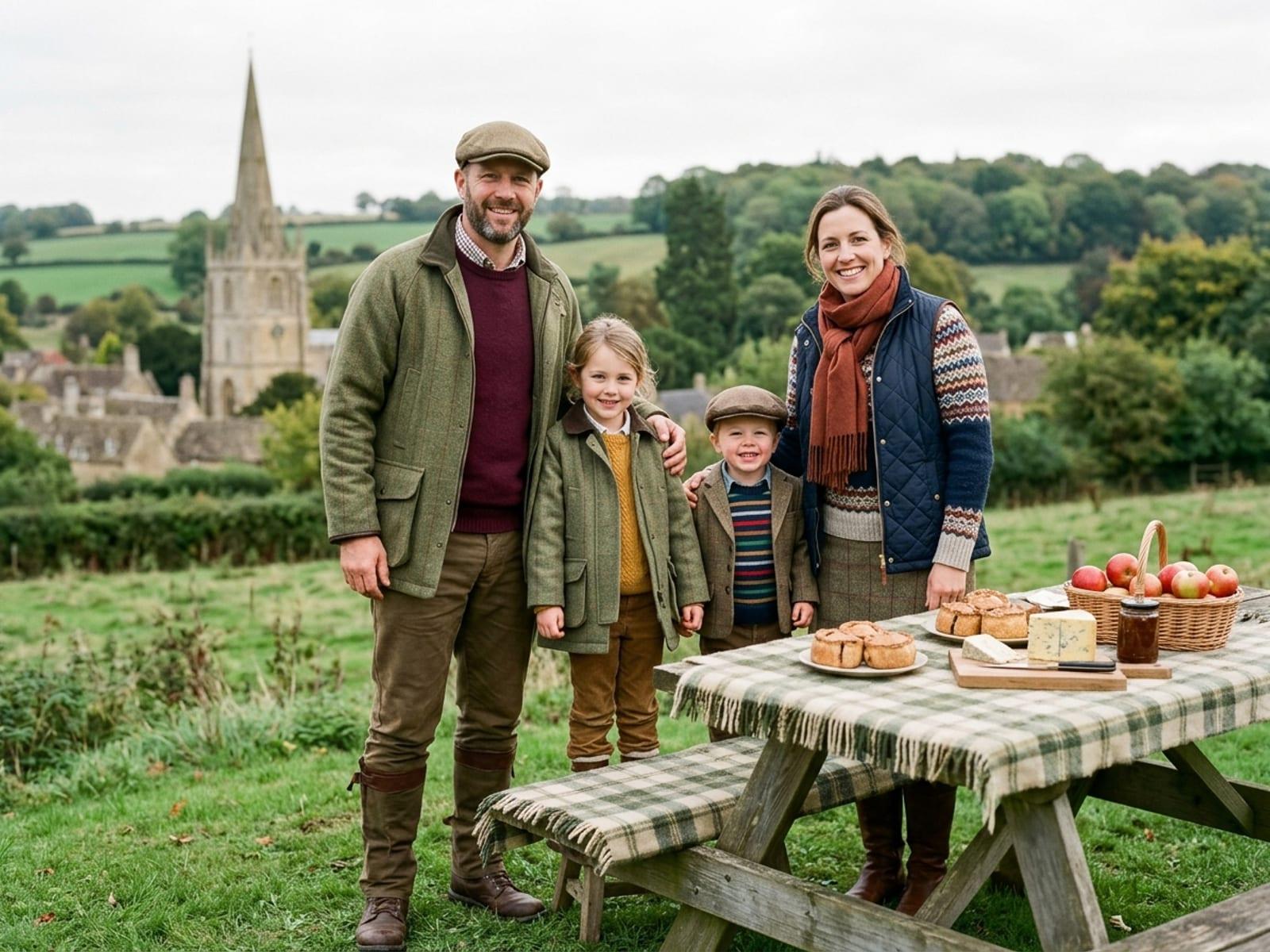
The Melton Mowbray pork pie is a Midlands speciality of uncured pork baked in hand-raised pastry, with jelly filling the gap between meat and crust. It was registered as an EU Protected Geographical Indication (PGI) in 2009 and is now protected under the UK's own scheme. In the Leicestershire market town of Melton Mowbray you can buy one all year from shops including one founded in 1851, and taste Stilton, the blue cheese born nearby. Pork pies are normally eaten cold, so with children pick a small one and add pickles or an apple for an easy picnic.
Born in a hunting town as a packed lunch for workers
From the 16th century, enclosure turned the land around Melton Mowbray into pasture, and farmers kept cattle and made cheese. The whey left over from cheesemaking was fed to pigs, and those pigs went into the pies, so pork pie and Stilton grew out of the same farmyard. The pies are said to have been carried by farm workers, by the grooms who looked after the horses, and by servants attending the hunt, with the thick pastry acting as a container to protect the filling. People sometimes threw away the outer crust and ate only what was inside, a story also told about the Cornish pasty that Cornwall's tin miners took underground.
By the late 18th century the town had become a fox-hunting centre for three local hunts. The pork pie association says visiting hunters "discovered" the pie in the 1780s when they saw their grooms and servants eating it. The romantic picture of aristocrats carrying pies on horseback is less certain: a columnist writing in 1872 already called it extremely unlikely. The trade really took off around 1831, when Edward Adcock, who ran a small baker's and confectioner's shop, began sending pies to London by stagecoach. Once the railway arrived, pies were shipped as far as Australia, New Zealand and South Africa. The industry boomed from the 1870s until the turn of the century, and the First World War ended the export trade.
What it takes to be called "Melton Mowbray"
Pork pies are sold all over Britain, but only those made in a defined area by a defined method can be called Melton Mowbray pork pies. The area is much larger than the town itself. It is bounded by the A52 to the north (including the city of Nottingham), the A1 to the east (including Grantham and Stamford), the M1 to the west and the A45 and A605 to the south (including Northampton).
The rules rest on three things. The first is the meat: fresh, uncured pork, diced or minced and seasoned with salt and pepper, making up at least 30% of the whole pie. Cured meat turns pink like ham, but fresh pork turns grey when cooked. The association explains that pigs in this region were traditionally slaughtered in autumn and winter, so using fresh meat straight away was simply the norm.
The second is the pastry. A hot water crust is raised by hand around a wooden mould called a dolly, or a jar, to form a case. The pie is then set on a baking tray without support and baked free-standing, so its sides bulge gently outward and each one is slightly different. These "bow-walled" sides are the mark of a Melton Mowbray pie. The third is the jelly. Stock made from bones is poured into the hot pie after baking, and as it sets it fills the gap between meat and pastry, stops the meat drying out and keeps the pie from crumbling when you cut it.
Getting the name protected took years. Local producers formed the Melton Mowbray Pork Pie Association in 1998, worried by Melton-style pies being made in factories far from the town. The food company Northern Foods took the government to the High Court, arguing that the proposed area was wider than the town itself. In December 2005 the judge dismissed the challenge, holding that the registered area does not have to match the exact place a food comes from. The name entered the EU register in June 2009, and since 31 December 2020 it has been protected under the UK's scheme. The same idea of tying a name and method to a place also protects Yorkshire forced rhubarb further north.
Buying, and making, a pie at a shop founded in 1851
Ye Olde Pork Pie Shoppe on Nottingham Street, in the middle of town, grew out of a bakery that John Dickinson opened in 1851. The shop credits Mary Dickinson, his grandmother, with starting the method of raising the pastry around a wooden mould and pouring in jelly. In 1992 the building was badly damaged by fire, but it was restored and is still trading.
According to the shop's website, it opens Monday to Saturday from 8 am to 4:30 pm and is closed on Sundays. There is also a Tasting Room for samples and light meals. Pie-making workshops are offered too; check dates, age requirements and prices on the shop's website. Raising pastry by hand feels a lot like playing with modelling clay, and it's the kind of task children get absorbed in.
A big pie is good for sharing as a family, while the palm-sized ones make an easy snack to eat as you walk. Pickles, chutney or apples alongside cut through the richness. If you'd like to see where the apples grow, Herefordshire's orchards and cider villages lie to the west.
Stilton was born just down the road
Stilton, with blue veins running through it like marble, is one of Britain's most famous blue cheeses, and it received Protected Designation of Origin (PDO) status in 1996. It may only be made in three counties, Derbyshire, Leicestershire and Nottinghamshire, using local milk, and only a handful of dairies are licensed to make it.
The village of Stilton, which gave the cheese its name, lies outside those three counties. Cooper Thornhill, who kept the Bell Inn at Stilton on the road between London and the north, is said to have come across the cheese around 1730 at a farm near Melton Mowbray and sold it to stagecoach travellers, which made it famous. Tradition also credits Frances Pawlett of Wymondham, a Leicestershire village, with setting the cheese's modern shape and style in the 1720s. In Melton Mowbray itself, Arla Foods announced in 2024 that it would end production at the Tuxford & Tebbutt creamery, which had made Stilton since 1780.
Stilton is matured for at least nine weeks. People eat it with celery or pears or melt it into soups and sauces, and it's traditional at Christmas, when adults often pair it with port. Pouring port into a hollow in the cheese, however, is no longer recommended. The blue mould has a strong smell, so children may find White Stilton, which has no blue veins, easier to start with.
Tuesday market, and a church full of pies in March
Melton Mowbray is an old market town whose market was already recorded in the Domesday Book of 1086, and Tuesday has been market day since a royal grant in 1324. The town calls itself the "Rural Capital of Food". St Mary's Church in the centre, built mainly between the 13th and 15th centuries, is considered one of the finest churches in the county.
Every March the same church hosts the British Pie Awards, run by the pork pie association, with more than 20 classes. At the 18th awards in 2026, judging took place on 4 March and the Supreme Champion was chosen from a record 1,040 entries. Check the official website for the next dates and whether visitors can attend.
With children, a pie and some cheese from the market make an easy picnic in the town park. A photo of your family picnicking over pies and cheese can also be made with pokesta's AI-generated photos ($1 per photo). Both pies and cheese need to be kept cold, so bring a cool bag if you're taking some home. If you're crossing borders, many countries restrict imports of meat and dairy products, so always check the rules of the country you're heading back to.
Change at Leicester by train, or drive to the Vale of Belvoir
The town lies about 31 km north-east of Leicester and about 32 km south-east of Nottingham, and the nearest airport is East Midlands Airport (EMA). Trains from the Birmingham, Leicester and Peterborough directions stop at Melton Mowbray station roughly once an hour, but there's only about one direct train a day from London St Pancras, so plan on changing at Leicester or elsewhere. With a car, you can head north to the Vale of Belvoir, regarded as the heart of Stilton country.
Pork pies have long been tied to Christmas, too: by the mid-19th century it was already the busiest time of year for Melton's pie makers. You might picture a British Christmas table set with Stilton and pork pie as a family photo.
References