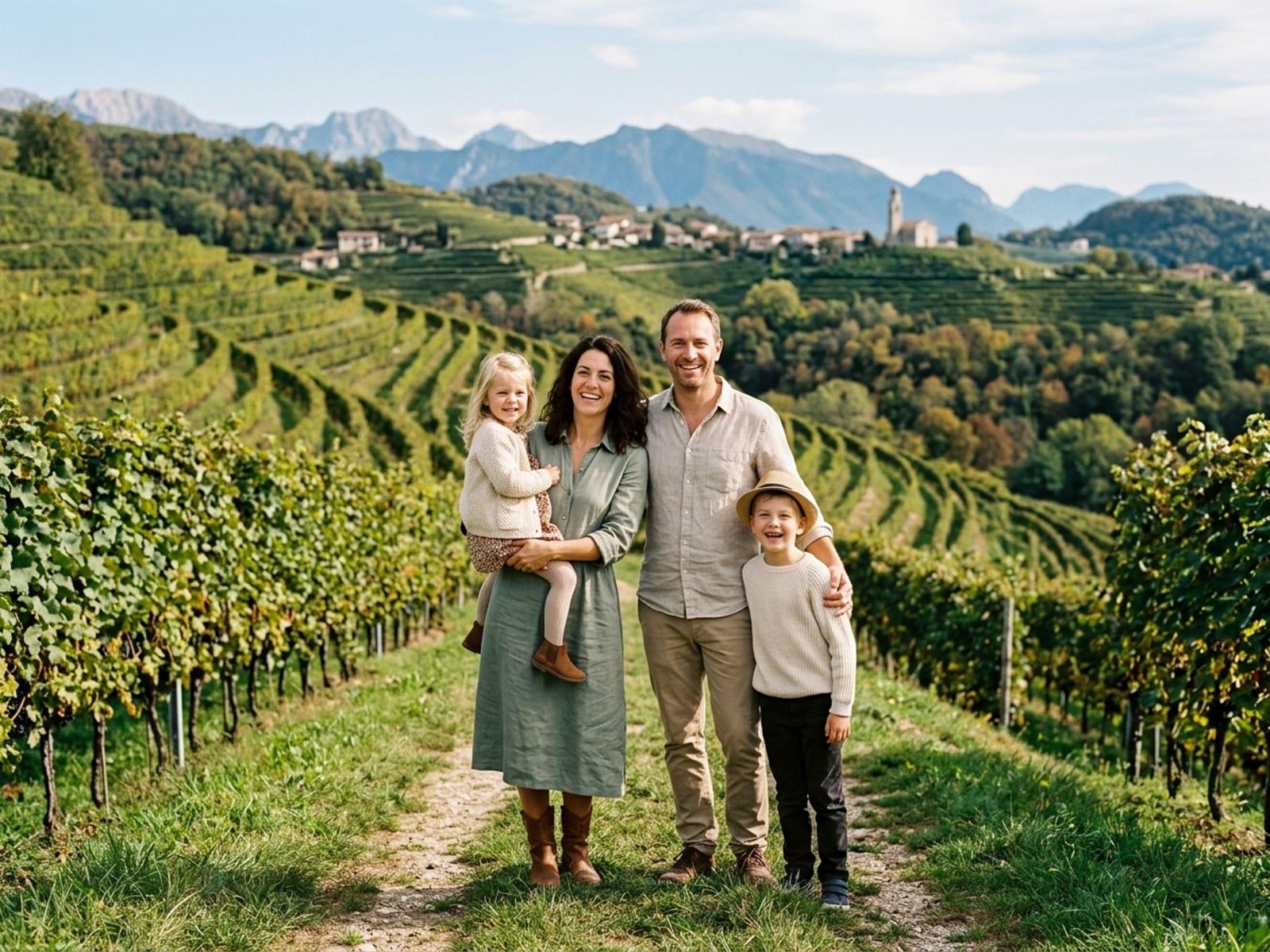
About 50 km north of Venice, just before the Alps begin, a line of narrow hills runs east to west like a spine. Their slopes are covered with vineyards held in place by grassy banks, with patches of woodland in between and villages on the hilltops. These are the hills of Conegliano and Valdobbiadene, home of the sparkling wine Prosecco, and in 2019 their landscape became a UNESCO World Heritage Site. Even with children who won't be drinking any wine, you can easily fill a day here: walk the lanes between the vines, look out over the hills from a viewpoint, and visit an old mill or an abbey.
The landscape, not the wine, is the heritage site
What UNESCO listed is not the wine but the hill landscape that centuries of grape growing have shaped. After the nomination was turned down in 2018, it was approved in July 2019 at the World Heritage Committee in Baku, Azerbaijan, becoming Italy's 55th World Heritage Site.
Three features won it the listing. The first is the terrain: "hogback" hills, steep, narrow ridges that line up like the backs of pigs. The second is the ciglioni, small terraces on the steep slopes held up by grass banks rather than stone, where since the 17th century the rows of vines have been laid out in a checkerboard pattern. The third is the mosaic-like mix of vineyards, woods and small villages. A distinctive way of training the vines that spread in the 19th century, the bellussera, has also shaped how the land looks.
Vineyards kept alive by 600 hours of handwork
Prosecco is made from a white grape that was itself called Prosecco until 2009; in Italy it's now known as Glera. Prosecco is produced across the Veneto and Friuli-Venezia Giulia, and Conegliano Valdobbiadene is one of the areas within that zone with the higher DOCG status (Controlled and Guaranteed Designation of Origin). Since the designation of origin was introduced in 1969, production here has been limited to 15 municipalities.
On the Conegliano side the hills are gentler; on the Valdobbiadene side they're steeper and face fully south. The vineyards lie between 100 and 500 meters above sea level, and many are on steep ground. According to the producers' consortium, looking after a vineyard takes at least 600 hours of manual work, about four times as much as a mechanized one. More than 3,000 growers tend these hills.
The best known of the special plots is the hill of Cartizze in Valdobbiadene. It covers only about 107 hectares, all of it facing south. There are also 43 "Rive" wines, each made only from grapes from a particular village or slope, so you can taste how one vineyard differs from another. Then there's col fondo, the traditional style in which the wine undergoes a second fermentation in the bottle and is left on its lees. It looks slightly cloudy and tastes more complex.
With kids, go for viewpoints and the mill
Italy's first wine road was created here in 1966. Today the Strada del Prosecco e Vini dei Colli Conegliano Valdobbiadene offers several signposted routes. The main one runs about 50 km from the wine-making school in Conegliano to Valdobbiadene.
With children along, a mix of views and sights works better than one winery after another. Try San Pietro di Feletto, which looks out over hills and valleys; the church of Sant'Alberto near Valdobbiadene, from which you can reportedly see as far as the Venetian Lagoon on a clear day; and the Credazzo tower at Farra di Soligo, overlooking the vineyards. Follina, with its 12th-century Cistercian abbey, and Cison di Valmarino, with its castle, are both easy stops on a drive.
The one most likely to delight children is the Molinetto della Croda in Refrontolo, an old mill built right up against the rock. It's a different kind of scenery from the vineyard hills.
Families who like walking can try the Anello del Prosecco, the "Prosecco loop" through the vineyards of Cartizze, on foot or by mountain bike. The recommended season is March to October. For something more serious, the Cammino delle Colline, opened in 2023, runs about 51 km in four stages from Vidor to Vittorio Veneto. It climbs more than 2,200 meters in total, though, so with kids, walk just a short piece of one stage.
Visiting wineries with children
Winery tours and tastings are essentially for adults. When you book, ask whether children are welcome and whether there's somewhere for them to wait. To keep kids from getting bored during a tasting, it helps to choose a winery with a garden or terrace overlooking the vines. Whoever is driving should skip the tasting, or let a non-driving adult do the sampling. Settle the roles before you set off.
Smart casual clothes suited to a hill walk are about right. The vineyard paths are earth and grass, so wear sneakers or walking shoes you don't mind getting dirty. If you want to see how a family photo against the curving rows of vines might look, you can try pokesta's AI-generated photos ($1 per photo).
Spring green or harvest autumn, best seen by car
The area has a mild climate shaped by the sea and the Alpine foothills, with an average annual temperature of about 12.3°C. Rain often comes as heavy summer showers and totals around 1,250 mm a year. The best seasons for walking are April and May, when the leaves are fresh, and September and October, when the grapes ripen and the harvest begins. Vineyards are busy during the harvest, so check early whether they're taking visitors.
The nearest major international airport is Venice Marco Polo (VCE). The easiest plan is to take the train from Venice to Conegliano, then drive around the hills. To reach the viewpoints and small villages efficiently, arrange a rental car or a driver.
If you're combining the trip with Venice, the winter Venice Carnival or the Bolzano Christmas Market at the foot of the Dolomites fit into the same northern Italy itinerary. Entry requirements for Italy depend on your nationality, so check your own government's official information before you travel.
References