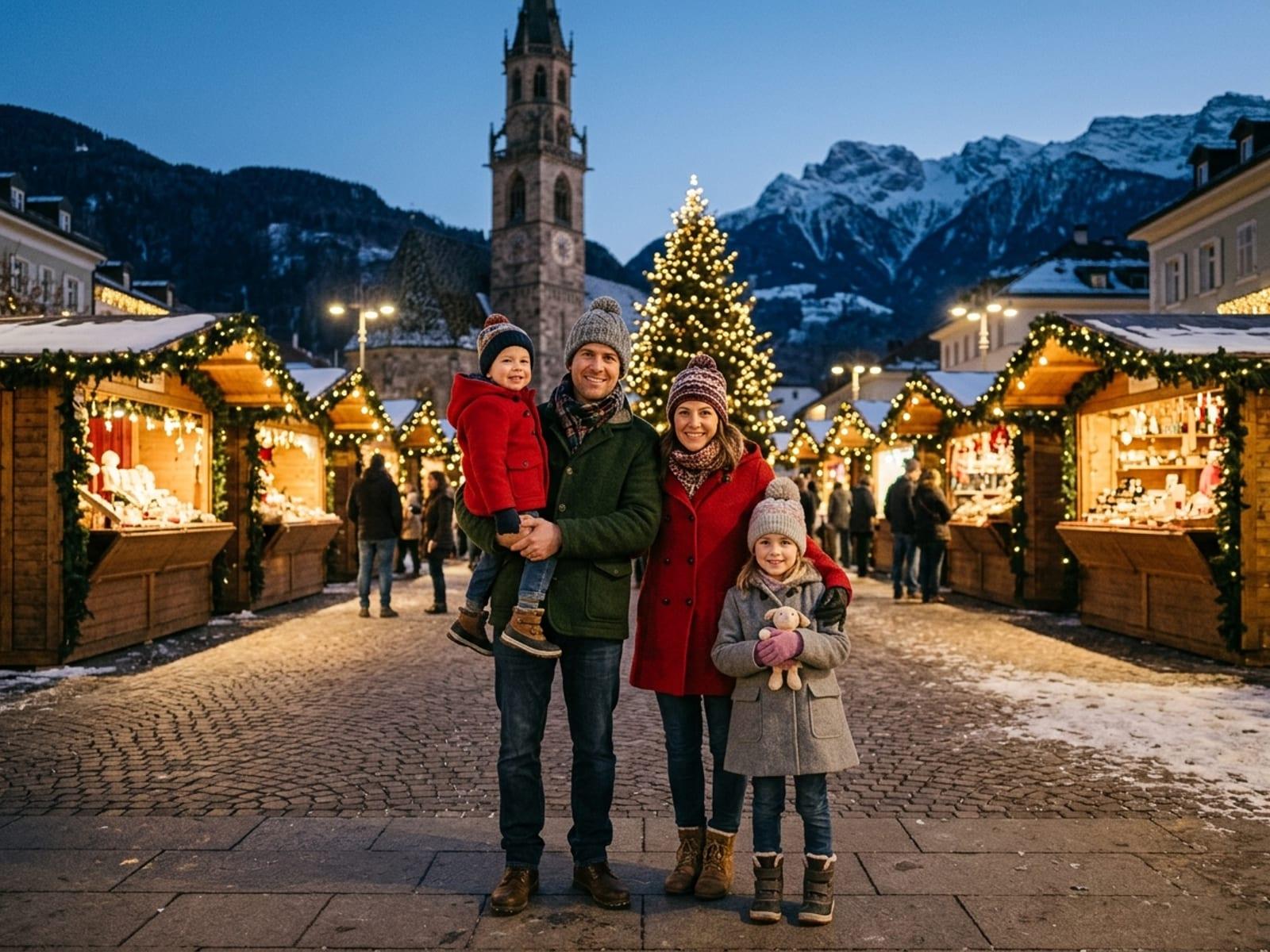
Bolzano (Bozen in German) sits in an Alpine valley at Italy's northern edge and is the main town of South Tyrol, where both Italian and German are spoken. Every year from late November to January 6, wooden stalls fill the squares of the old town and the whole place turns to Christmas. The local tourist board calls the town a "Christmas capital," and 2026 is the market's 35th edition. For browsing boiled-wool jackets and wooden crafts, then spending a winter evening with something warm to drink, it's a comfortable size for a family.
Italy's first Christmas market
Christmas markets have been around since the Middle Ages in Germany and Austria, but in Italy they're a fairly recent habit. Bolzano's market started in 1990 and is considered the first Christmas market in Italy. It has since grown into the most visited one in the country.
The town's history helps explain why. For centuries Bolzano belonged to the County of Tyrol and later to Austria-Hungary, and it only became part of Italy after the First World War. Around one in four residents still speaks German as a first language. Christmas customs from north of the Alps took root here naturally.
It opens on November 26 with the tree on Piazza Walther
The 2026 market opens at 5 p.m. on Thursday, November 26, when the big Christmas tree on Piazza Walther is lit. It closes on Wednesday, January 6, 2027, the Epiphany, which in Italy marks the end of the Christmas season.
According to South Tyrol's tourist board, the market is generally open from 10 a.m. to 7 p.m. On December 24 it closes at 4 p.m., it's closed on the 25th, and New Year's Eve and New Year's Day have their own hours. Food and drink stalls keep different hours on some days, staying open until 9 p.m. from December 27, for example. The official listings don't always agree with each other on times, so check the hours for your day on the official website shortly before you go.
On New Year's Eve the town also hosts a traditional running race, the BOclassic. If you're spending the holidays in Bolzano, watch for road closures that day.
Each square has its own character
The market isn't confined to one square; it spreads across the old town. The heart of it is Piazza Walther and Via Stazione, which leads toward the train station. The wooden stalls there sell South Tyrolean crafts.
For a closer look at artisans' work, head to the craft market on Piazza Duomo and Via Isarco. Piazza Municipio has an artistic nativity scene (presepe), and churches host a number of concerts. A charity market runs on Piazza del Grano until December 23, and a little away from the center, Piazza Mazzini has a small weekend-only market from November 27 to December 20.
For families, a real help is the family area along Via Stazione. Walk stall after stall at adult pace and children lose interest fast; stopping here partway through gives the day some rhythm.
What to buy and what to eat
This being an Alpine town, wool stands out. Jackets, hats and slippers in boiled wool or felt are practical things people actually wear through the winter here, and you can sometimes find them in small children's sizes. Wooden kitchen tools and decorations, and glass or ceramic tree ornaments, are common too. One nice way to shop is for each family member to choose one ornament to hang on the tree every year.
The food is South Tyrol's winter fare: speck (smoked cured ham), fried pastries, apple strudel, traditional cookies and Christmas sweets. For Italy's own Christmas bread, panettone from Milan is stacked in shop windows at the same time of year. South Tyrol also grows a lot of apples, and apple juice is an easy order for kids. For adults there's mulled wine scented with cinnamon, as well as local reds such as Santa Maddalena and Lagrein.
Most stall food is eaten standing up, so with small children, find a bench or somewhere to sit before you buy. Less gets spilled and less goes cold.
Prepare for the cold and the crowds
From late November to January, Bolzano gets very cold once the sun goes down. The tree lights look their best after dusk, which is also about when children reach their limit with the cold. Browsing the stalls in daylight and keeping the after-dark part short tends to work well.
Wear a wool coat or down jacket with a knitted hat, gloves and a scarf. For your feet, thick-soled winter boots will cope with both the cold and wet stone. Gloves come off when you eat at the stalls, so carry a spare pair for the kids. A family bundled up in Alpine winter clothes in front of the lit-up stalls is the kind of picture pokesta's AI photos ($1 per photo) can make before you go.
Weekend evenings are especially crowded. The aisles between stalls are narrow, so a baby carrier is easier than a stroller. Car traffic is restricted in the center of the old town, and the tourist board recommends arriving by train.
Weekdays in late November and early December are quietest
The 2026 season runs from November 26 to January 6, 2027, closed on December 25. To avoid the crowds, aim for weekdays in late November and early December.
The nearest major international airport is Verona (VRN); from the south you can reach Bolzano by train via Verona. From the north, the railway crosses the Brenner Pass via Innsbruck, so you can combine Bolzano with Munich or Innsbruck. The A22 motorway also runs through the valley. Bolzano's own small airport has a few routes at certain times of year.
A good stop with kids between market visits is the South Tyrol Museum of Archaeology in the old town. It opened in 1998 to house Ötzi the Iceman, a mummy about 5,300 years old found in an Alpine glacier in 1991. He's kept in a room at minus 6 degrees Celsius, close to glacier conditions, and the clothes and copper axe found with him are on display. It's a chance to warm up while imagining life in the Alps in the distant past.
From Bolzano, the snow-covered Dolomites are right on the doorstep. For a scene of Christmas at home, Italian style, you can also make Italian Christmas photos. If you're traveling in winter, you could continue to the Venice Carnival after New Year. Entry requirements for Italy depend on your nationality, so check your own government's official information before you travel.
References