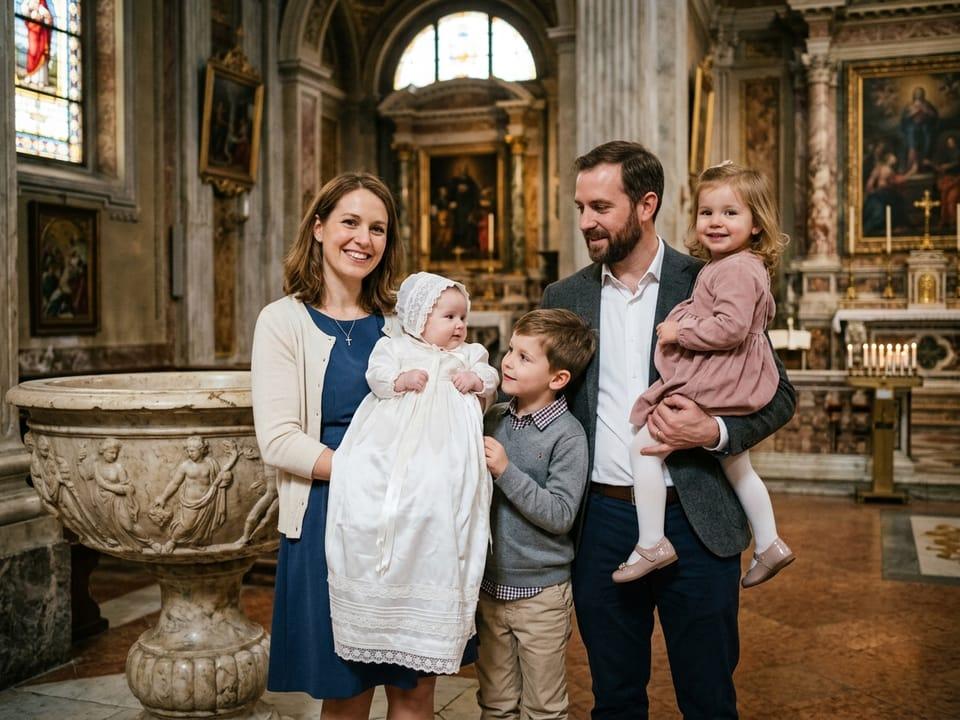
In Italy, many Catholic families have their baby baptized at the parish church. The battesimo unfolds in four parts (the rite of welcome, the liturgy of the Word, the celebration of the sacrament and the concluding rite), and along the way the family moves from the church door to the lectern, the font and finally the altar. Know what happens where, and you can decide in advance where the person taking pictures should stand. Afterwards comes a long family lunch, and guests take home bomboniere filled with confetti, sugared almonds.
The parish sets the date, and Sunday or the Easter Vigil is preferred
Canon law asks parents to have their child baptized within the first weeks of life, and to approach the parish priest, the parroco, as soon as possible after the birth or even before it. Baptism can be celebrated on any day, but the Code recommends Sunday as the norm or, where possible, the Easter Vigil (veglia pasquale), the night liturgy before Easter Sunday. In 2027 that is the evening of Saturday, March 27. Some parishes baptize during Sunday Mass; others hold one celebration for several families on set dates.
As a rule a baby is baptized in the parents' own parish church unless there is good reason to go elsewhere, so if you are hoping for the church in your grandparents' town, raise it at that first meeting. Ask then, too, whether you can take pictures during the rite, how close you can get and whether flash is allowed. Practice varies a lot from church to church.
Godparents must be at least 16, confirmed and practicing Catholics
A child may have one godfather (padrino), one godmother (madrina), or one of each. Canon 874 sets out who qualifies. A godparent is chosen by the parents (or whoever takes their place) and must intend to carry out the role. They must be at least sixteen, unless the diocesan bishop has set a different age or the parish priest allows an exception for a just cause. They must be a Catholic who has been confirmed and has received the Eucharist, and who leads a life of faith in keeping with the role. They must not be under a canonical penalty, and they cannot be the child's own mother or father. A baptized Christian from another church can take part only as a witness, alongside a Catholic godparent.
So a close friend who was never confirmed cannot be a godparent; check your choice with the parroco early. Godparents stay beside the baby throughout and will turn up in plenty of shots, but make a point of one photo after the ceremony of the parents and godparents gathered around the baby. Years from now, that is the picture you will reach for when you tell your child who their padrino and madrina are.
It begins at the church door, then moves to the lectern
The rite of welcome (riti di accoglienza) takes place at the entrance, or wherever the families have gathered. The priest asks the parents, "What name do you give your child?" and "What do you ask of God's Church?", and they answer, "Baptism." He then traces the sign of the cross on the baby's forehead without a word and invites the parents, and sometimes the godparents, to do the same. Whoever is taking pictures should stay at the door with the family rather than heading for a seat.
For the liturgy of the Word (liturgia della parola), everyone moves to the lectern for one or two readings and a short homily. When several babies are being baptized, they can be looked after elsewhere and brought back for the litany of the saints, to which the children's name saints and the patron saints of the church or town may be added. The priest then anoints each baby's chest with the oil of catechumens. Treat this part as time to listen, and use it to move quietly to your spot near the font.
Let that anointing guide the baby's outfit. The Diocese of Como's guide to the rite notes that, because of how babies are dressed, the oil often ends up just below the throat, so pick something that opens easily at the neck. The white garment (veste bianca) presented later should be brought by the family and be something the baby can actually wear. Parents and siblings in beige, grey or muted blue make the baby's white stand out better than an all-white family.
At the font, water, chrism, the white garment and the candle come within minutes
The celebration of the sacrament (liturgia del sacramento) takes place at the baptismal font (fonte battesimale). Once the parents and godparents have renounced sin and professed their faith, the priest pours water three times over the baby's head (or immerses the child), saying "Io ti battezzo nel nome del Padre e del Figlio e dello Spirito Santo": I baptize you in the name of the Father, and of the Son, and of the Holy Spirit. It is over in seconds. Next come the anointing of the head with sacred chrism and the white garment. Finally the priest presents the Easter candle (cero pasquale) with the words "Receive the light of Christ," and one member of the family, the father or the godfather for instance, lights the baby's candle from its flame.
The Easter candle is blessed each year at the Easter Vigil and, after Pentecost, kept by the font so that the candles of the newly baptized can be lit from it. For the water, find out beforehand which side of the font the person holding the baby will stand on, and shoot from the side where the baby's face is visible. Leave the flash off during the rite, even where it is allowed, and tap the baby's face on screen to set the exposure.
In the concluding rite (riti di conclusione), everyone processes to the altar carrying the lit candle and prays the Lord's Prayer, and the rite ends with blessings for the mother, the father and all present. The parents and godparents may then sign the baptismal register. Shoot the procession from behind and a little way back, and the whole family fits in one frame.
From the church steps to lunch: blue or pink confetti, in odd numbers
Once the rite is over, gather everyone on the sagrato, the open space in front of the church, or on the steps. Seat the grandparents, put the parents holding the baby in the middle with the godparents on either side, and bring the children to the front.
If lunch is at a restaurant or trattoria, our guide to eating out in Italy explains the different kinds of places and the order of courses. Before the guests sit down, photograph the table of bomboniere. Confetti colors carry meaning: white marks sacraments such as First Communion, Confirmation and marriage, but a birth or baptism calls for light blue for a boy and pink for a girl. Baptism bomboniere are usually a single color, wrapping and confetti alike. The almonds come in odd numbers, traditionally five or more depending on local custom, and five are said to stand for health, wealth, happiness, fertility and long life.
Keep the candle and the white garment for the baptism anniversary
After the ceremony, the parents keep the baptismal candle and the white garment. The Diocese of Como's guide describes them as a keepsake that will remind the child what the day meant when they come across them again, especially on the anniversary of their baptism, and notes that the candle's flame can shine again each year in the opening procession of the Easter Vigil. For another Italian Easter tradition built around fire, see Florence's Scoppio del Carro.
On the day itself, let one person take the pictures so everyone else can be part of the rite. A few weeks later, once the baby holds their head up better, you can put the white garment back on, set the unlit candle beside them and take your time over a few photos at home.
If grandparents live abroad or couldn't travel, pokesta can create a photo of the whole family together in baptism clothes with AI, from each person's own phone photos ($1 per photo, the first one free).
References
- Code of Canon Law (Italian), canons 850–860, "The celebration of baptism" https://www.vatican.va/archive/cod-iuris-canonici/ita/documents/cic_libroIV_850-860_it.html
- Code of Canon Law (Italian), canons 864–871, "Those to be baptized" https://www.vatican.va/archive/cod-iuris-canonici/ita/documents/cic_libroIV_864-871_it.html
- Code of Canon Law (Italian), canons 872–874, "Sponsors" https://www.vatican.va/archive/cod-iuris-canonici/ita/documents/cic_libroIV_872-874_it.html
- Catechism of the Catholic Church, "The Sacrament of Baptism" (Italian) https://www.vatican.va/archive/catechism_it/p2s2c1a1_it.htm
- Diocese of Como, "Il rito del battesimo 1: rite of welcome" (Italian) https://liturgia.diocesidicomo.it/wp-content/uploads/sites/7/2024/08/1-RitoBattesimo.pdf
- Diocese of Como, "Il rito del battesimo 2: liturgy of the Word" (Italian) https://liturgia.diocesidicomo.it/wp-content/uploads/sites/7/2024/08/2-RitoBattesimo.pdf
- Diocese of Como, "Il rito del battesimo 5: celebration of the sacrament" (Italian) https://liturgia.diocesidicomo.it/wp-content/uploads/sites/7/2024/08/5-RitoBattesimo.pdf
- Diocese of Como, "Il rito del battesimo 6: concluding rite" (Italian) https://liturgia.diocesidicomo.it/wp-content/uploads/sites/7/2024/08/6-RitoBattesimo.pdf
- Wikipedia (Italian), "Confetto" https://it.wikipedia.org/wiki/Confetto
- Wikipedia (Italian), "Bomboniera" https://it.wikipedia.org/wiki/Bomboniera