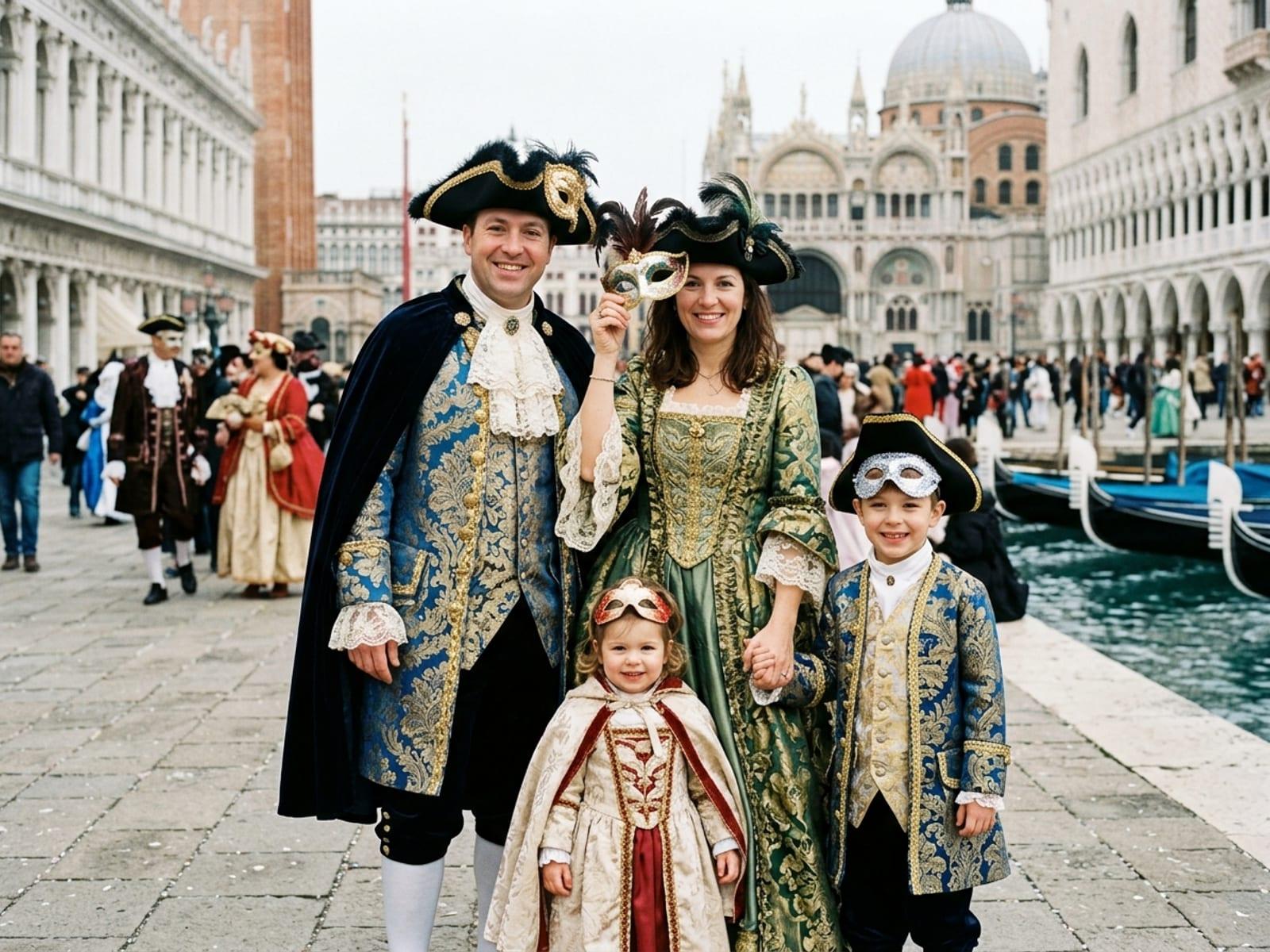
The Venice Carnival is a festival only this city could stage: for two to three weeks before Lent, somewhere between late January and early March depending on the year, people in masks and lavish costumes drift across stone squares and along the canals. Watching is fun enough on its own, but it's more fun still when everyone in the family, children included, has a small mask of their own.
The last party before the fast
Carnival is a chance to celebrate to the full before Lent, the roughly 40 days before Easter when Christians traditionally give up meat and other indulgences. Records of carnival in Venice are said to go back to 1094, and in the days of the Venetian Republic it lasted nearly six weeks, from December 26 until the day before Lent.
Behind a mask, no one could tell your rank or who you were, so nobles and commoners could let loose in the same square, and that more than anything set the Venice Carnival apart. After the Republic fell at the end of the 18th century, the carnival disappeared for a long time. It was revived in 1979 and grew into the international festival it is today.
The dates change every year. The last day is always the Tuesday before Ash Wednesday, the first day of Lent, and Ash Wednesday is worked out backward from the date of Easter. So the carnival shifts around between late January and early March and runs for about two to three weeks. In 2026, for example, it ran from January 31 to February 17. Dates and programs for future years are announced on the official website.
The Flight of the Angel, the Festa delle Marie and the water parade
Each year has its own theme, and the events are built around it. The most famous is the Flight of the Angel (Volo dell'Angelo), in which a costumed "angel" glides down on a wire from the top of the bell tower in St. Mark's Square to a stage in the square below. It usually takes place on the first weekend of the carnival. The square fills up early, so with small children it's more realistic to watch from the edges, looking up.
The Festa delle Marie recalls the story of twelve young women kidnapped in the 10th century and rescued after a chase led by the Doge. A group of chosen young women parade through the city in costume. There are also water parades on the Grand Canal and elsewhere, as well as mask and costume contests; each year's program tells you what's on which day.
Even when nothing official is happening, you'll run into people in costume as you wander. Those in the most elaborate outfits often pose for photos under the arcades of St. Mark's Square or with a canal behind them. Ask before taking a picture, and say thank you afterward. When a child speaks to them, they'll sometimes strike a new pose just for that child.
Fried treats that only appear at carnival time
When carnival season comes around, the display cases of Venetian pastry shops and bars fill up with fried sweets. The best known are frittelle, round balls of fried dough rolled in sugar. Some are old-fashioned, studded with raisins and pine nuts; others are filled with custard or zabaione cream, and every shop's version tastes a little different. Galani, thin sheets of dough fried into ribbons, are another seasonal staple.
Both are easy to eat standing up with your fingers, and just sweet enough to make a good break for kids worn out from walking. On cold days, order them at a bar with a hot chocolate or warm milk to thaw out. They tend to vanish from shop windows once carnival is over, so if you spot them, don't pass them up.
Putting together masks and costumes
Traditional Venetian masks include the bauta, which covers the whole face and juts out over the mouth, and the moretta, a round black mask. For children, though, a half mask that covers only the eyes, or a mask on a stick held up to the face, is the better choice. Full-face masks narrow the field of vision, which is dangerous in a crowd.
Masks are sold in shops all over the city, but price and quality vary a great deal. Workshop masks made from layered papier-mâché and painted by hand make keepsakes you can display for years. As for costumes, adults can get the look by adding a cape or a hat, and some shops rent out full 18th-century-style gowns and cloaks. For children, it's safer to get a well-fitting dress or cape before you leave and bring it with you.
To see what a family costume photo might look like before you go, you can try pokesta's AI-generated photos, at $1 per photo.
Venice is cold in February. Wear warm layers under your costume and non-slip shoes that are comfortable for walking. A dress that trails on the ground gets soaked in no time on rainy days or during high water, so keep children's hems short.
Bridges, crowds and high water with children
No cars can enter central Venice, so you get around on foot and by vaporetto (water bus). The bridges have steps, which means you'll be lifting a stroller more often than pushing it. In most situations a baby carrier is easier.
On carnival weekends, especially around St. Mark's Square and the Rialto Bridge, the crowds can get so thick it's hard to move. Agree on a meeting point in case you get separated, and give each child a card with your contact details. Going early in the morning or on a weekday makes walking much easier.
In winter, acqua alta (high water) sometimes floods the squares. Tide forecasts are available on the city's website and elsewhere, and if you're worried, pack rain boots or plastic shoe covers.
Venice also charges an access fee to day-trippers visiting the historic center on certain days. Which days, how much, and conditions such as the exemption for under-14s change from year to year, and overnight guests are treated differently. Check the official website before your visit to see whether your day is covered.
Reaching the island by bus, boat or train
The gateway airport is Venice Marco Polo Airport (VCE), on the mainland. From there you can take a bus to Piazzale Roma, the island's entry point, or an Alilaguna water bus straight to stops such as those near St. Mark's Square. Trains from Milan, Rome and other Italian cities run directly to Santa Lucia station on the island, with no changes.
During the carnival, hotels on the island fill up early and prices rise. Staying in the historic center means you can meet costumed revelers in the quiet early mornings and evenings; to keep costs down, stay across the water in Mestre and come in by train or bus. With a spare day, take the train north and walk the vineyards of the Prosecco hills. To catch Italian festivals in other seasons, there's the Scoppio del Carro in Florence in spring and the Palio di Siena in summer. Before you travel, check your own government's official information on what your nationality needs to enter Italy.
References