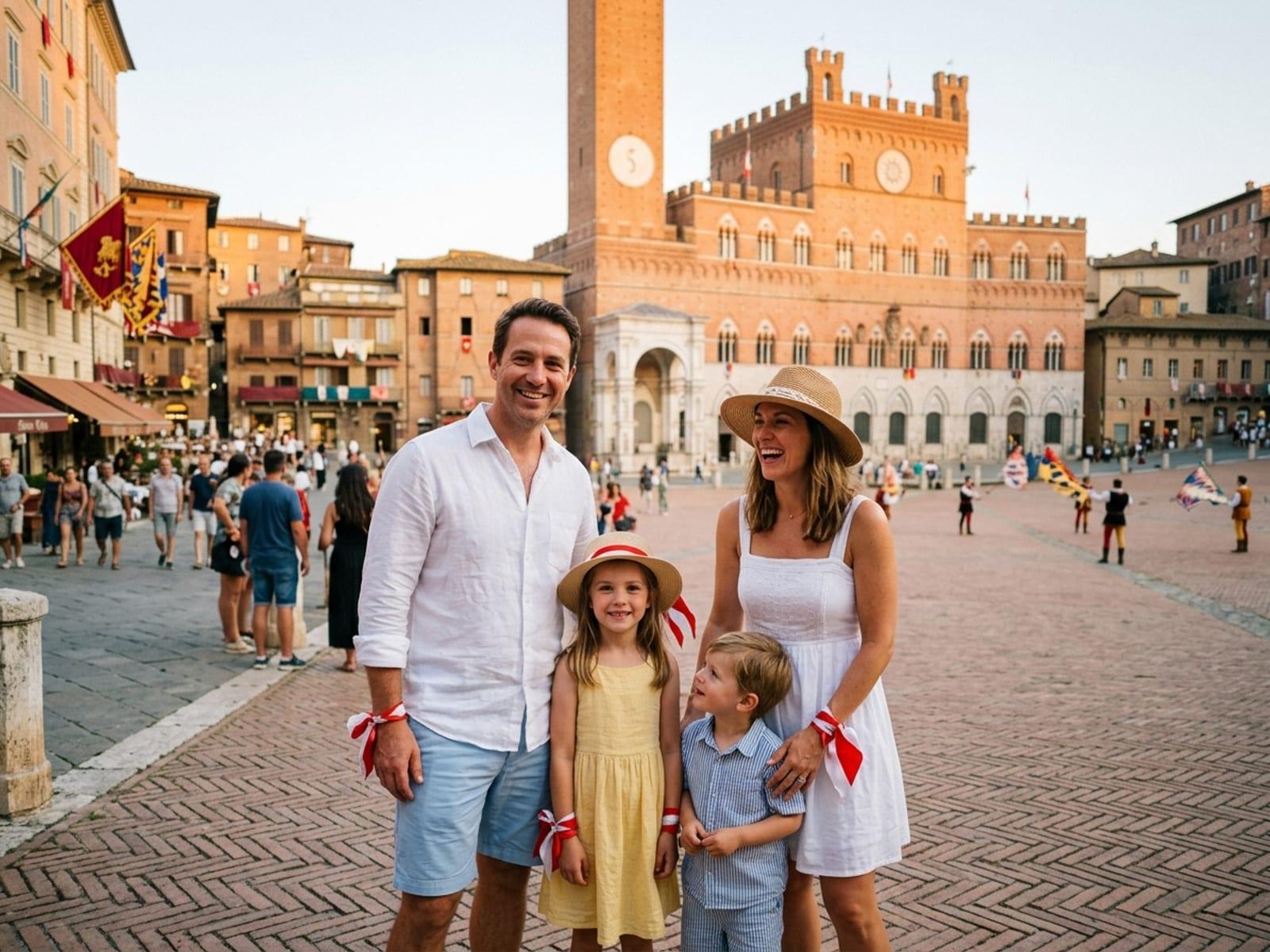
The Palio di Siena is a horse race between the districts of Siena, in Tuscany, held every year on July 2 and August 16 in the city's shell-shaped central square, Piazza del Campo. Ten of the 17 contrade enter a horse each, and jockeys riding bareback race three laps of the square over a track of packed earth. It's all over in 90 seconds at most, yet the city spends four days building up to it with the horse draw and trial runs, and keeps celebrating long after. The dates never change, though the weekdays do: in 2027, July 2 is a Friday and August 16 a Monday. If you're going with children, plan around the trial runs (prove) in the days before rather than the main race, which means standing for hours in a crowded square at the height of summer.
Seventeen districts, each cheering for its own horse
The Palio is a contest between the 17 contrade, the districts that divide Siena's old town. Each has an emblem, often an animal or an object, such as the Eagle, the Caterpillar, the Snail, the Owl, the She-Wolf, the Tortoise, the Wave and the Unicorn, and each has its own flag colors. Which contrada you belong to is largely a matter of where you were born, and many contrade have their own baptismal fountain. Once you can read the flags and tell which district is singing in the street, wandering the city becomes far more interesting.
Only 10 of the 17 contrade run in any one Palio. The seven that sat out the same race the previous year qualify automatically, and the remaining three are drawn by lot. Horses are assigned to the districts by lot as well, so the mood in a contrada can swing a long way depending on whether it draws a strong horse.
The July 2 race is the Palio di Provenzano and the August 16 race is the Palio dell'Assunta; both are dedicated to the Virgin Mary. The race in its current form, with laps around the square, is said to date from 1633, and the August race was added in 1701. Before that, from around 1590, the contrade competed in the square using buffalo and donkeys. The number of districts was fixed at 17, and the limit of ten runners per race introduced, in 1729.
Four days of build-up, and the historical parade on race day
Each Palio takes four days: June 29 to July 2 for the July race, and August 13 to 16 for the August one. On the first day the horses are drawn (the tratta). Trial runs follow every morning and evening, and after six of them comes the race itself.
Race day is packed from early on. Around 8 a.m. there is a Mass for the jockeys in the chapel beside the town hall, and around 3 p.m. each horse that will run is blessed. A blessing for the horses says a lot about the character of this festival. After that comes the historical parade, about two hours of flag wavers and drummers in medieval costume circling the square, and the crowd roars each time a flag is tossed high into the air.
The start is usually around 7:30 p.m. in July and around 7 p.m. in August. Lining the horses up at the rope, the mossa, can drag on, partly because of tactics between rival districts. Once they're off, it's three laps and roughly a minute. A horse can even win without its jockey: if it crosses the line first wearing its district's colored plume, that contrada takes the Palio.
The winner receives the drappellone, a large silk banner painted specially for each race. It has to include the city's insignia and the emblems or colors of the ten contrade running, but the style is up to the artist. The banner then belongs to the winning district. After the race, each contrada holds its own dinner outdoors.
Bad weather can move the date. In 2026, the July Palio was postponed to the next day, July 3, because of rain, so leave some slack in your itinerary.
With children, choose a trial day over the race
The center of the Campo is free to enter on race day. But the square is full by late afternoon, and once the entrances close you can't leave until the race is over. That means hours on stone with no shade in midsummer, which is hard to recommend for small children or anyone with a stroller. Talk it through as a family beforehand: if someone feels unwell, getting out won't be easy.
The trials are another matter. Crowds are thinner and you can take in the square at a slower pace. Note that on race day itself, children are currently not allowed in the center of the square and can only watch from the stands or from windows.
If you'd like a seat, there are wooden stands built around the edge of the square, and seats at windows and on balconies of the buildings overlooking it. All are paid and sold through shops and agents in the old town. Prices vary a lot by position and by year, so ask early.
It's also worth knowing that the Palio carries real risks for the horses. The square has tight bends and there have been accidents in the past. Animal rights groups protest the race every year and monitor the horses' condition. Safety rules have been added over time: thoroughbreds are not allowed to run, veterinary checks are compulsory, and since 1999 padded barriers have lined the dangerous San Martino bend. Talk to your children about this side of the Palio before you watch it together.
Dress for the heat, and add a district's colors
There's no dress code. Beating the heat comes first, so a hat, sunscreen and water are essential. Choose breathable linen or cotton and shoes you can walk in. The square slopes and its paving is uneven, so closed shoes feel steadier than sandals.
If you want to join in a little, pick a contrada whose emblem or colors you like and work its two colors into your clothes or accessories. You can also see how a family photo in district colors, with costumed flag wavers behind you, might look using pokesta's AI-generated photos ($1 per photo).
The dates are fixed, so book your room first
Because the dates are the same every year, hotels fill up early around them, so book a room as soon as you decide to go. The nearest major international airport is Florence (FLR), and from Florence you can reach Siena by bus or train. If you stay in Florence, the Mercato Centrale food hall is a good place under cover for lunch on a hot day. Itineraries through Pisa or Rome airports also work.
Siena's old town is full of slopes and narrow lanes, and car access is restricted. It's especially crowded during the Palio, so a baby carrier will make life easier than a stroller. Outside Palio season, you can still feel the festival's presence in the Campo and in the contrade's museums.
If July and August don't work for you, Italy has other festivals: the Venice Carnival in winter, and Florence's Scoppio del Carro on Easter morning. Entry requirements for Italy depend on your nationality, so check your own government's official information before you travel.
References