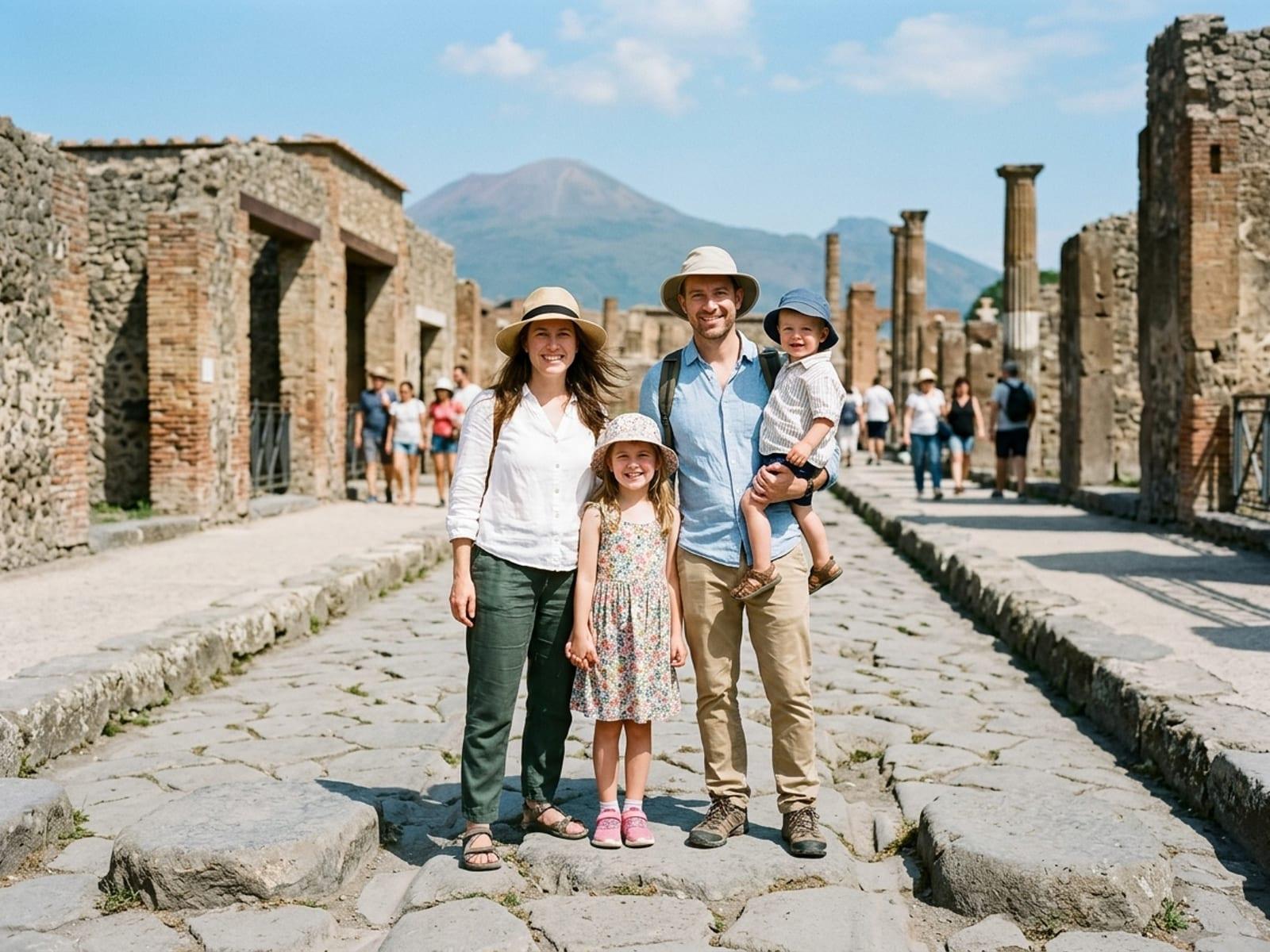
In AD 79, the eruption of Mount Vesuvius buried the town of Pompeii under a thick layer of ash and pumice. The excavated site still has its paved streets, the remains of bakeries and snack bars, theaters and an amphitheater, and you can walk through it to see how people lived 2,000 years ago, a whole town at a time. In 1997 it became a UNESCO World Heritage Site together with the nearby ruins of Herculaneum and Torre Annunziata. The site is large and has little shade, so with children it's more realistic to pick what you want to see and do it in half a day than to try to see everything.
A town stopped in AD 79
Pompeii was a provincial Roman town near the Bay of Naples. Its population at the time of the eruption is estimated at around 10,000 to 20,000, and the town covered 64 to 67 hectares. Because it was sealed under thick ash, buildings, streets and even graffiti on the walls survived. Excavation began in 1748 and is still going on.
Giuseppe Fiorelli, who took charge of the excavations in 1863, developed a way of pouring plaster into the hollows left in the ash by human bodies, capturing the final moments of the people who died. You may come across these plaster casts on your visit. They can be upsetting for young children, so decide beforehand whether you'll show them and how you'll explain them.
Looking for "everyday life" with your kids
With children, Pompeii lands best when you treat it as an old town rather than a ruin. Take the streets. Roads paved with big stones have raised sidewalks on either side, and in places large stones are set across the road. Ask your child what they think those stones are for, and they'll start picturing the town for themselves.
Food is another good way in. Pompeii has the remains of nearly 100 thermopolia, shops with a counter facing the street that sold hot food and drinks, and at least 31 bakeries have been found. Large jars called dolia are set into the counters; call it "a fast-food place from 2,000 years ago" and children get it right away. Another of these shops was dug out in 2020, with eight jars. That the excavation is still going on surprises children too. If you've had pizza in Naples the same day, talking about the differences is fun as well (see pizza in Naples).
Near the Piazza Anfiteatro entrance is the amphitheater, built around 70 BC. Its broad oval of seating is the kind of place children want to run up and down, but the old stone chips easily and the steps are high, so hold hands. Other highlights include the Forum, the central square; the House of the Faun, a large mansion; and the Villa of the Mysteries outside the town walls, known for its frescoes. Which houses you can enter changes over the year, and the official website lists the houses open and their hours. Millions of people visit every year, so if there's a particular house you want to see, choose the entrance closest to it to cut down on walking.
Hours and tickets in 2026
According to the archaeological park's official website (checked in October 2026), Pompeii opens at 9 a.m. every day. In the summer period, from March 16 to October 14, last entry is at 5:30 p.m. and the site closes at 7 p.m. In the winter period, from October 15 to March 15, last entry is at 3:30 p.m. and closing is at 5 p.m. It's closed on December 25 and January 1.
Under the prices in effect from January 12, 2026, tickets include Pompei Express at 20 euros, covering the town only, and Pompei+ at 25 euros, which adds the suburban villas and a shuttle bus. EU citizens aged 18 to 24 pay a reduced price of 2 euros. Children's prices depend on the ticket type and conditions, so check the official ticketing site. Entry is free on the first Sunday of every month, but you still need to get a free ticket, and those days tend to be crowded.
Tickets are issued in the visitor's name, and entry is capped at 20,000 people a day. From March 16 to October 14 there are also separate quotas for morning and afternoon, so once your dates are fixed it's wise to buy early from the official online ticket site. Prices, hours and rules can change, so always check the official website for the latest information.
Pack small and wear good shoes
Bags may be no larger than 30 × 30 × 15 centimeters; anything bigger goes to the left-luggage office. If you use a backpack, choose a small one and fill it with water, hats, sunscreen and snacks. Eating and drinking are only allowed in designated areas, so check the map for rest spots before a child gets hungry.
The official rules also recommend comfortable walking shoes. The website describes "Pompeii for All," a route of a little over 3.5 kilometers designed to be easier for wheelchairs and strollers. It runs from Piazza Anfiteatro along the main street to the Sanctuary of Venus, past the major buildings, and there are baby-changing and nursing rooms at three points along the way (you borrow the key at the entrance and return it on the way out). The site notes, however, that some stretches have slopes steeper than 8 percent, sudden changes in level of just under 5 centimeters and uneven original paving, so even with a stroller, bring a baby carrier as well. In summer there's almost no shade, so with children it's best to enter early in the morning and leave before the hottest part of the day. The rules also warn against sheltering under trees during a storm.
You can see how your family might look lined up on a paved street with the volcano behind you with pokesta's AI photos ($1 per photo, and your first one is free).
Getting there from Naples
The nearest airport is Naples International (NAP). From Naples, the easiest option is the Naples–Sorrento line of the Circumvesuviana, a private railway. It calls at Napoli Porta Nolana and Napoli Garibaldi, and Pompei Scavi station is the closest to the main entrance of the ruins. There's also the Campania Express, a tourist train with fewer stops (supplement required). The Naples–Sorrento line takes about an hour to its terminus in Sorrento, so after Pompeii you could move on to the coast and visit the terraced groves behind the lemons of the Amalfi Coast. There are three entrances, Piazza Esedra, Porta Marina and Piazza Anfiteatro, and tickets are also sold at the entrances. Entry requirements for Italy depend on your nationality, so check your own government's official information before you travel.
References