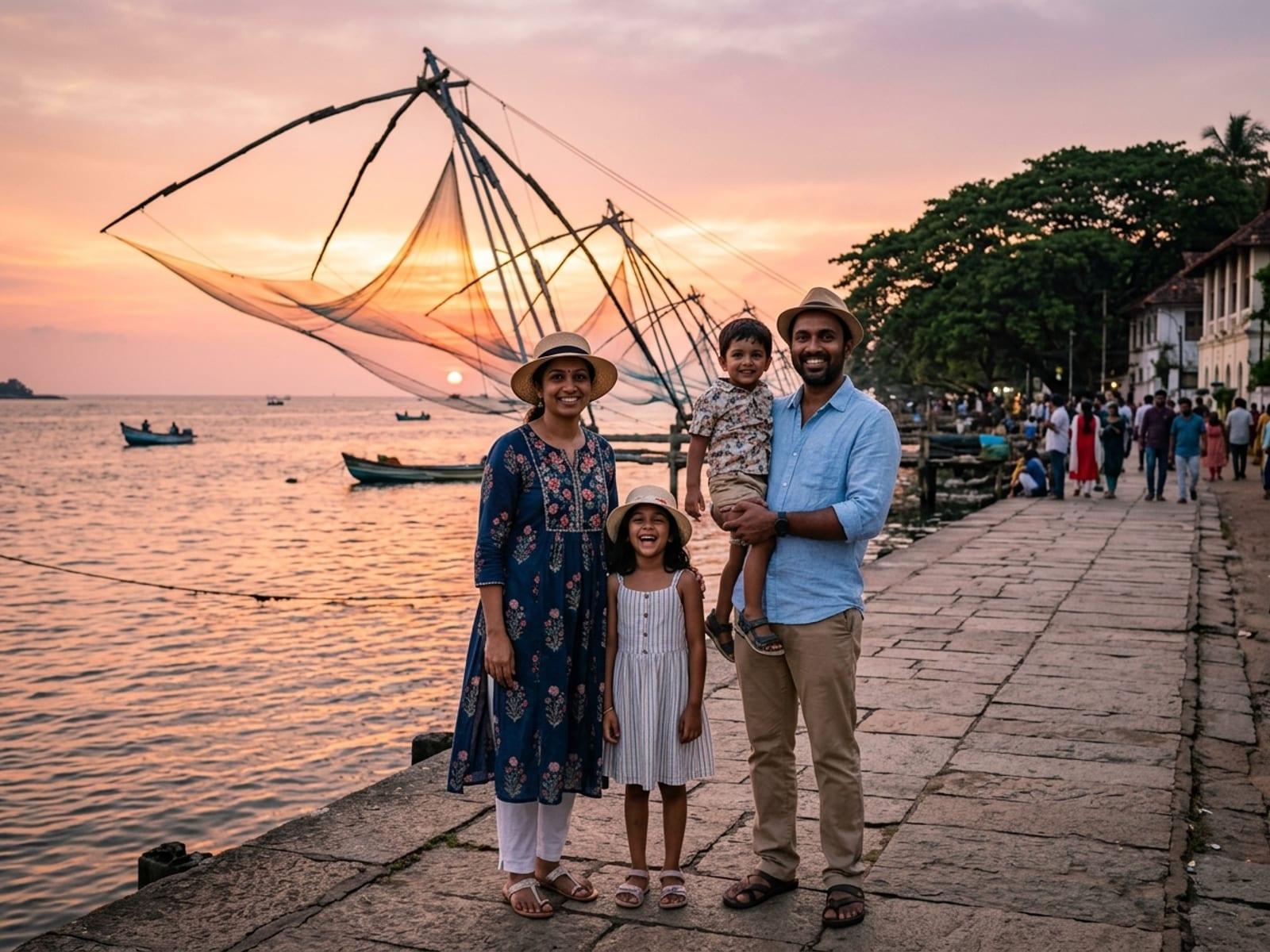
At dusk, a row of huge timber-framed nets lines the shore, slowly rising and dipping into the water. Fort Kochi, the old quarter of the port city of Kochi in the South Indian state of Kerala, is known for these cantilevered "Chinese fishing nets." Portugal, the Netherlands and Britain ruled here one after another, and their history survives as churches, cemeteries, a palace and a synagogue packed into an area small enough to explore on foot with children. Getting there and back, you can ride the electric boats of the Water Metro.
A port where European powers came and went
Fort Kochi takes its name from Fort Manuel, built by the Portuguese and said to be the first European fort on Indian soil. Portugal held the area for about 160 years, then the Dutch took over, and in 1795 it came under British rule. Foreign rule ended only in 1947. Fort Kochi lies southwest of mainland Ernakulam, in an area made up of several islands, with the town of Mattancherry right next door. In 2020 National Geographic ranked it ninth on a list of 25 places to visit, and it draws travelers from India and abroad. The Portuguese left their mark on other west-coast harbors too: the island of the Elephanta Caves in Mumbai Harbour was named by the Portuguese after a stone elephant they found there.
St. Francis Church tells much of this story. Built in 1503, it is one of the oldest European churches in India, and the navigator Vasco da Gama, who died in Kochi in 1524, was first buried here. His remains were moved to Lisbon 14 years later and now lie in the Jerónimos Monastery. The Dutch, who captured Kochi in 1663, tore down other churches but used this one as their government church. Portuguese-era tombstones remain inside. One, carved with the name "Vasco," was long mistaken for da Gama's, but it actually belongs to Vasco Fernandes Pimentel, governor of Kochi from 1564 to 1567. The tale of a different man with the same name makes a good way to show children how history gets checked.
Nearby are Santa Cruz Cathedral and a Dutch-era cemetery. Everything is a few minutes' walk apart, so hand your child the map and let them lead the way ("Which way next?"), and the walk turns into a treasure hunt.
The "Chinese nets" along the shore
Walk along the beach at Fort Kochi and the first thing you'll notice is the Chinese fishing nets. Locally they're called cheena vala, "Chinese nets," and they are said to have been brought by Chinese visitors in the 14th century; one account credits the fleet of Zheng He, the Ming admiral who sailed these waters in the early 15th century.
The nets work on simple leverage. A timber frame more than 10 meters tall holds a net over 20 meters across horizontally at one end, while large stones hang on ropes at the other. When a person walks along the main beam, their weight lowers the net into the sea, and a few minutes later it is raised again. Each net is worked by a team of up to about six fishermen, and the catch from a single haul is usually modest.
The moment a net rises may be the best show in town for children. The nets and stone weights are big, heavy equipment, though, so tell them to watch from a little way off, without wandering into the fishermen's work area or touching the ropes. On the beach you can also buy fish from the catch and have it cooked at a stall nearby. The same nets can also be seen in Kollam, a port town in southern Kerala.
Mattancherry's palace and synagogue
Next to Fort Kochi is Mattancherry. Its Mattancherry Palace is also called the "Dutch Palace," but it was actually built by the Portuguese around 1545 and presented to the Raja of Kochi. It got its nickname after the Dutch took control of the area in 1663. The Archaeological Survey of India restored it between 2007 and 2009. Inside are murals in the tradition of Hindu temple painting and portraits of the Rajas of Kochi from 1864 onward.
In the part of Mattancherry known as Jew Town stands the Paradesi Synagogue, built in the 16th century. It is the oldest active synagogue in the Commonwealth of Nations. The floor is laid with 18th-century hand-painted Chinese porcelain tiles, each with its own pattern, and Belgian glass chandeliers hang from the ceiling. An 18th-century clock tower also survives.
Watch the closing days here. The synagogue is closed on Fridays, Saturdays and Sundays and on Jewish holidays. It's a place of worship, so cover shoulders and knees and ask children to stay quiet inside. Opening hours and closing days, the palace's included, can change, so check official information before you set out.
Cross by Water Metro, end the day on the beach
You can reach Fort Kochi from mainland Ernakulam by road, but with children the Water Metro is the more fun ride. Kochi Water Metro is a network of electric boat routes opened in 2023, including a 3.5 km route from the High Court terminal to Fort Kochi. The boats are electric, running on battery or hybrid power, at 8 to 10 knots, and you can transfer to the Kochi Metro rail line with the same card.
An easy plan for the day: the palace and synagogue in Mattancherry in the morning, a rest at midday, the churches and cemetery in the afternoon, and the nets and the sunset on the beach in the evening. You avoid walking around in the worst of the heat, and the best sight is saved for last.
Avoid the monsoon; go in the dry months
Kochi lies in the path of the southwest monsoon, and June to September brings heavy rain. January and February are the driest months. Since 2012 the city has hosted the Kochi-Muziris Biennale, India's first contemporary art biennale, and in biennale years venues pop up all over town. If your trip does fall in the August rains, there are compensations: the Nehru Trophy Boat Race is held to the south in Alappuzha, and around Onam you can eat sadya, the vegetarian feast served on a banana leaf.
The gateway is Cochin International Airport (COK), also known as the world's first airport to run entirely on solar power. Entry requirements for India vary by nationality, so check your own government's official information before you go. You can try a photo of your family in front of the nets at sunset with pokesta's AI photos ($1 per photo).
The one thing to check up front is that the synagogue closes Friday through Sunday. After that, catch the boat and wander the town at an easy pace until it's time to watch the nets come up.
References