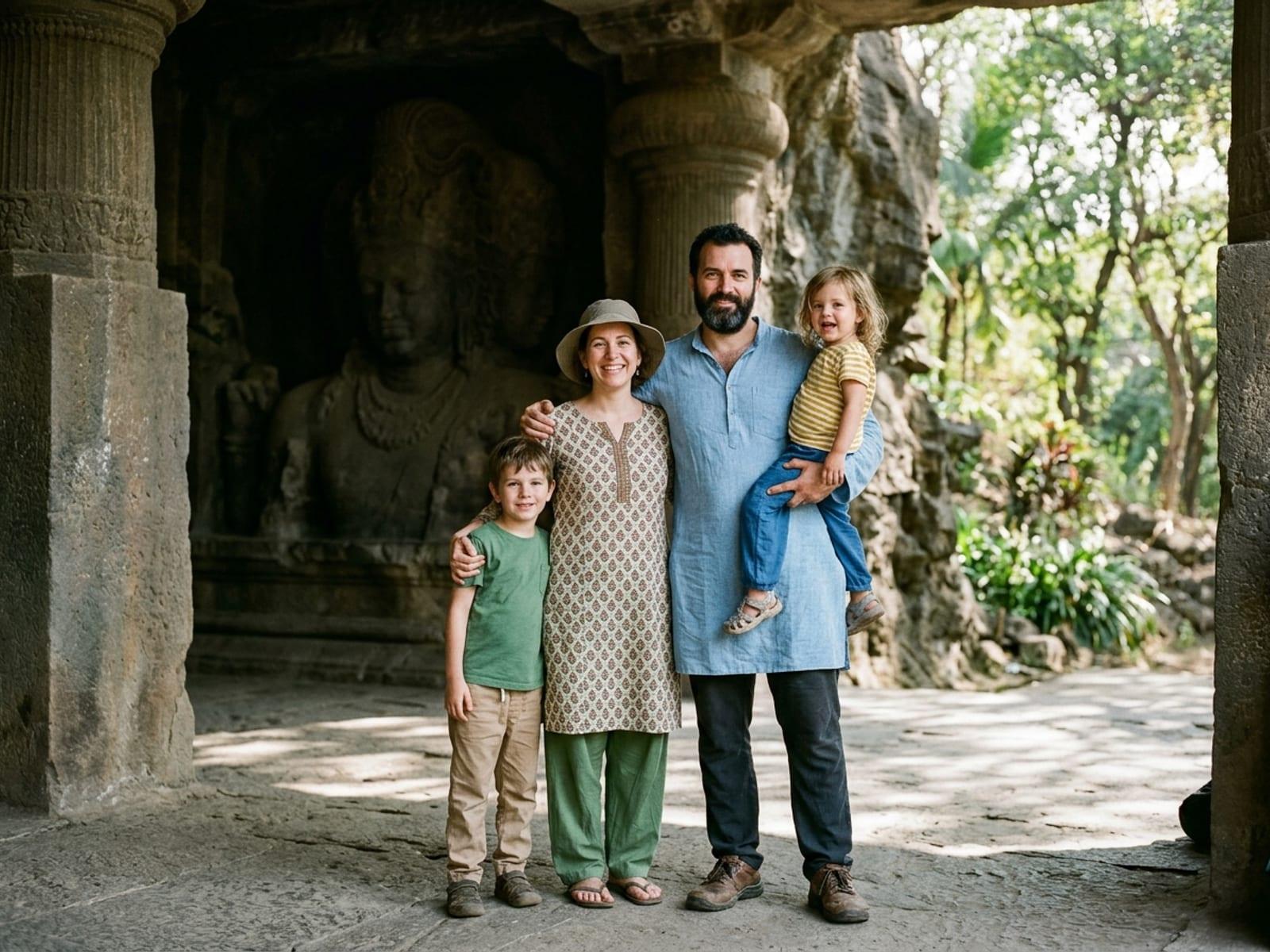
Take a boat from the Gateway of India, the stone arch on Mumbai's waterfront, and about 50 minutes later you reach Elephanta Island, out in the harbor. Its rocky hill holds cave temples hewn from solid rock some 1,500 years ago. A three-faced image of Shiva, more than 5 meters tall, is the emblem of these caves, which became a UNESCO World Heritage Site in 1987. A boat trip, a climb up stone steps and a cool hall of rock make it feel like an adventure for children. But if you don't sort out the closing day, the boat times and the heat in advance, you may not get across at all, or end up rushing for the last boat back.
Boarding at the Gateway of India
Your starting point, the Gateway of India, is a 26-meter arch built to commemorate the landing of King George V and Queen Mary at this spot on December 2, 1911. It was designed by the Scottish architect George Wittet; the foundation stone was laid on March 31, 1913, and it opened to the public on December 4, 1924. It's a good place for a family photo before you board. The waterfront here is called Apollo Bunder, and tourist boats to Elephanta Island leave from its jetty. The crossing takes about 50 minutes.
Elephanta Island, known locally as Gharapuri, lies in Mumbai Harbour about 10 km east of the city. Its name comes from the Portuguese, who ruled the area and called it "Elephanta" after a large stone elephant they found on the island. That elephant now stands in Jijamata Udyan, a park in Mumbai. Seeing the caves and then visiting the real source of the island's name ties the whole day into one story for a child.
The island sits right in the middle of Mumbai's port, with a big container terminal close by. There's a small village called Gharapuri on its south side, and the landing points are on the northwest, northeast and south of the island. From the boat you can watch huge cargo ships passing and the busy harbor, another highlight for children who love vehicles.
120 steps, and a toy-sized train
From the jetty to the caves is an uphill walk of about 1 km, finishing with roughly 120 stone steps up from the ticket counter. A small tourist train also runs along the way, so families with small children, or anyone unsure on their feet, can use it to save energy.
Parts of the stairway have little shade, so bring hats and water and take breaks, especially in the hottest hours. A stroller is hard to manage here, so a baby carrier suits infants and toddlers. Boats to the island can be canceled or delayed by weather, so check that day's service before setting out. Pack at least one bottle of water per person, a towel for sweat, sunscreen and a light snack. Putting everything in a backpack keeps your hands free on the steps, which is safer.
The three-faced Shiva of the Great Cave
The western hill of the island has five Hindu caves, and the eastern hill has two Buddhist caves and the remains of a stupa from around the 2nd century BCE. The centerpiece is Cave 1, the Great Cave. Most scholars think the caves were made between the 5th and 7th centuries, and that the work was largely finished by around 550.
The Great Cave is a large hall about 40 meters square. The north-facing entrance is modest, and stepping inside you find a surprisingly vast space. Directly opposite the entrance, carved into the south wall, is the Trimurti (Sadashiva), Shiva with three faces representing creation, preservation and destruction. Sources give its height as anywhere from 5.45 to 7 meters, but either way, children will crane their necks to take it in. Because it faces the entrance, the three faces seem to rise quietly out of the back wall as your eyes adjust to the dark.
Other reliefs fill the walls: Ardhanarishvara, Shiva and Parvati joined in a single body; Shiva catching the Ganges in his hair as it falls from the sky; the demon king Ravana trying to shake Mount Kailash; and Shiva dancing with eight arms. Inside the hall stands a square shrine with a doorway on each side, every one flanked by guardian figures about 4.6 meters tall. Many of the sculptures are damaged, thought to have been broken during Portuguese rule and at other times, though scholars disagree about who was responsible.
Rows of pillars divide the hall into smaller bays, and besides the main north entrance there are openings to the east and west, so daylight falls in from the sides too. Conservation began in 1909 under British rule, and in the 1970s the Indian government repaired collapsed parts of Cave 1 and broken pillars in the other caves. Today the site is managed by the Archaeological Survey of India (ASI) and sees about 1,000 visitors a day.
On the eastern hill are the two Buddhist caves, water cisterns and the remains of the stupa dating back to around the 2nd century BCE. They show that the island was a place of Buddhist worship long before the Hindu Great Cave was carved. If you have time and energy left, it's worth the extra walk.
Reading the stories behind the reliefs beforehand, in a children's picture book or illustrated guide, adds the fun of spotting "that's the scene from the story" on the spot. Inside the rock hall you're out of the direct sun, so you can catch your breath as you look around.
Closed on Mondays; go in the dry season
The caves are closed on Mondays. Turn up at the Gateway of India on a Monday and you won't get to the island, so check this first when planning. Times of the first and last boats out, and of the last boat back from the island, vary by season, so confirm them at the Gateway of India jetty on the day and plan your time on the island to leave a comfortable margin for the return trip. Allow about half a day, including the boat both ways, to see things without rushing.
In Mumbai the monsoon starts in June, peaks in July and usually ends around the third week of September. For a trip across the water, the drier months from November to March are best. Crowds grow around Maha Shivaratri, the festival of Shiva, on World Heritage Day (April 18), and during World Heritage Week (November 19 to 25).
The gateway airport is Chhatrapati Shivaji Maharaj International Airport (BOM). Take the Konkan Railway south from Mumbai and you reach Ratnagiri, home of the Alphonso mango, in season in April and May. Entry requirements for India vary by nationality, so check your own government's official information before you go. Back on the mainland in the evening, trying Mumbai's vada pav and street food makes a good end to the day. You can also see how a photo of your family standing in the rock hall might look with pokesta's AI photos ($1 per photo).
Avoid Mondays, take a morning boat, and plan your walk backward from the return sailing. Settle those three, and you can see the caves across the water with children without racing for the last boat.
References