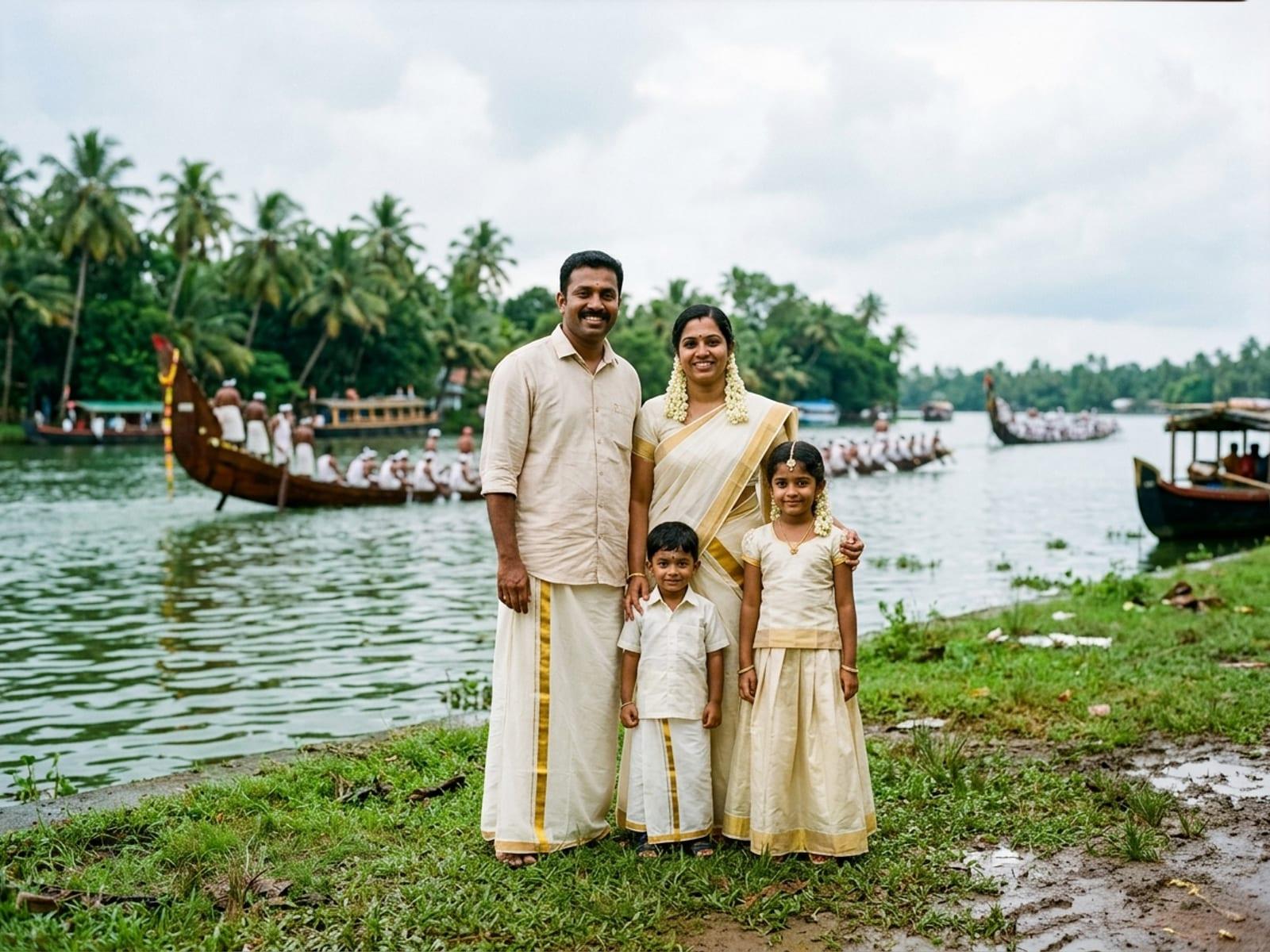
A narrow wooden boat more than 30 meters long, sometimes carrying over a hundred rowers, shoots straight across a lake ringed with coconut palms. The Nehru Trophy Boat Race, held every August in Alappuzha in the southern Indian state of Kerala, is the signature water festival of Kerala's monsoon season. Even from a seat on the bank it's thrilling, and it makes a good family outing, as long as you come prepared for monsoon weather and very big crowds.
It began with an impromptu race for a prime minister
Around Alappuzha lie the backwaters, a web of canals and lakes. To the east is Vembanad, one of India's largest lakes, where several rivers branch out before reaching the sea. Boats are still an everyday way of getting around, even in town. In a place where life has always moved by water, villages have long sent out their boats to race each other in vallam kali ("boat games"), held in many spots from the monsoon through the Onam festival.
The Nehru Trophy dates back to 1952. When Jawaharlal Nehru, India's first prime minister, visited the backwaters, local people welcomed him with a fleet of snake boats and put on an impromptu race of nine boats. Nehru later donated a silver trophy shaped like a snake boat. First called the Prime Minister's Trophy, it was later renamed the Nehru Trophy, and the race took its name. The first formal race was held in 1954 at Kainakary. The venue later moved to Punnamada Lake, close to Alappuzha town, where it is still held today.
Snake boats are a village's pride
The stars of the race are the chundan vallam, known in English as snake boats. They measure from 30 to just over 40 meters long. The rowers sit two abreast, 64 of them and sometimes as many as 128. Helmsmen steer with long oars, and around 20 or more singers line up in the middle of the boat.
The boats are built from anjili, the wood of the wild jack tree, which holds up well in water. Each boat belongs to a village, and villagers treat their boat almost like a deity, holding rituals before a new one is launched. Traditionally the crews are men of the village. Each village picks its best rowers and trains them for race day.
Listen during a race and you'll hear vanchipattu, the boat songs. They're sung in Malayalam, and the rowers on both sides dip their oars in time with the beat. As the song speeds up, so do the oars, and the boat surges forward in a way you can feel even from far away.
From morning heats to the evening final
On race day, heats for the smaller boats begin in the morning, the opening ceremony follows, then come the snake boat heats, and the final is held in the late afternoon. In 2023, 72 boats took part, 19 of them snake boats. Alongside the snake boats, several other kinds of traditional boats of different shapes and sizes race in their own categories. The course is about 1.4 km, split into lanes marked with bamboo poles, and several boats race side by side.
Since 2019 the race has also been one round of the Champions Boat League, a series of Kerala boat races. The boat with the most wins is Karichal Chundan, and each village's supporters bring plenty of noise to the banks.
The Nehru Trophy isn't Kerala's only boat race. During the July to September monsoon, boats come out all over the backwaters: the Champakulam Moolam boat race, the Payippad water festival, and the Uthrattathi boat procession linked to the Parthasarathy Temple in Aranmula, among others. Some, like Aranmula, are tied to temple rituals and feel more like worship than sport. If your dates work out, seeing a second race before or after the Nehru Trophy shows you how much the boats and songs differ from village to village. Local schools often close on race day, and you'll see lots of children along the banks.
Dress for rain and sun alike
There's no dress code for spectators. But August in Kerala is the southwest monsoon season, when sunny spells and heavy rain take turns. Quick-drying cotton clothes and a rain jacket that leaves your hands free are the safe choice. Umbrellas block the view for people behind you, so expect them to be impractical in a packed viewing area.
Some families choose kasavu, Kerala's traditional off-white cotton with gold borders, for photos. Men wear a mundu wrapped at the waist with a light shirt, and women wear a two-piece set mundu or a long cream skirt with a blouse. Around Onam you'll see many people dressed this way, and it looks lovely against the green backwaters. The festival also brings the Onam sadya, a vegetarian feast of 20-plus dishes on a banana leaf, one of the tastes of the season.
With kids, break the long day into shorter pieces
The racing runs from morning to late afternoon, which is a lot of time on the bank with small children. It's easier to arrive in time for the highlights, the snake boat heats and the final, and rest at your hotel the rest of the time, keeping it to about half a day. Some viewing areas are ticketed, and the way tickets are sold and what they cost change from year to year, so check the official information.
The banks get crowded and can be muddy underfoot, so a baby carrier helps with toddlers. A boat flashes past in seconds, so tell children ahead of time, "When you hear the singing, the boat is coming," and they won't miss it. For photos, aim for the moment the oars hit the water together and the spray flies up, and shoot a few frames in burst mode. Bring plenty of water, snacks and a change of clothes in case of rain. You can also try pokesta's AI photos ($1 per photo) to see how a family shot with the snake boats behind you might look.
When to go and how to get there
The Nehru Trophy is traditionally held on the second Saturday of August. It can be postponed because of floods or disasters, though: in 2024 it was held on September 28 after the Wayanad landslides, and it was cancelled in 2020 and 2021 because of COVID-19. Always check the date shortly before you travel.
The nearest international airport is Cochin International Airport (COK), about 78 km north of Alappuzha. Alappuzha also has a railway station, reachable by train from Kochi (Ernakulam) and elsewhere. If you're staying in Kochi, consider an extra day for the Chinese fishing nets of Fort Kochi, which rise and fall along the shore at sunset. Before or after the race, it's easy to add a cruise around the backwaters on a kettuvallam houseboat. India's entry requirements vary by nationality, so check your own government's official information.
References