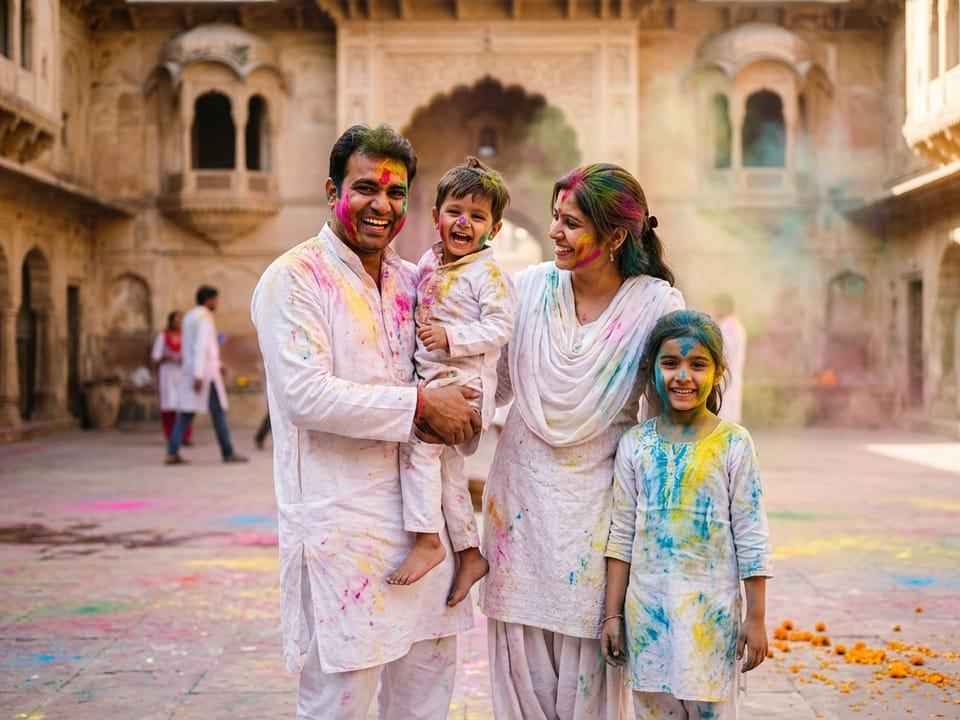
What usually goes wrong with Holi photos isn't technique but planning. Pull out your phone once everyone is already covered and you'll find a screen full of powder, a lens smeared with coloured water and a photographer whose hands are bright red. Decide on one person to take pictures, have them shoot three moments in order (before the colour, the moment powder flies, and after the play is over) and put the phone in a waterproof case from the start. Those two decisions change what you end up with.
Take the first photo before any colour goes on
Once everyone is dressed in white, take a family photo before leaving the house or before joining the crowd. A doorstep or courtyard with an uncluttered background is fine. With this one picture beside the colourful ones, the change over the day is clear at a glance.
One idea for this shot: put a little powder in a child's palm and have them hold it out towards the camera. Faces and clothes still pure white, with bright colour only in their hands, it captures the excitement just before the festival begins.
Shoot flying powder with the sun behind and in burst mode
How a cloud of powder looks in a photo depends heavily on the light. With the sun straight on, the powder tends to come out as a flat haze. Put the sun behind the family, or behind and to one side, and each grain catches the light so the cloud of colour seems to float.
The moment lasts less than a second. Instead of pressing the shutter once at a time, use burst mode (on many phones you hold down the shutter button or slide it sideways) and pick the best frame later. Agree that on "one, two, three" everyone throws their powder straight up, and the photographer can time it too. The rule is that powder goes up, never at faces.
For soft light, mornings are easier. Outlook Traveller's guide to Holi in the Braj region warns that by midday movement slows and visibility drops in the haze of powder, and advises arriving early. If you want clean family photos, take them early, when the play is just starting.
If burst mode isn't working out, video is another option. On phones that shoot slow motion, you can watch the powder spread at leisure and pull favourite moments out as stills later. Frames taken from video are less detailed than photos, though. Use photos for the shot you want to print large and video for the atmosphere, and you'll miss less.
Keep the phone in a waterproof case, and rinse off coloured water
Don't overestimate your phone's water resistance. Apple's support page says the splash, water and dust resistance of an iPhone is not permanent and may decrease as a result of normal wear, and that liquid damage isn't covered by the warranty. It also says to avoid exposing the phone to soap, detergent and water at high velocity. It's safer not to assume that a bit of coloured water, with powder mixed in, will be fine.
A travel company that runs Holi tours in India also says a waterproof case is a must. On the day, keep shooting with the phone inside a waterproof pouch worn around your neck or a zip-lock bag. When shooting through plastic, pull it taut in front of the lens and wipe powder off the outside often, and your photos will come out less blurry.
If coloured water does get on the phone, Apple's instructions are a good guide. If it is exposed to a liquid other than water, rinse the affected area with tap water and wipe it with a soft, lint-free cloth. Tap the phone gently against your hand with the connector facing down, and leave it in a dry area with some airflow. Wait at least five hours before charging. Don't dry it with external heat such as a hair dryer, and don't insert anything such as a cotton swab into the ports. Dust and dirt should be wiped off with a soft cloth, without cleaning products or compressed air. For Android phones, check your model's manual for its water and dust rating and care instructions.
Take turns as photographer, and plan the shot with everyone in it
If one person is the photographer all day, that person never appears in the pictures. Swap by time, one parent for the first half and the other for the second, so the photographer gets to play too. When you swap, wipe your hands before taking the phone. A coloured finger on the lens can blur a whole day's photos.
The shot with everyone in it is best taken after the play, once you've moved into the shade. In strong sun, colour-covered faces get harsh shadows. Set the phone on a wall or a ledge and use the self-timer with it still in the waterproof pouch, and the photographer is in the picture too. If you ask someone nearby, check that their hands are clean first and hand it over pouch and all.
The usual arrangement is fine: shorter children in front, adults standing behind. Expressions are hard to read on colour-covered faces, so ask everyone to smile with their teeth showing; the smiles come through clearly. Having everyone hold their coloured hands out towards the camera makes a very Holi picture too.
Ask before you photograph others
On Holi, even strangers throw colour at each other. Still, when photographing other people's faces, especially women and children, ask first. It's also best not to post other families' children who end up in your photos on social media. Photography may be restricted in temples; Outlook Traveller warns that photography inside the Banke Bihari Temple in Vrindavan in particular is often restricted.
If the photographer missed out on being in the pictures, or you'd like the grandparents far away to be in the same picture, pokesta can create a Holi family photo with AI, from each person's own phone photos ($1 per photo, the first one free).
Choose a dry photographer before opening the bags of colour
Holi photos don't depend on skill so much as on protecting the phone and shooting in the right order. Before the colour, the moment it flies, and after the play: with those three, that year's Holi comes through. For clothes, see What to wear for Holi; for a small celebration in a garden or on a balcony, see Celebrating Holi at home.
References