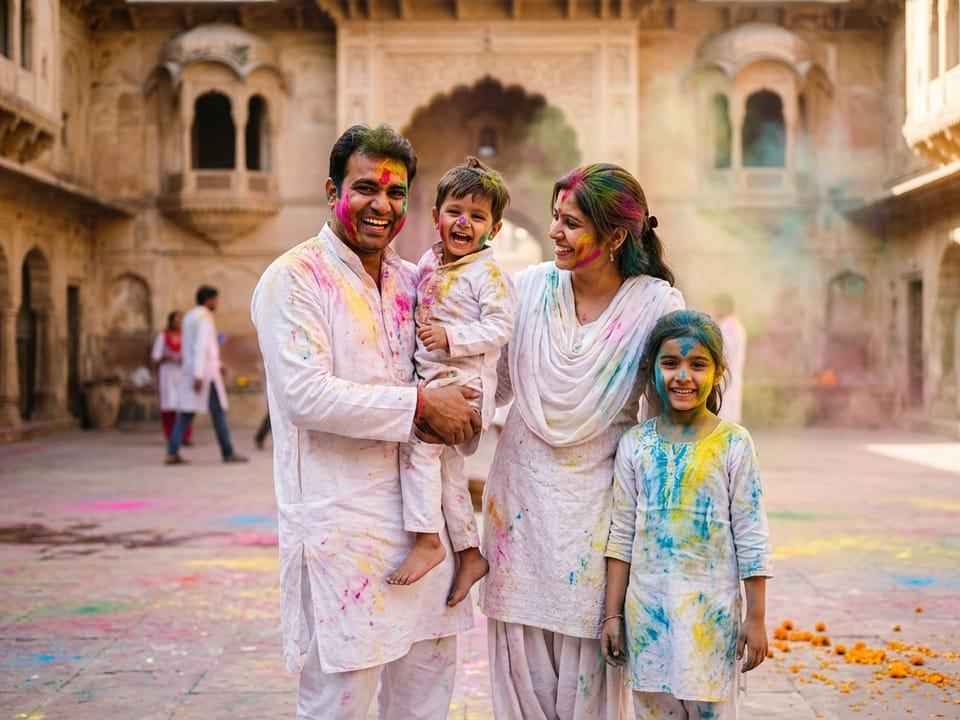
Holi has a story for its night and another for its morning. The bonfire on the eve recalls Prahlada, a devoted boy who was protected from the flames, and his aunt Holika, who tried to burn him and was burned instead. The colours the next morning recall Krishna playfully smearing colour on Radha's face. On top of both sits the plain joy of winter ending and spring arriving. If a child asks what Holi is about, "a day when we burn away bad things in a fire, then celebrate spring with colours the next morning" is about as close as a short answer gets.
The bonfire: Prahlada and Holika
Put together from Incredible India, the Indian government's tourism site, and Wikipedia, the bonfire story goes like this. The demon king Hiranyakashipu demanded that people worship him as a god. His son Prahlada refused to stop worshipping the god Vishnu. Furious, the king turned to his sister Holika for help in getting rid of the boy. Holika wrapped herself in a cloak that protected her from fire and tricked Prahlada into sitting with her on a pyre. When the fire was lit, the cloak flew from her onto Prahlada. Holika burned, and Prahlada walked away unharmed.
The bonfire on the eve of Holi is called Holika Dahan, "the burning of Holika", and it calls this scene to mind. The English Wikipedia article describes it as a symbol of good triumphing over evil and of clearing out the old to make way for the new.
When you tell it to a child, you don't need to dwell on the frightening parts. Something like "A powerful king said everyone should worship only him. But a boy kept faith with the god he believed in. And the person who tried to hurt him was the one the fire defeated" carries the heart of the story. Watching the fire together, you might add, "Tonight's the night we burn away the bad stuff." Small children remember a line like that.
The colours: Krishna and Radha
The colours of the following morning are tied to the story of the god Krishna and his beloved Radha. Incredible India explains that Krishna teasing Radha by colouring her face grew into the custom of throwing colours, which is why Holi is also called a festival of love.
Another version, recounted on Wikipedia, has Krishna worried that fair-skinned Radha would not like him because of his dark skin. His mother, Yashoda, tells him to go to Radha and let her colour his face in any colour she likes. Holi is celebrated on an especially grand scale in Mathura and Vrindavan, places tied to Krishna's life, and in Barsana, said to be Radha's home, because of these stories.
For children, the part that lands easily is "a boy who worried about looking different, and who made friends by painting each other's faces". Before you put colour on a family member's cheek, saying "Krishna played like this too" turns it from simple mischief into a game that means something.
A story told in South India: Kama and Shiva
In some regions, a different story entirely is told. According to Wikipedia, traditions devoted to the god Shiva link Holi with the tale of Kama, the god of love, who shoots an arrow at Shiva while he is deep in meditation. Shiva opens his third eye and its fire reduces Kama to ashes. Versions of this story are found particularly in South India. Kama's wife, Rati, carries out forty days of austerities, and Kama is eventually restored.
It is common in India for several stories to gather around a single festival, and Holi is one of them. None of them is the correct one; different families and places hold different stories dear. Telling children this in advance means they won't be confused when they see another family celebrate differently.
A spring festival, and a day for forgiving
Set the myths aside and Holi still has meaning as a seasonal festival. Incredible India presents it as a festival welcoming spring as winter draws to a close. Wikipedia also mentions prayers for a good spring harvest.
Incredible India puts weight on one more side of Holi: a day of new beginnings and forgiveness. People throw colours across generations, social positions and religions, and old grudges are meant to be let go. You smear a little colour on a neighbour or a relative, call out "Happy Holi", and share sweets. That is the festival's other face. Wikipedia says that after the colours, people visit family and friends, and even former enemies eat and talk together. In Bihar these visits between relatives and acquaintances are called Holi Milan, and in Gujarat, it says, brothers-in-law bring sweets to their sisters-in-law in the evening.
For children, "the day we make up" may be the easiest explanation of all. In a house where siblings have been squabbling, a dab of colour on the other one's cheek and calling it even is not far from what the festival is about.
Things to keep in mind when you tell these stories
Holi is a Hindu festival, and the figures in its stories are gods that many people worship today. Avoid embellishing them like fairy tales or making fun of the characters. Even in families outside India, simply starting with "This is a story about gods that people in India hold dear" changes how children take it in.
The same story is told quite differently from one person to the next. If a grandparent or relative heard these tales as a child, ask them to tell it in their own words on the night before Holi. The phrases that have been handed down in a family are that family's Holi, and they can't be found in a book or online.
The Holika story is also a story that ends with someone burning. If a small child finds it scary, lean less on the fire and more on the boy who was protected because he held on to what he believed.
Remember it as "drive out with fire, welcome with colour"
Put simply, the eve of Holi uses fire to drive out what is bad, and the morning uses colour to welcome spring and the people around you. For how the date is worked out, see When is Holi 2027?; for an overview for travellers, see Holi in India. Knowing the stories before the day tends to make each colour look a little different.
If you want one picture of the whole family on the festival day, pokesta can generate a family photo of everyone dressed for Holi with AI, from each person's own photos ($1 per photo, the first one free).
References