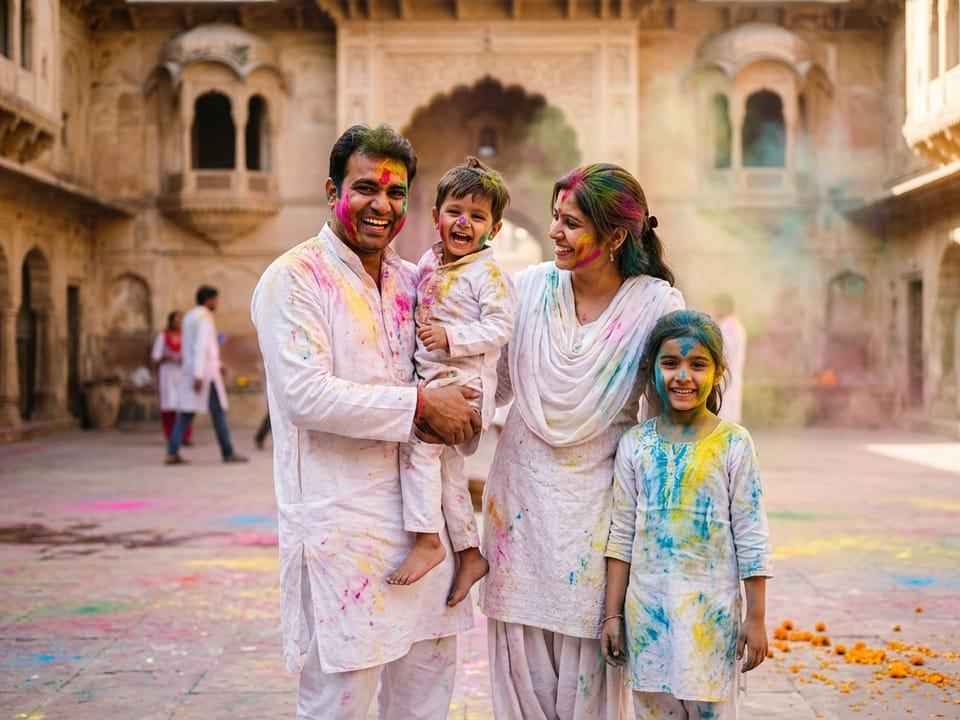
People wear white on Holi because colour shows up best on it. Watching a crisp white kurta or T-shirt turn blotchy with pink, yellow and green is half the fun of the festival. The catch is that clothes rarely come back once the colour is in. Choose everyone's outfit on the assumption that this is its last outing, and put together combinations that won't cause trouble when wet or stained. That is the secret to a relaxed day.
White is for watching the colours build up
A travel company in India also recommends white T-shirts for Holi. For a more Indian look, men and boys can wear a white kurta (a loose, longish tunic) with white pyjamas (loose trousers), and women and girls a white salwar kameez (tunic and trousers) with a light scarf. When the whole family wears white, the photos after the colour goes on look like they belong together.
There is no rule that it has to be white. Some people wear pastel yellow or pale blue kurtas, and an ordinary white T-shirt with cotton trousers works fine. What matters is a pale colour that acts as a canvas for the colour. On dark clothes the powder barely shows, and in photos it's hard to tell what day it was.
If you are celebrating outside India, a plain white T-shirt with white or beige cotton trousers is all you need. For children, choose clothes with a little room rather than a snug fit: it's easier to add a layer underneath, and they cling less once soaked. If you are buying a new kurta, check that the sleeves and hem aren't too long. A long, wet hem wraps around the legs, and for a child running around, that's a fall waiting to happen.
Cotton, long sleeves and long trousers
Cotton, which soaks up sweat well, is the best fabric. Holi falls as winter turns to spring, and over the day you'll be drenched with coloured water and dry off again many times. Heavy fabrics and too many layers get weighty when wet and make it hard to move.
Longer sleeves and trouser legs mean less colour lands directly on skin, which means less washing afterwards. With a short-sleeved T-shirt, a thin long-sleeved layer underneath is one option.
Just as important: white clothes go see-through when wet. Assume you'll be soaked by coloured water and water balloons, and have women and girls wear a camisole or sports bra underneath. A thin white T-shirt on its own is more see-through than you'd expect on boys too, so an undershirt helps. Underlayers close to skin tone, like beige, show less than white ones when wet.
Shoes: disposable, non-slip, and staying on
Footwear causes more trouble than clothes. Outlook Traveller's guide to Holi in the Braj region advises wearing sturdy shoes, because colour and water make the streets slippery.
Sandals and thin-soled shoes slip on wet stone paving, and in crowds they can get trodden on and pulled off. Give children trainers with a closed heel. Colour soaks in, so pick a pair you were about to replace rather than new ones. Socks should be white or pale ones you don't mind throwing away.
Children's hair, nails and glasses, and what babies wear
Powder gets into hair and under nails as well as onto clothes. Ten minutes before you leave makes a big difference to the clean-up.
Tie long hair back firmly and add a cap or bandana. A thin layer of coconut oil or similar on hair and on exposed skin such as the face and arms keeps colour from sitting directly on the skin and makes it easier to wash off later. Simply trimming nails short stops colour from lodging underneath them.
For children who wear glasses, powder and coloured water on the lenses make it hard to see. Use an old spare pair if you have one. Some families use sunglasses or swimming goggles to protect eyes. Adults and older children who wear contact lenses should bring spare glasses, so they can take the lenses out and rinse their eyes straight away if powder gets in. Leave watches, rings and earrings at home, since powder works into every gap. For choosing the powder itself, see Choosing safe Holi colours for children.
If you bring a baby, the starting point is that the baby doesn't take part in the colour play. Even so, if the adult carrying them gets doused, it transfers to the baby's clothes. Dress them in a long-sleeved, full-length romper and a light hat to keep as little skin showing as possible. Even if the rest of the family is in white, a pale colour that hides stains is less stressful for a baby. Colour gets on baby carriers too, so use an old one or one that washes easily.
What to bring, and what happens to the clothes afterwards
You don't need to carry much for a family outing:
- A full change of clothes for everyone (so you don't stain the car or taxi on the way home), packed in a large plastic bag
- A few old towels and an old sheet to sit or stand on
- Your phone in a waterproof case, plus a zip-lock bag for coins and keys
- Drinking water
Plan your change of clothes together with how you'll get the colour off. Whether you shower as soon as you get home or brush off the powder outside first changes how many towels you need. For the full routine, see Removing Holi colour.
As a local travel company's guide points out, Holi colour rarely comes out in the wash. Always wash coloured clothes separately so the dye doesn't run into other laundry. Once a few washes have left only a faint tint, the clothes can be reused for next year's Holi or as gardening clothes. If a child says they want to keep an outfit, you can put it away in a bag unwashed. Every year's stains are different, so a few of them together bring back each year's Holi, along with how much the child has grown.
Get the "last outing" whites and throwaway shoes ready for everyone
Dressing for Holi comes down to three decisions: white cotton you're happy to retire, an extra layer so wet clothes don't turn see-through, and old shoes that don't slip. Once those are settled, all that's left is enjoying the colour. For the bigger picture of the festival, see Holi in India.
When and how to photograph the family in white is covered separately in Holi family photos. In a year when the family can't all be together, pokesta can create a family photo of everyone in white kurtas with AI, from each person's own phone photos ($1 per photo, the first one free).
References