
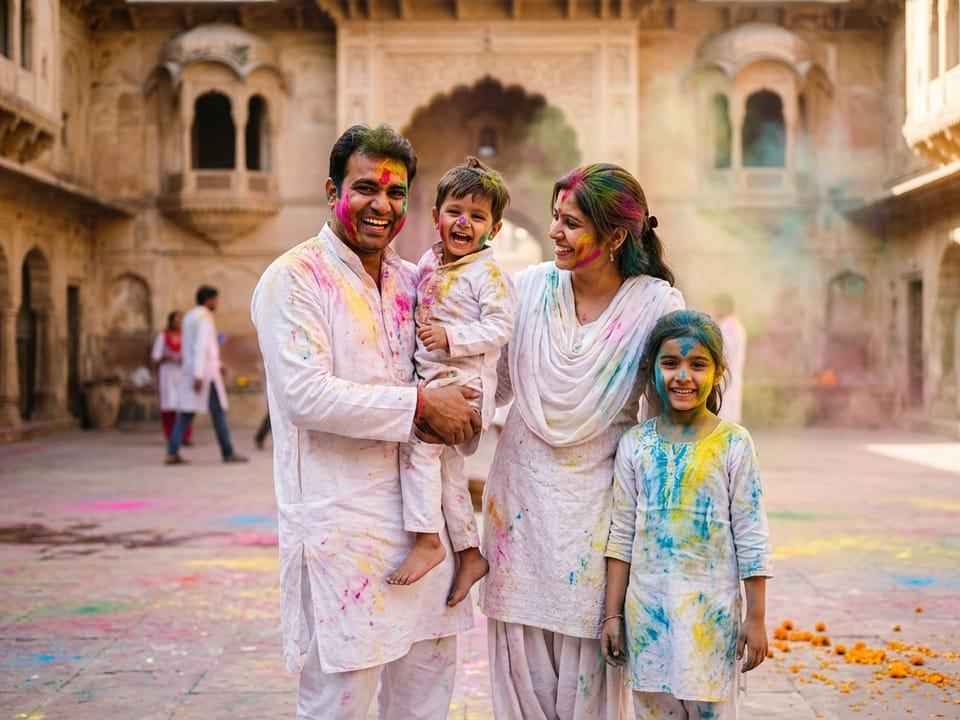
"Holi" covers a lot of ground. In some towns it's a single day of throwing colour; in others, temple after temple holds its own events over more than a week. Some places welcome spring with songs and dance, and at one festival martial skills take centre stage rather than colour. If you're travelling as a family, it helps to sort each celebration into "one to watch" or "one to join in". That makes it much easier to decide where to go and how to spend the day.
Braj: nearly ten days of events, different in every town
The Braj region, which takes in Mathura and Vrindavan, both tied to the life of Krishna, and Barsana, said to be Radha's home, celebrates Holi for longer and more loudly than anywhere else. The 2026 schedule compiled by the travel magazine Outlook Traveller shows how it unfolds.
On 24 February came Laddu Holi at the Radha Rani Temple in Barsana, where priests shower devotees with laddus, round sweets, from the temple balcony. Barsana's Lathmar Holi followed on the 25th, and on the 26th Lathmar Holi moved to the Nand Bhawan Temple in the neighbouring town of Nandgaon. On the 27th the Banke Bihari Temple in Vrindavan held Phoolon Wali Holi, where priests shower devotees with flower petals instead of coloured powder. Holika Dahan was on the evening of 3 March, the main day of colours on the 4th, and on the 5th came the Huranga at the Dauji Temple in Baldeo, about 30 km from Mathura. The dates move every year with the calendar.
Lathmar Holi, "Holi of sticks", re-enacts a story, according to Wikipedia, in which Krishna came from Nandgaon with his friends to throw colour on Radha and her companions in Barsana and was chased away with sticks. Each year men from Nandgaon visit Barsana, and the women greet them with colour and sticks (lathis). The men shield themselves and take this "welcome" in their stride.
It's thrilling to watch, but it is a ritual handed down by the people who live there. Visitors should not think of stepping into the circle of sticks. Outlook Traveller warns that the road to Barsana is narrow and jams quickly, so you end up parking far from the temple. With children, the comfortable way to take part is to watch temple events such as Laddu Holi, or flower Holi from a little distance. The guide also says photography inside the Banke Bihari Temple is often restricted, and that entry may be stopped when it gets too crowded.
West Bengal: Dol Purnima at the full moon, and Basanta Utsav in song
In Bengal, the festival that corresponds to Holi is called Dol Jatra or Dol Purnima. According to Wikipedia, images of Radha and Krishna, smeared with coloured powder, are carried in procession in a swinging palanquin decorated with flowers (dol means swing); it is celebrated on the full moon of Phalguna. For Gaudiya Vaishnavas, the branch of Vaishnavism that grew up in Bengal, it is also the birthday of their founder, Chaitanya.
At this time of year Santiniketan holds Basanta Utsav, the spring festival. The poet Rabindranath Tagore nurtured the festival, and it is said to have continued since 1923. It began as a procession around the place of learning while singing songs of spring. Instead of the frenzy of colour-throwing, it has the gentler mood of welcoming the season with song and dance, which makes it a good one to watch with children. Large crowds gather, though, so check that year's announcements on how the public can take part before you go.