
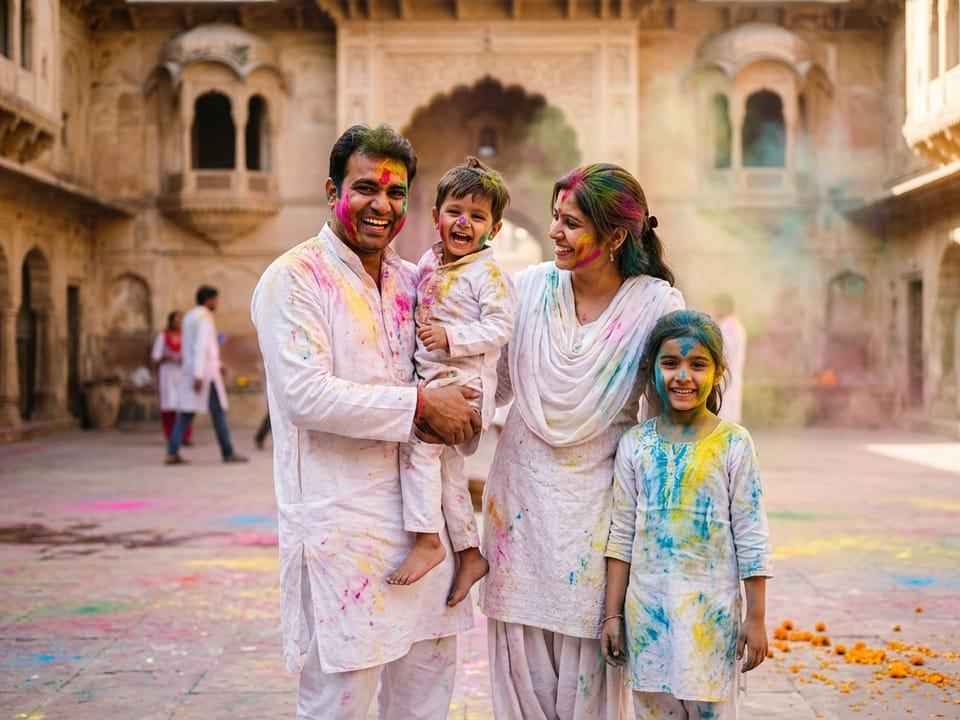
On most calendars, Holi 2027 falls on Monday 22 March, the day of colours (Rangwali Holi), with Holika Dahan, the bonfire the night before, on the evening of Sunday 21 March. Holi follows Purnima, the full moon of the Hindu month of Phalguna, and in 2027 that full moon lasts from around sunset on the 21st until late afternoon on the 22nd. The Government of India's 2027 holiday list, however, puts the Holi holiday on Tuesday 23 March. Neither is a mistake: the full moon straddles two days, and different ways of counting it give different dates.
2027: the night of the 21st and the 22nd, with the government holiday on the 23rd
Drik Panchang, a widely used Hindu calendar site, gives Holika Dahan 2027 for New Delhi as Sunday 21 March, with the auspicious window for lighting the fire from 6:33 p.m. to 8:55 p.m. The colour day, called Rangwali Holi or Dhulandi, falls the next day, Monday 22 March.
The 2027 list of central government holidays, issued in July 2026 by India's Department of Personnel and Training, tells a different story. For central government offices in Delhi it shows "Holi, 23 March (Tuesday)". The restricted-holiday list in the same order, from which staff can choose days off, puts Holika Dahan and Dol Yatra (the full-moon festival celebrated in Bengal and elsewhere) on the 22nd. That whole set sits a full day later than most calendars.
Whether schools and workplaces close depends further on each state's holiday list and on the employer. If you are choosing a day for your family to go out and play with colours, check both the calendar date and the local holidays where you are.
The full moon of Phalguna sets the date
Because the Indian calendar counts days by the phases of the moon, the Phalguna full moon moves around on the Gregorian calendar. It usually lands in March, occasionally at the end of February. In 2026, Holika Dahan was on the evening of 3 March and the colours on the 4th.
A calendar "full moon day" does not switch over at midnight. It is counted in tithis, lunar days calculated from the positions of the sun and moon, and their start and end times change every year. In 2027 the full-moon tithi begins at 6:21 p.m. Indian Standard Time on 21 March and ends at 4:13 p.m. on the 22nd.
According to Drik Panchang, the rule is that Holika Dahan takes place during Pradosh, the period after sunset, while the full-moon tithi is in force. It should also avoid Bhadra, a span considered inauspicious. In 2027 the full moon starts almost exactly at sunset on the 21st, and Bhadra falls in the small hours of the 22nd, so the bonfire is on the night of the 21st and the colours follow the next morning.
But the 22nd lies entirely inside the full-moon tithi, from sunrise to late afternoon. In years when the full moon spans two days, people reach different conclusions about which evening should have the bonfire and which morning should have the colours, and 2027 is exactly that kind of year. If a calendar site and the holiday list disagree, there is no need to decide that one is wrong. Just find out which day the gathering you plan to join is actually being held.