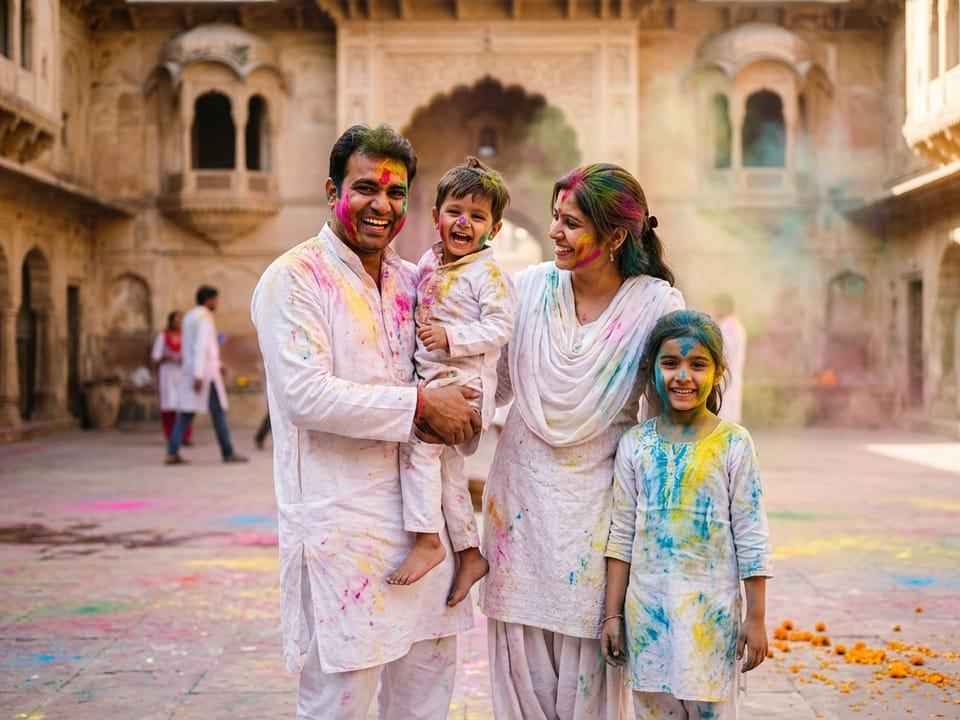
The first things that come to mind on a Holi table are gujiya, a fried half-moon pastry, and thandai, a cold milk drink full of nuts and spices. Incredible India, the Indian government's tourism site, also names malpua, pancakes dipped in syrup; dahi vada, lentil fritters soaked in yoghurt; and ghevar, a disc-shaped sweet, as the tastes of Holi. If you're cooking at home, do the gujiya and the soaking the night before, the thandai and dahi vada on the morning, and the malpua once you're back from the colours. In a house with children, the most important thing of all is making sure nobody mixes up the drinks with the adults-only bhang thandai.
Gujiya: a sweet the family folds together the day before
Gujiya is a pastry of semolina (suji) and all-purpose flour (maida) wrapped around a sweet filling, shaped into a half moon and fried in ghee (clarified butter). According to Wikipedia, the filling is khoa, also called mawa, which is milk cooked down to solids, mixed with powdered sugar, coconut and dried fruit such as raisins, plus nuts like almonds, walnuts, cashews and pistachios. It is especially popular in Uttar Pradesh, Rajasthan, Gujarat and the Bihar and Bhojpuri regions, and it is made for Holi as well as for Diwali and Chhath. The earliest mention goes back to the 13th century, when a mixture of jaggery and honey was covered in wheat flour and dried in the sun.
The name and shape change with the region. It is karanji in Maharashtra, ghughra in Gujarat, pedakiya in Bihar, nevri in Goa, kajjikayalu in Andhra Pradesh and karjikayi in Karnataka, while Tamil Nadu has the half-moon chandrakala and the round suryakala. Bihar's pedakiya comes with two fillings: semolina roasted in ghee with sugar, almonds, cardamom and raisins, or khoa mixed with nuts and sugar. Even within India, the shape of "our gujiya" depends on where the family comes from, which is a good conversation starter.
The work splits into four steps: making the filling, rolling the dough, filling and folding, and frying. If children are helping, folding suits them best. Pleating and sealing the edge of the dough is something small hands pick up quickly, and even a slightly lopsided gujiya turns into a proper sweet once it's fried.
Frying is an adult job. Hot oil is dangerous even for a child just watching nearby, so make it a rule that once the folding is done, children leave the kitchen.
Malpua and dahi vada change name and method from region to region
Malpua is a sweet pancake fried in oil and soaked in syrup. In North India, a batter of maida or semolina with milk or yoghurt is left to rest for a few hours, then spooned into hot oil to fry into a round that should be crisp at the edges, and soaked in thick sugar syrup. In Bihar, sugar goes into the batter before frying; in Odisha, the fritters are dipped in syrup after frying. In the Bhojpuri region, non-vegetarian households may serve malpua with mutton curry at Holi, and the Madheshi people of Nepal make it for Holi too. It is also a favourite for iftar, the evening meal that breaks the fast during Ramadan.
Dahi vada starts with washed urad lentils, soaked overnight and ground into a batter. The fried dumplings are dipped briefly in water, then moved into thick beaten yoghurt and left to soak before serving, topped with coriander or mint, chilli powder, chaat masala, cumin and tamarind chutney. In Maharashtra and Gujarat the yoghurt is often sweeter. The name shifts with the language: dahi bhalla in Punjabi, doi bora in Bengali, dahi bara in Odia, thayir vadai in Tamil. A recipe for it already appears in the Manasollasa, a 12th-century Sanskrit encyclopedia.
In Maharashtra and South India, the Holi sweet may well be puran poli instead: a sweet flatbread with a filling of chana dal and jaggery scented with nutmeg and cardamom, wrapped in wheat dough, rolled out and cooked on a hot griddle, usually with ghee. It is also made for Gudhi Padwa and Ganesh Chaturthi. In some places the sweets are the event itself, as at Barsana in the Braj region, where laddus are showered on the crowd from a temple balcony (see how Holi differs across India).
Thandai: cold milk with nuts and spices
Thandai is a cold drink of ground almonds, fennel seeds, watermelon seeds, rose petals, black pepper, poppy seeds, cardamom and saffron, mixed with milk and sugar. Wikipedia calls it the drink at the centre of Holi, served alongside dahi vada, gujiya and savoury chaat. In the Hindu and Sikh culture of North India it is tied to Holi and to Hola Mohalla, a Sikh festival, and it is particularly popular in Punjab and Haryana.
To make it at home, soak the nuts and spices in water the night before, grind them in the morning, thin with milk and chill well. After working up a sweat with the colours, it's a glass children love too.
Bhang thandai is a drink for adults
This is the part everyone needs to know: bhang thandai. Bhang is a traditional Indian preparation made from the leaves of the cannabis plant. According to Wikipedia, it is traditionally handed out and consumed around Maha Shivaratri and Holi. It is consumed in especially large quantities in Mathura, where it turns up as bhang thandai and as bhang lassi, made with curd. Because bhang is prepared from the leaves and seeds of the plant, it is not banned under India's NDPS Act of 1985, but some states regulate or ban its sale and consumption.
Bhang thandai looks and smells almost exactly like ordinary thandai. It contains THC and other cannabinoids, so it is intoxicating, and Wikipedia's thandai article notes that whole milk and ground nuts are often used because their fat helps dissolve these fat-soluble compounds. In other words, the very ingredients of ordinary thandai help carry the bhang. Bhang goli, taken as pills, is said to take around two hours to take effect, so people may keep drinking because they still feel fine. Outlook Traveller warns that several glasses can quickly derail your plans.
Make a firm rule that children drink no thandai except what was made at home. If it's served at a relative's house or a gathering, an adult should check whether it contains bhang before handing it over. If you live outside India, food containing cannabis may be strictly prohibited where you live, so adults who tried it on a trip should not think of bringing any home.
Ask about nuts first, and break the gujiya small
Both gujiya and thandai use plenty of nuts. If a child has a nut allergy, you can leave the nuts out of the filling and use only coconut and khoa, or make thandai with just spices and milk. At family gatherings, tell children to ask whether something has nuts before eating it.
Mind the size of the gujiya for small children, too. A fried pastry with pieces of nut and raisins is easy for a young child to choke on. Break it into small pieces and have them sit down to eat.
During the colour play, hands are covered in powder, so wash them, or at least wipe them with a damp towel, before eating. For small children, a proper meal before the colours start means fewer meltdowns from hunger halfway through. For organising the colour play itself, see Holi with kids.
Split the kitchen into three: the night before, the morning, after the colours
The night before is also the night of Holika Dahan, the bonfire on the eve of the colours (in 2027, the evening of 21 March; see when Holi 2027 falls for how the date is set). Before or after the bonfire, cook down the gujiya filling, fold and fry. This is also the night to put the thandai nuts and spices and the urad lentils for dahi vada in water. If you're marking the eve at home instead of at a bonfire, celebrating Holi at home has ideas.
In the morning, grind the thandai, thin it with milk and put it in the fridge. Fry the dahi vada dumplings and set them in the yoghurt to chill before you go out, and they'll have soaked up the flavour by the time you're back. Malpua is best straight from the oil, so make it after you've come home and washed off the colour. Splitting the work this way keeps whoever is in the kitchen from being busy all day.
Hands folding gujiya together the night before make a picture that is very much your family's own, quite apart from the colour-covered shots. Stand under the brightest light in the kitchen and shoot from directly above: floury hands and a row of gujiya. A grandmother's hands and a grandchild's on the same piece of dough is the kind of picture you'll want to look at for years. In a year when someone is far away and can't share the meal, pokesta can create a Holi family photo with AI, from each person's own phone photos ($1 per photo, the first one free).
References