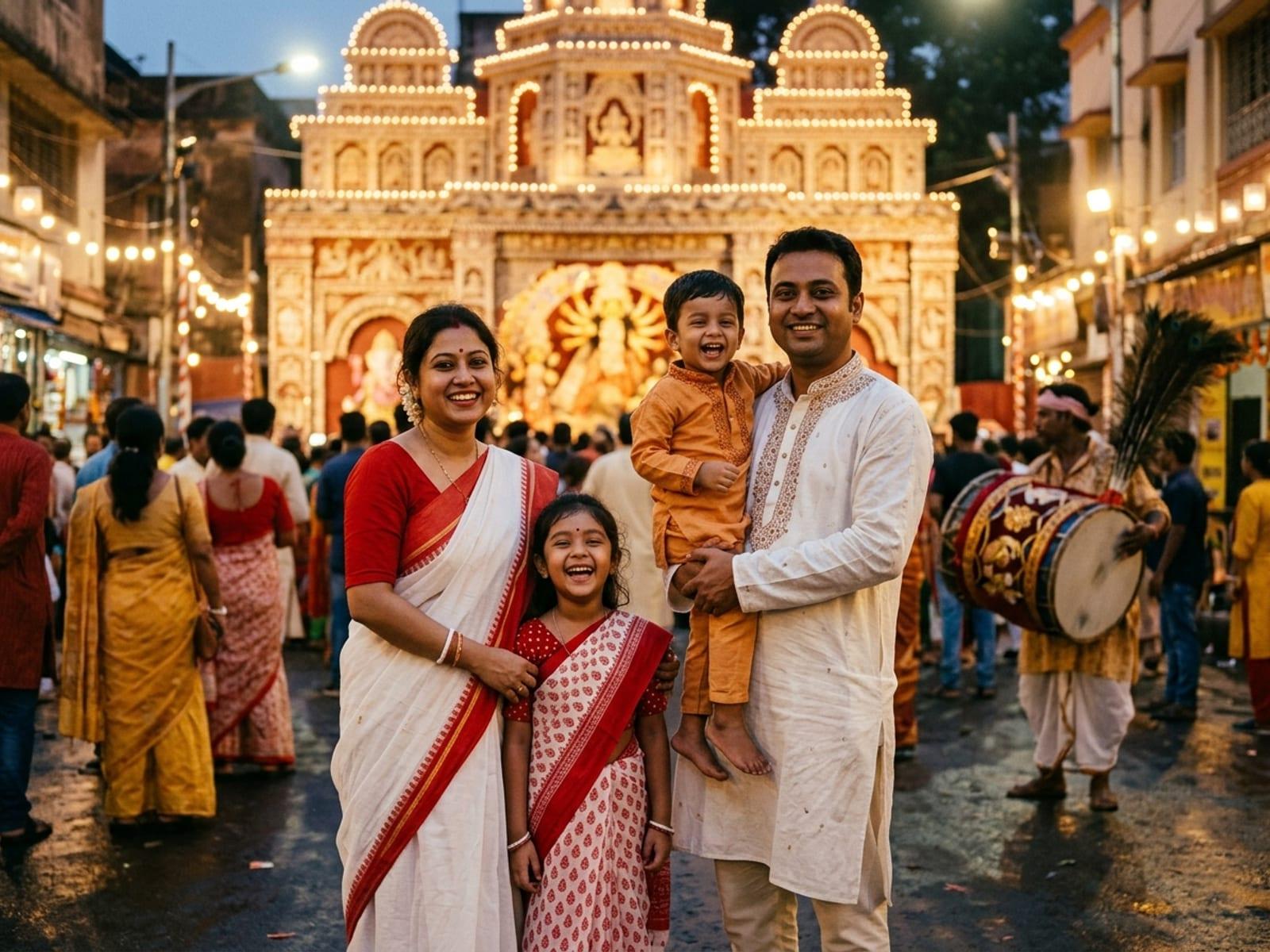
For a stretch of days in September or October, Kolkata, the big city of eastern India, stays up all night as people head out to see the temporary shrines called pandals that spring up all over town, each one housing an image of the goddess Durga. This is Durga Puja, the biggest festival in Bengal, and in 2021 "Durga Puja in Kolkata" was inscribed on UNESCO's list of Intangible Cultural Heritage. Walking from one lit-up pandal to the next late into the night is how the festival is enjoyed, but the crowds are on a different scale altogether, so with children you'll need to think carefully about when you go and how you get around.
Ten days celebrating a goddess's victory over a demon
Durga Puja is a Hindu festival celebrating the victory of the goddess Durga over Mahishasura, a demon who took the form of a buffalo. It's celebrated widely in eastern India, Bangladesh, Nepal and elsewhere, and for Bengalis it's the biggest festival of the year.
The date follows the Hindu lunisolar calendar and falls in the month of Ashvin, roughly September to October. It moves every year, so always check that year's calendar when planning. The festival lasts ten days and opens with Mahalaya, which is also a day for making offerings to ancestors. The heart of the festival is the last five days: Shashthi (day six), Saptami (day seven), Ashtami (day eight), Navami (day nine) and Vijaya Dashami (day ten).
According to UNESCO, the eyes of the clay images are painted in on Mahalaya, and this is when the goddess is believed to enter the image. At the moment Ashtami turns into Navami, the Sandhi Puja is performed with offerings of 108 lotus flowers and 108 lamps. It's one of the most important rites of the festival, and many people time their pandal visits to catch it. On the last day the images are carried to the river and immersed. UNESCO describes the image's return to the river as a symbol of returning to one's roots each season. It's also the time when married daughters come home to their parents, so the festival has the feel of a seasonal family gathering too.
Goddesses made from river clay
Durga images are built over months from clay taken from the Ganges. The neighborhood best known for image makers is Kumartuli in north Kolkata, on the banks of the Hooghly, a distributary of the Ganges. It began as a potters' quarter, where craftsmen made pots from river clay to sell at market. Over time they started making images of gods for wealthy households and community pujas, and today they ship images abroad too.
Walk its narrow lanes in the weeks before the festival and you'll pass rows of half-finished images: straw frames, layers of clay, paint going on. It's a stage you never see once they've been carried off to the pandals. These are working studios, so when you visit, don't block the lanes, don't touch the images, and ask before taking photos.
Pandal-hopping is the main event
During the festival, Kolkata holds countless pujas, neighborhood by neighborhood. In 2022 there were said to be around 3,000 baroari pujas alone, the ones organized by local residents. Pandals are temporary structures of bamboo and cloth, but many are works of art in their own right: copies of famous buildings, or themes drawn from traditional crafts or current events. UNESCO itself points to the large installations by artists and designers as a feature of the festival.
People spend the evenings pandal-hopping, going from one to the next. At night the lights come on, and at some pandals the dhak drums start up and people begin the dhunuchi naach, a dance with smoking incense burners. UNESCO notes that during the festival the boundaries of class, religion and ethnicity largely dissolve. Between pandals, sweet shops stocked for the festival are a good place to rest over rosogolla, sandesh and Kolkata's other mishti.
If you'd like something more traditional, don't skip the pujas that old families have kept up in their own homes. The Sabarna Roy Choudhury family in Barisha is said to have held theirs since 1610, and the puja at Shobhabazar Rajbari reportedly began in 1757. Some of these family pujas are far older than the community ones, the first of which dates to 1910.
On Vijaya Dashami, the last day, married women offer vermilion sindoor to the goddess and smear it on each other's faces in sindoor khela. Afterward the images are carried to the river and returned to the water. Since 2016, a carnival on Red Road has brought together images from famous pujas.
A festival for new clothes
Durga Puja is a festival you dress up for in new clothes. Women often wear saris, and men wear the long panjabi shirt with trousers or a dhoti. Visitors don't need to match, but Kolkata's markets sell these clothes, including children's sizes, so trying them on is part of the fun.
Comfortable shoes are a must. Visiting several pandals in one night adds up to a lot of walking. Pandals are places of worship, so avoid showing too much shoulder or knee, and take your shoes off if asked.
With kids, go early in the evening or in daylight
The crowds are bigger than you can picture. In a year when a giant goddess image went viral, one pandal was estimated to draw around a million visitors, and some pandals had to close temporarily when people surged in. With small children, skip the packed nights of Ashtami and Navami. The quieter days after Mahalaya, or daylight hours, let you look around in peace.
Pick three or four pandals close to each other and leave it at that. If you go out at night, put your contact details in your child's pocket in case you get separated, and agree on a meeting point. The dhak drums are very loud, so ear defenders help children who are sensitive to noise. You can also try pokesta's AI photos ($1 per photo) to see what a family photo in front of a lit-up pandal might look like.
When to go and how to get there
The festival falls between late September and October, and the dates change each year. The gateway is Netaji Subhas Chandra Bose International Airport (CCU) in Kolkata. Traffic in the city is extremely heavy during the festival, and cars can grind to a halt near popular pandals, so the metro is the practical way to get around. Hotels fill up early, so book as soon as your dates are set. India's entry requirements vary by nationality, so check your own government's official information.
Diwali, celebrated across India in the same season, comes a few weeks after Durga Puja, so you can plan a trip that takes in both festivals. Head north and the Darjeeling tea gardens, in the same state of West Bengal, are in their autumn-flush season in October and November.
References