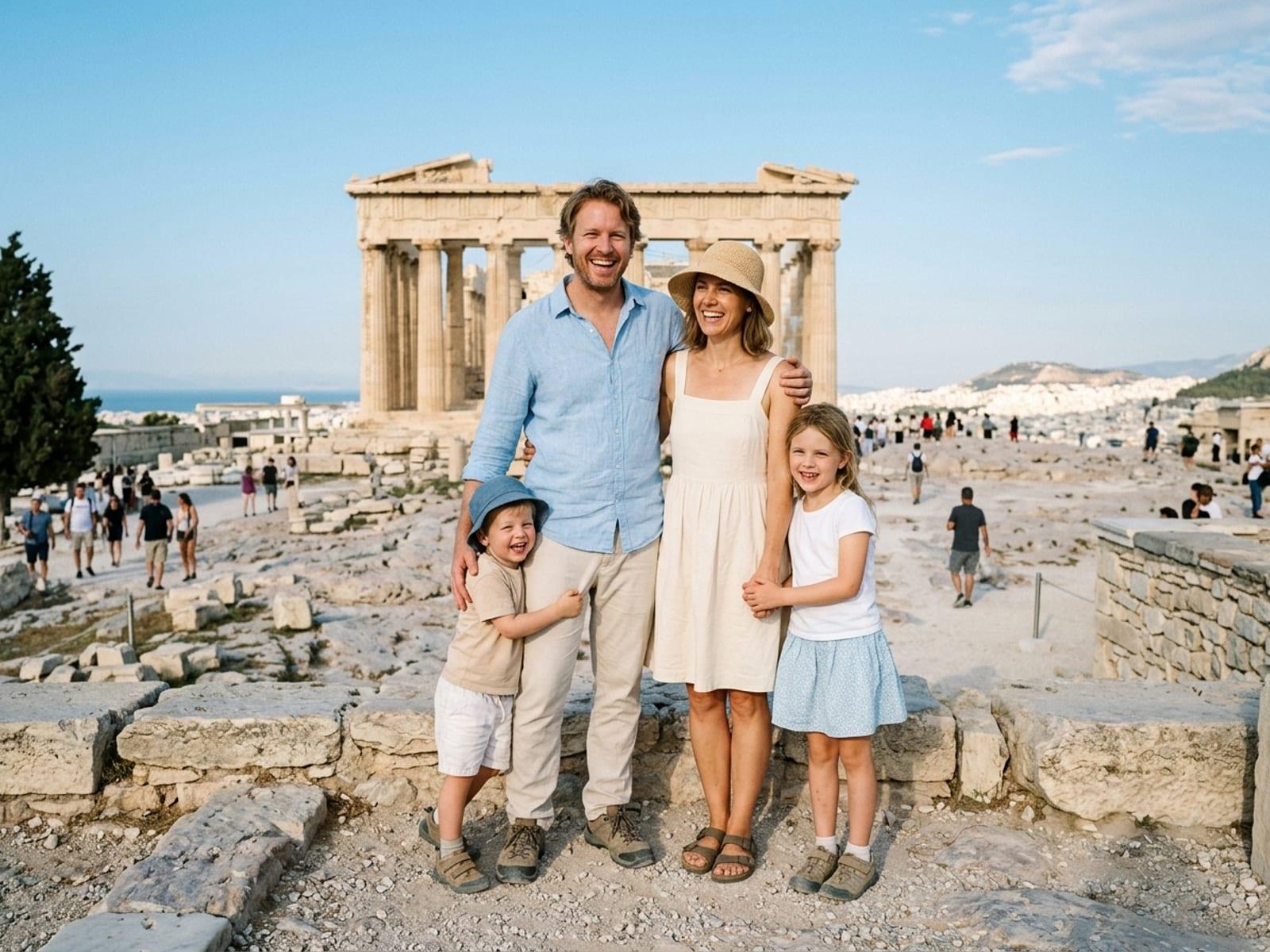
From almost anywhere in Athens you can look up and see the Parthenon on its rocky hill. The Acropolis, inscribed as a UNESCO World Heritage Site in 1987, is the defining monument of ancient Greece. At its foot is the Acropolis Museum, home to the sculptures found on the hill. With children, the least stressful plan is to climb the hill in the cool of the morning and spend the hours of strong sun inside the museum. The two need separate tickets, which is worth sorting out in advance.
A temple on a rock 150 meters above the sea
The Acropolis is a flat-topped rock about 150 meters above sea level, with a summit area of roughly 3 hectares. Most of the buildings you see today were built in the 5th century BC, during Athens' golden age, under the statesman Pericles.
The first thing you pass through on the way up is the Propylaea, the monumental gateway. Beyond it stands the Parthenon, the temple of the goddess Athena. To the north is the Erechtheion, and on its southwest porch stand the Caryatids, statues of women that hold up the roof in place of columns. The small temple on the bastion just before the gateway is the Temple of Athena Nike, dedicated to the goddess of victory. On the southern slope are the remains of the Theatre of Dionysus.
Children tend to get interested when you tell them what a place was for before you tell them its name. The hilltop was a sanctuary for the gods, and the Parthenon was a temple for Athena, the goddess who protected the city, for example. From the top you can see the white city spreading out below, all the way to distant mountains and the sea.
Climb the hill in the morning
There's almost no shade on the Acropolis. In summer you'll be walking with nothing between you and the sun, so with children it's best to go up in the morning, as the gates open. Don't go without wide-brimmed hats, sunscreen and a bottle of water per person. The paths over the rock and the marble steps have been worn smooth over the centuries and are slippery in places. Put children in sneakers with non-slip soles and hold small children's hands.
Getting a stroller to the top is hard work. The slopes and steps keep coming, so a baby carrier is easier for babies.
The Acropolis requires its own ticket, separate from the museum's. Prices, the conditions for free or reduced entry for children and young people, and the way you get in have changed several times, so check the Greek Ministry of Culture's official information and the e-ticket service before you go, and book early. Conditions depend on age and nationality, so bring passports for the children too.
At the museum, an ancient neighborhood under your feet
The Acropolis Museum opened on June 20, 2009. It was designed by the architect Bernard Tschumi in collaboration with the Greek architect Michael Photiadis. It stands about 300 meters from the Parthenon, so you can walk straight down from the hill.
The first thing that surprises children at the museum is the floor. Parts of it are glass, and beneath your feet you can see the excavated remains of a neighborhood of ancient Athens. The excavation has been open to the public since 2019, and your museum ticket lets you walk around it at the lower level, reached from the courtyard in front of the entrance.
The exhibition begins with finds from the slopes of the Acropolis, displayed in a long gallery that rises gently like a ramp. Next is a large gallery of Archaic sculpture, where you'll also find sculptures from the Erechtheion, the Temple of Athena Nike and the Propylaea. The top floor is the Parthenon Gallery. This floor alone is turned at a slight angle to the floors below, so that it lines up with the Parthenon on the hill. Forty-eight columns trace the outline of the temple, and through the glass walls you can see the real Parthenon. In all, more than 4,250 objects are on display.
Family loans and places to rest
The Acropolis Museum is very well set up for families. According to its website, you can borrow a family backpack and pick up family trail guides free of charge at the Visitor Services Desk, and the family audio guide is free too. Strollers can be borrowed from the cloakroom on the ground floor, and there's a baby room on the first floor. Next to the restaurant on the second floor is a Kids Corner with digital games. Children's workshops are held at certain times of year.
The galleries are air-conditioned, which makes them a good place to spend the hottest part of the day. Coming down from the hill, take a break at the museum café first and then see the exhibits, and the children won't wear themselves out. If you'd rather eat lunch outside, souvlaki and gyros, wrapped in pita and eaten with one hand, are sold on street corners all over the historic center.
Prices, hours and getting there (as of October 2026)
Admission to the Acropolis Museum is €20 general and €10 reduced. According to the official site, children and young people up to 25 from EU countries enter free with ID, children up to 5 from non-EU countries are free, and children and young people up to 25 from non-EU countries pay the reduced price. Reduced and free tickets can only be collected at the museum's ticket desk.
In summer (April 1 to October 31) the museum is open Monday 9 a.m.–5 p.m. and Tuesday to Sunday 9 a.m.–8 p.m., with Friday until 10 p.m. In winter (November 1 to March 31) it's open Monday to Thursday 9 a.m.–5 p.m., Friday 9 a.m.–10 p.m., and Saturday and Sunday 9 a.m.–8 p.m. Last entry is 30 minutes before closing. It's closed on January 1, Orthodox Easter Sunday, May 1, and December 25 and 26. Prices and hours can change, so check the official site for the latest.
Because it's open until 10 p.m. on Fridays, in the hot months you can rest at your hotel at midday and head to the museum once the sun is lower. On Friday and Saturday nights the restaurant stays open until midnight, and dinner looking up at the Acropolis is something you can only do here. With young children, though, bedtime suggests wrapping up on the early side. Note also that museum tickets are valid only on the date they're issued and can be used once.
The nearest station is Akropoli on Metro Line 2. From Athens International Airport (ATH), take Metro Line 3 from the station next to the airport into the city and change to Line 2 at Syntagma. If you have a few days in Athens, spend another morning at the fish and produce halls of Varvakios Central Market for a look at how the city lives today. Aiolou Street, a short walk from the market, has a café that has been frying loukoumades since 1923, handy for a treat after you come down from the hill.
Curious how a family photo in front of the Parthenon in the morning light would turn out? pokesta's AI photos ($1 per photo, first one free) let you see before you go. Entry requirements for Greece depend on your nationality, so check your own government's official information before you travel.
References