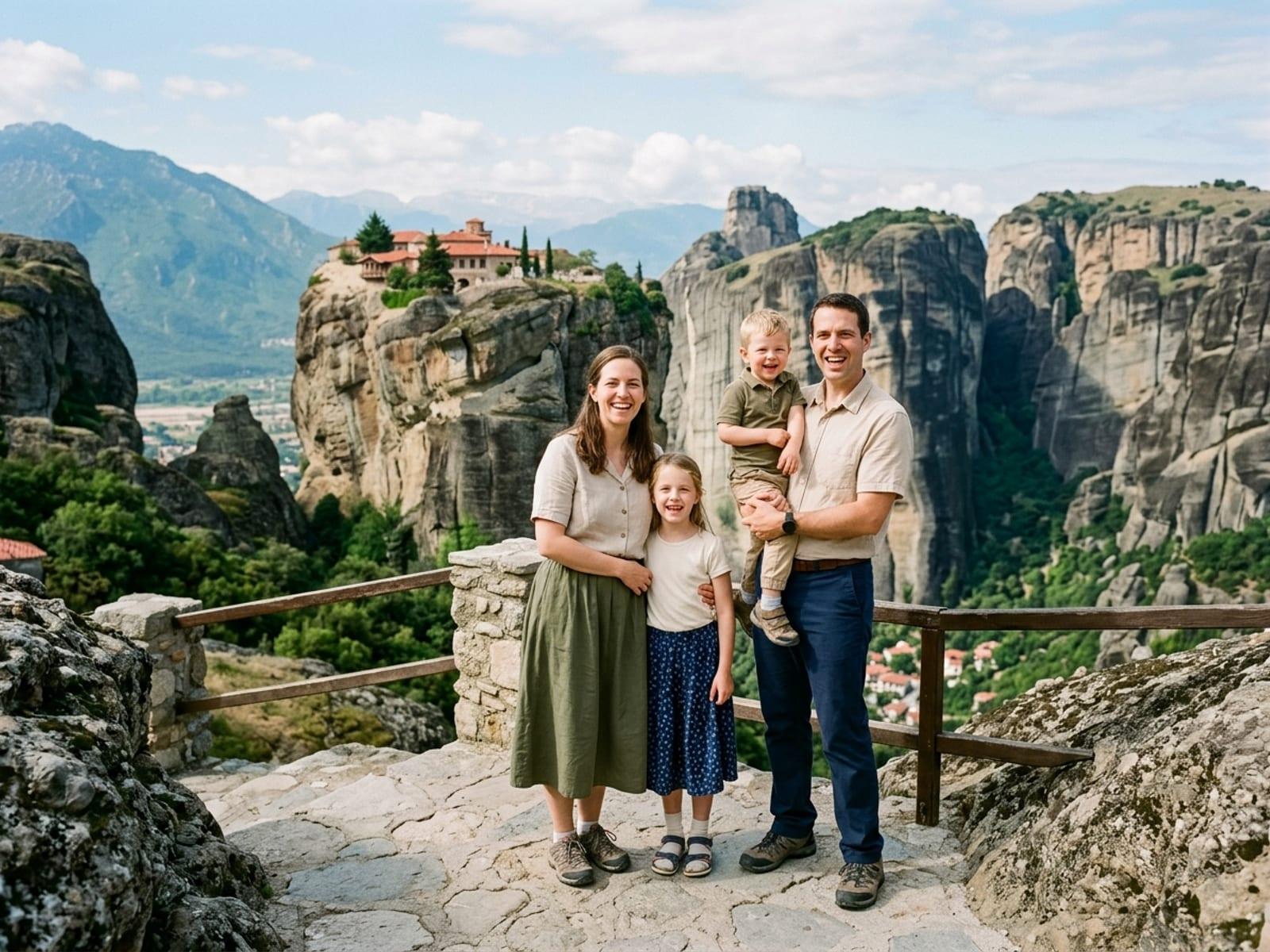
Huge gray pillars of rock rise out of a green valley, and on their summits sit monasteries with red-tiled roofs. Meteora, in the Thessaly region of central Greece, was inscribed as a UNESCO World Heritage Site in 1988 for this landscape of rock and monastery. Monks and nuns still live lives of prayer here, so visitors must follow a dress code, and each monastery closes on different days of the week. If you're going with children, check those two things first and plan the day around them.
Monasteries reached by nets and ladders
Meteora's rock pillars are made mainly of sandstone and conglomerate, weathered over a very long time along vertical faults into the shapes you see now. Roussanou monastery, for example, sits on a rock 484 meters above sea level.
From around the 9th century, hermit monks settled in the cracks and caves of these rocks, and monks are known to have been living in caves here in the 11th century. Monasteries began to be built on top of the rocks in the 14th century. The largest, the Great Meteoron, was founded by the monk Athanasios between 1356 and 1372.
Back then, the only ways up were ladders and nets or baskets hung from ropes. People and supplies alike were hauled up in nets. Steps weren't cut into the rock until the 1920s. If you're telling children about the place, the story of riding up in a net is the one they'll love.
At their peak in the 16th century there were 24 monasteries; six remain today: Great Meteoron, Varlaam, Roussanou, Agia Triada (Holy Trinity), Agios Stefanos (St. Stephen's) and Agios Nikolaos Anapafsas. Agios Stefanos has been a convent for nuns since 1961.
The dress code applies to children too
You need to be dressed appropriately to go inside the monasteries. Women wear skirts that reach below the knee and a top that covers the shoulders; trousers aren't allowed. Men wear long trousers. Sleeveless tops aren't permitted for anyone. Some monasteries lend wrap-around skirts at the entrance, but there can be a wait at busy times, so bringing your own is more reliable.
Children may be held to the same standard as adults, so pack below-the-knee skirts or dresses for girls and long trousers for boys and you won't be caught out at the door. Summers are hot, so long skirts in thin cotton or linen trousers are the comfortable choice. For covering shoulders, one thin cardigan you can throw on is enough.
Before they're tourist sites, the monasteries are places of prayer. Be quiet inside the chapels and follow any rules about photography. Agree with your children before going in that there'll be no shouting or running around, and the adults will be able to look around in peace as well.
Each monastery closes on a different day
Each of the six monasteries closes on one or more days a week, and the days differ from monastery to monastery. In the example summer 2026 timetable published by a local travel company, opening hours run roughly from 9 a.m. to around 4 p.m. Great Meteoron closes on Tuesdays, Varlaam on Fridays, Roussanou on Wednesdays, Agia Triada on Thursdays, Agios Stefanos on Mondays and Agios Nikolaos on Fridays. Agios Stefanos takes a long break at midday. Some monasteries close on more days in winter. Admission is €5 per person at each monastery, paid in cash at the entrance. Timetables and fees can change without notice and also shift around Orthodox holidays, so check the latest information right before you go.
With children, two or three monasteries in a day is a sensible target. The monasteries are linked by road, so you can move between them by car or taxi and stop at viewpoints along the way to take in the rock formations.
With kids, watch the steps and the cliff edges
The walk from the car park to the entrance varies a lot from one monastery to another. At Agia Triada and Agios Nikolaos you climb steep paths and steps. Agios Stefanos is known as one of the easiest to reach from the road. With small children, include one easy-access monastery and the day won't be too much. Strollers are no use on the steps, so bring a baby carrier.
The monasteries and viewpoints sit right beside sheer drops. Keep your eyes on the children and hold their hands so no one steps beyond a railing or leans out. Midday sun in summer is strong and some paths have little shade, so don't forget hats and water.
Getting there and where to stay
The bases for the monasteries are the town of Kalambaka, at the southwest foot of the rocks, and the village of Kastraki on the west side. Kalambaka station is the terminus of a branch line from Palaiofarsalos, a junction where intercity trains on the main Athens–Thessaloniki line stop. Storm damage in 2023 disrupted the branch line, however, and as of December 2025 replacement buses link Kalambaka and Palaiofarsalos. Services change, so check with the Greek rail operator before you set off. The nearest major international airport is Thessaloniki (SKG), and you can also start from Athens International Airport (ATH) and travel on by train, bus or car. That makes it easy to see the Acropolis and its museum in Athens first and then head north. If you come via Thessaloniki, start the day with a slice of fresh-baked bougatsa before you set off.
To be there when the monasteries open in the morning, it's easiest to spend a night in Kalambaka or Kastraki. Looking up at the rock pillars from town in the evening light, after the day-trippers have left, is something only an overnight stay gives you.
Kalambaka itself has a long history. In Byzantine times it was a fortified town called Stagoi and the seat of a bishop. Its cathedral from that period, the Church of the Dormition of the Theotokos, was built in the late 11th or early 12th century on top of an even older late-antique church. The walls of the town's oldest church of the Virgin incorporate stones from an ancient Greek temple. On a day when closures overlap and few monasteries are open, visit the town's churches in the morning and one open monastery in the afternoon, and the children won't get too tired.
You can see how a photo of your family with the rock pillars behind you might turn out with pokesta's AI photos ($1 per photo, first one free). Entry requirements for Greece depend on your nationality, so check your own government's official information before you travel.
References