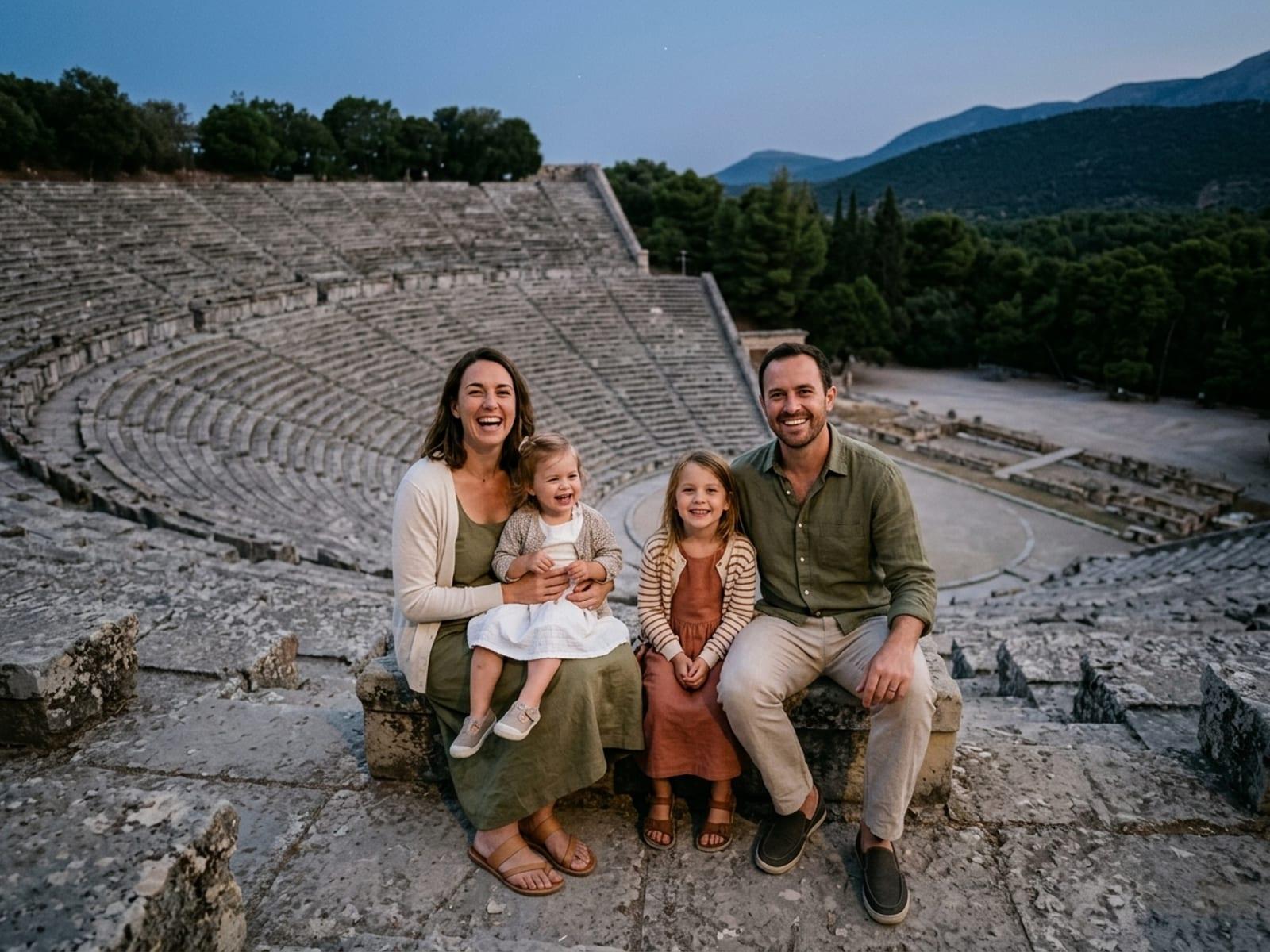
At Epidaurus, in the eastern Peloponnese, there is a stone theatre built in the 4th century BC, and every summer its seats still fill with an audience. As part of the annual Athens Epidaurus Festival, ancient Greek tragedies and comedies are performed there on summer nights. Children under six, however, are not admitted to performances. For a family, the realistic plan is to explore the site by day, then choose between the play and a children's workshop in the evening, depending on ages.
A theatre built for sound, inside a healing sanctuary
The theatre is said to have been designed between about 340 and 300 BC by Polykleitos the Younger, an architect who shared his name with the famous sculptor. The seating is divided into 12 sections in the lower tier and 22 in the upper, and holds roughly 13,000 to 14,000 people. It is often called the most perfect of all ancient Greek theatres for its acoustics and its proportions, and it is famous for the way a small sound made at the center of the stage carries all the way to the top rows.
The theatre stands at the southeastern edge of the sanctuary of Asklepios, the god of medicine. In ancient times, people seeking cures traveled here from all over the Greek world. The sanctuary, including the theatre and the Temple of Asklepios, was inscribed as a UNESCO World Heritage Site in 1988.
Ancient drama on a summer stage since 1955
The theatre's first modern performance was Sophocles' Electra in 1938. Performances resumed in 1954 after the Second World War, and from 1955 they became an annual festival of ancient drama. Today it runs together with venues in Athens, such as the Odeon of Herodes Atticus, as the Athens Epidaurus Festival. The festival as a whole lasts from around May to October, but performances in the ancient theatre at Epidaurus are mainly on Fridays and Saturdays in July and August. The program and dates are announced each year, so check the official website in spring.
The festival officially opened on 19 June 1955 with Euripides' tragedy Hecuba. Plays by ancient writers such as Sophocles, Euripides and Aristophanes are still the core of the program. Tragedies have heavy plots and run fairly long, so if you're going with a primary-school child, read up on the characters and story together beforehand, in a picture book or a children's book of myths. It makes it much easier to follow what is happening on stage. Choosing a night with a comedy is another option.
Down by the sea in the village of Palaia Epidavros there is also a "Little Theatre", likewise from the 4th century BC. Excavation began in the 1970s, and it became a performance venue with the "Musical July" program in 1995. It originally had about 2,000 seats; after restoration, about 800 are in use today. The program here leans toward music and small-scale theatre, and it feels much more intimate than the great theatre.
Performances take place on summer evenings. From your seat you watch the sky change color, and by the end of the play it is fully dark. Because the site sits among hills, far from city lights, the night sky above it is something to see in its own right.
The festival's history has not been smooth. It stagnated under the military junta that took power in 1967, and only in 1975 were companies other than the National Theatre allowed to perform in the ancient theatre. In 1982 the English director Peter Hall became the first foreign director to stage a production there. Today, Greek and international companies bring their own readings of plays written more than 2,000 years ago.
No entry under six, and workshops for kids during the show
Festival rules say that children under six may not attend performances. If you're traveling with younger siblings, decide in advance whether the adults will take turns watching or skip the play and just visit the site in the daytime.
For children of the right age, there are creative workshops held while the performance is on. Built around that evening's play, they include theatre, movement, music and art activities, and parents can watch the performance in peace meanwhile. The idea is that parents and children talk about the play together afterwards. Children are split into groups by age and level of understanding. The age range varies by year; it has previously been 4 to 12. Check the official website each year for whether workshops are running, the age range and how to sign up, and book early.
During performances, entry after the start (except at the interval), eating and drinking in the theatre, high heels, and taking photos or video are all prohibited. Audiences are asked not to leave food scraps, and chewing gum in particular, on the seats, because they damage the ancient stone. The stone seats are hard and it can get cooler than you'd expect once the sun goes down, so a light layer and a small cushion to sit on make the evening more comfortable.
By day: the site, the museum and your family photos
Since you can't take pictures during the performance, get your family photos on a daytime visit. Climb close to the top rows and you can fit the bowl of seats, the round stage and the pine-covered hills behind into one frame. Children love the old trick of clapping softly at the center of the stage to see whether family members up in the seats can hear it. The summer sun is strong, so bring hats and water. The site has little shade, so early morning is the best time.
How the family would look lined up in the bowl of stone seats is something pokesta's AI photos ($1 per photo) can show you too.
Two hours from Athens, or stay in Nafplio
The main international airport is Athens International Airport (ATH). In some years, buses for audience members run from Athens on performance days. In 2023, for example, the bus left from near Eleonas metro station at 5 p.m., and on the way back it left the theatre 20 minutes after the performance ended and dropped passengers at Syntagma Square. The fare was €14, you needed a ticket for the performance to ride, and online booking closed 24 hours before departure. Pick-up points, fares and deadlines change from year to year, so check that year's information.
By car it's about two hours from Athens, or about 30 minutes from the port town of Nafplio. At Palaia Epidavros, home of the Little Theatre, there's a large car park at the southern end of the beach, about a 10-minute walk from the harbor car park. With children, staying in Nafplio makes for an easy schedule: the Palamidi fortress, Bourtzi and the old town or the beach by day, then off to the theatre in the early evening. With a spare day, you can also head north from Nafplio to the wineries and ancient stadium of Nemea.
Tickets are sold through the official website, and popular productions can sell out early. The language depends on the production, so check whether there are surtitles; it helps when picking a play to see with children. Entry requirements for Greece depend on your nationality, so check your own government's official information before you travel.
References