Greek Orthodox Easter, Pascha, is the most important holiday of the year in Greece, and the Ionian island of Corfu (Kerkyra in Greek) celebrates it in a way found nowhere else. At 11 a.m. on Holy Saturday, as church bells ring out, people in the Old Town start hurling clay pots full of water from their balconies. In 2027 that Holy Saturday falls on 1 May. With children, stay out of the streets directly beneath the balconies and watch the botides from the square side.
Four Venetian centuries left the island its own way of celebrating
Corfu was ruled by Venice from 1386 to 1797, more than 400 years. The island stayed Orthodox, but long exposure to Catholic Venice left its mark on both the townscape and the festivals. The Old Town became a UNESCO World Heritage Site in 2007. At its heart are Spianada, said to be the largest square in Greece, and the arcaded Liston. One corner of the square is a cricket ground, a leftover from the British protectorate of 1814 to 1864. Venice, France, Britain: each change of ruler added another layer to the town.
The island's patron saint is Saint Spyridon, a 4th-century saint whose incorrupt body rests in the Church of Saint Spyridon in the Old Town. Islanders honor him for saving Corfu from plague and famine, and processions with his relics are woven into the Easter program.
From Palm Sunday to Holy Saturday night
Holy Week begins on Palm Sunday, one week before Easter. At 11 a.m., a procession carries the relics of Saint Spyridon around town to commemorate the island's deliverance from plague in 1629. It is the longest of the saint's processions all year. The island's philharmonic bands join in, and afterwards they play cheerful marches around the Old Town.
Good Friday is the day of the epitaphios processions, the decorated biers that represent Christ's burial. The parish processions start around 2 p.m., and the bands walk the streets playing funeral music until the cathedral's procession sets out at about 10 p.m. Pieces such as Albinoni's Adagio are played, and the night is quiet and solemn, a sharp contrast with the pot-smashing the next morning.
Holy Saturday starts early. At 6 a.m., at the Church of Panagia ton Xenon, worshippers bang the pews to recreate the earthquake at the Resurrection. At 9 a.m., the saint's procession leaves the Church of Saint Spyridon. It marks the island's escape from famine in 1550, and since 1574, when the Venetians banned Orthodox processions on Good Friday, the epitaphios of Saint Spyridon's church has been carried in it too. The island's three main bands follow behind.
The "First Resurrection" at 11 and the botides
When the procession ends at 11 a.m., the vespers of the "First Resurrection" begin at the cathedral. As the metropolitan bishop recites the verse "Arise, O God, judge the earth", church bells ring all over town, and that is the signal for people to throw pots from their balconies and windows. The pots, called botides, are terracotta jugs with narrow necks and handles on both sides, filled with water and tied with red ribbons. Some are big, and they shatter on the stone paving with a tremendous crash. Most of the throwing happens between 11 and about 11:15. Red cloths, a symbol of the island, hang from the balconies.
Nobody is sure where the custom comes from. One theory is that islanders moved the Venetian habit of smashing old crockery at New Year to Easter. Others say the noise stands for the earthquake at the Resurrection, or that it drives away bad luck. Pieces of the broken pots are considered lucky, and some people pick them up and take them home. Once the smashing is over, the bands come back out and march through the Old Town, this time playing upbeat tunes. From the grief of Friday to the joy of Saturday: the change in the music makes the meaning of Easter easy for children to grasp.
In Pinia, a little outside the Old Town, a custom called the mastela has been revived. A decorated barrel of water is set out in the street, passers-by throw in coins while making a wish, and at the signal for the First Resurrection someone jumps into the barrel to collect them.
At night comes the midnight Resurrection service. Shortly before midnight, the Holy Light brought from Jerusalem is welcomed at the entrance to the Old Town and carried to the Church of Agia Paraskevi. When "Christ is risen" is proclaimed in front of the bandstand at the upper end of Spianada, the bands strike up and fireworks go off. People pass the flame from candle to candle and try to carry it home without letting it go out.
On Easter Sunday, churches across the island hold Resurrection liturgies and icon processions in the morning. In the afternoon, the cathedral holds the Vespers of Love, where the Gospel is read in several languages, a service that feels open to visitors from outside the island too.
Stay clear of the falling pots; watch from the square side
The pot-smashing draws big crowds, and people gather early along the Liston and around Spianada. The pots come down fast, so don't stand right under a balcony or close against a building. Shards and splashes fly everywhere, so with children it's safer to watch from a wide street or from the square side. The bells and the crashing pots are very loud, and ear defenders can help babies and noise-sensitive children stay calm.
Inside churches and near the processions, clothing that covers shoulders and knees is the safe choice, the same principle behind the dress code at the Meteora monasteries. The Good Friday processions are acts of prayer, so if you take photos, skip the flash and don't step in front of the procession. Easter Sunday is the day Greek families roast lamb together, and many shops close, so plan around that.
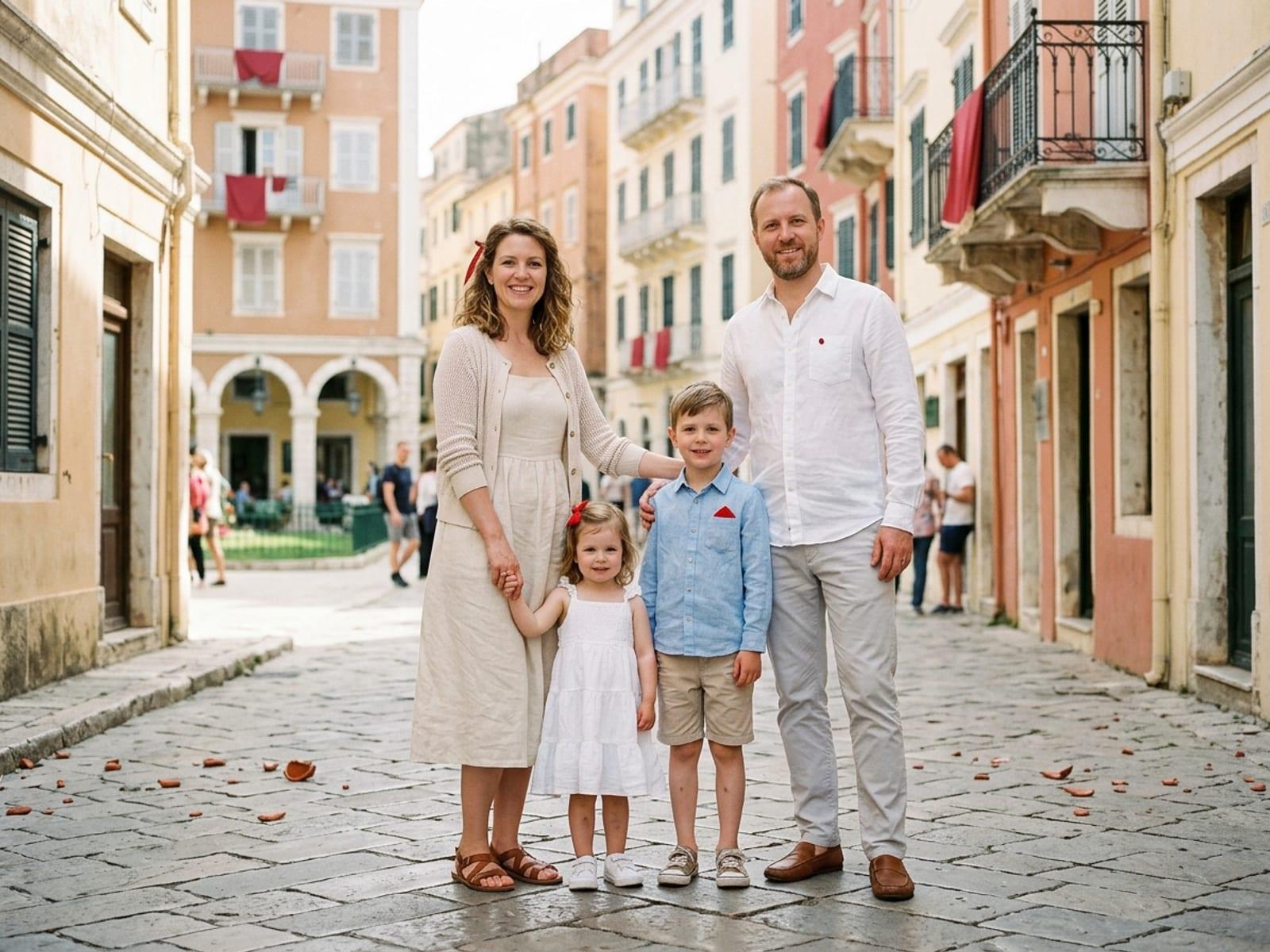
You can also see what a family photo beneath the red-draped balconies might look like with pokesta's AI photos ($1 per photo). Other families have shared their Greek Easter photos too.
In 2027, Holy Saturday falls on 1 May
Orthodox Easter is calculated on the Julian calendar from the first full moon after the spring equinox, so in many years it falls on a different date from Catholic and Protestant Easter. Orthodox Easter in 2027 is on 2 May, which puts the pot-throwing Holy Saturday on 1 May and the Palm Sunday procession on 25 April. The Patras Carnival, which ends just before Lent, is dated back from Easter in the same way; its grand parade in 2027 is expected on 14 March. Times can change from year to year, so check announcements from the municipality and the organizations that run the island's events.
The gateway is Corfu International Airport (CFU), only about 2 km south of the Old Town, roughly a 10-minute drive. From April to October, seasonal flights arrive from all over Europe, and there are domestic flights from Athens. Accommodation fills up early for Holy Week, so booking a place within walking distance of the Old Town well ahead makes the early-morning events much easier to reach. Entry requirements for Greece depend on your nationality, so check your own government's official information before you travel.
References