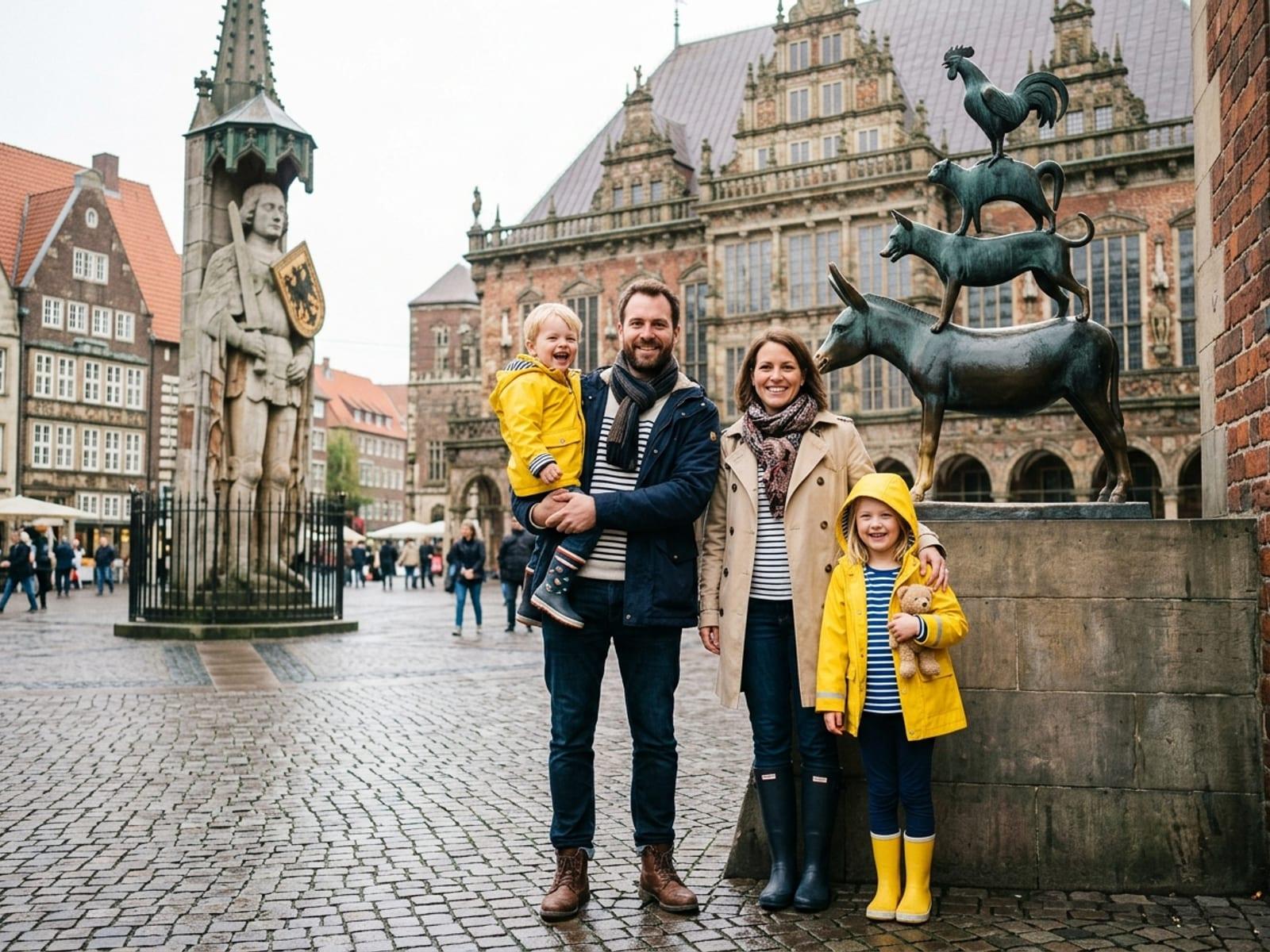
A dog on a donkey's back, a cat on the dog, and a rooster on top. The animals from the Grimms' fairy tale "Town Musicians of Bremen" stand as a bronze statue beside the Town Hall in Bremen, a port city in northern Germany. Touch the donkey's front legs and your wish will come true, people say, and there are always children reaching out to them. The old town is compact enough for small legs: the World Heritage Town Hall, porcelain bells that ring on the hour and narrow lanes of old houses are all within an easy walk. Read the story before you go and the whole town starts to feel like the next chapter of the picture book.
The animals never actually made it to Bremen
The Brothers Grimm added "Town Musicians of Bremen" to their Children's and Household Tales in the second edition, published in 1819. A donkey, grown old and about to be sold off, runs away and sets out for Bremen to join the town band. Along the way, a dog, a cat and a rooster, all old and in the same fix, join him. In the forest they find a robbers' house, and the four of them "sing" at full volume outside the window, scaring the robbers away. They like the house so much that they stay.
The animals in the story never actually reach Bremen. The town treasures the tale all the same, and you'll find statues and decorations of the musicians all over the old town. Read the story to your children before you set out, and suggest "let's go and meet the animals who never made it to Bremen." It gives the trip a clear purpose.
Touch the donkey's front legs, west of the Town Hall
The most famous Town Musicians statue is a bronze by the sculptor Gerhard Marcks, unveiled in front of the Town Hall on 30 September 1953. It was originally planned as a one-year trial, but it stayed and became the face of the town. It's about 2 meters tall, a little taller than a person, and stands by the west entrance of the Town Hall.
Visitors are often told that touching the donkey's front legs makes a wish come true. If you and your children plan to grab the legs with both hands, settle on the wish while you're waiting. A line often forms in front of the statue, and once you've had your turn, step aside for the next person.
There are several more Town Musicians figures around the city. In Böttcherstraße you'll find a bronze by the sculptor Bernhard Hoetger, there since 1926, and a brass version. There's a copper statue on the Teerhof, an island in the Weser River, and in 2019 a wooden statue, carved with a chainsaw from a beech trunk, was added in a park in the southwestern district of Huchting. Hand the kids a map and make it an animal hunt, and they'll follow along without complaining about the walking.
The World Heritage Town Hall and the Roland statue
Right next to the statue is Bremen's Town Hall. It was built around 1400 and remodeled between 1608 and 1612 with an ornate facade in the Weser Renaissance style. In July 2004 it was inscribed as a UNESCO World Heritage Site together with the Roland, the stone statue of a knight standing in front of it. The Roland is a limestone figure erected by the city council in 1404, before work on the Town Hall began. The statue alone is 5.47 meters tall, and including the column of its Gothic canopy it's over 10 meters. It represents the emperor and guarantees the market rights and freedoms the town claimed: the upright sword stands for the town's jurisdiction, and the eagle on the shield shows that it was a free town answerable directly to the emperor. There's a saying that as long as the Roland stands, Bremen will stay free, and there's even a story that a spare Roland is hidden in the Town Hall cellar for that reason. Introduce him to children as the giant who guards the town, and expect questions about where the spare one is hidden.
Beneath the Town Hall is the Ratskeller, a wine cellar that holds the oldest wine cask in Germany, made in 1653.
A lane with ringing bells, and houses strung like beads
A short walk from the Marktplatz brings you to Böttcherstraße. It's only 108 meters long, but it's lined with brick Expressionist buildings put up between 1922 and 1931 with the backing of the coffee merchant Ludwig Roselius, and it's sometimes called the town's "secret main street."
The thing to show children here is the carillon on the Haus des Glockenspiels. Porcelain bells hung between the roofs ring out, and in time with them ten carved wooden panels depicting people who crossed the oceans rotate into view. From 1 January to 31 March, it plays at 12:00, 15:00 and 18:00. The rest of the year it plays every hour on the hour from 12:00 to 18:00. Time your visit and look up together. In the courtyard of the Paula Modersohn-Becker House on the same street is Hoetger's 1930 fountain of the "Seven Lazy Ones," figures from a Bremen legend; this town has more than one old story worth telling a child. If you have a little time before the bells, the courtyard is a good place to wait.
The other place not to miss is the Schnoor quarter of the old town. A branch of the Weser once ran right beside it, and fishermen and boatmen who worked the river lived here. It's a district of narrow lanes dating back to the Middle Ages, with buildings from the early 15th century and houses from the 17th and 18th centuries that look almost as they always did. The name comes from the Low German word for "string," said to refer both to the rope- and string-makers who once worked here and to the way the little houses sit in a row like beads on a string. The lanes are full of craft shops, galleries, cafés and small museums, and some passages are so narrow even adults nearly brush shoulders with the walls. Strollers are awkward in places, so a baby carrier is easier.
Rainy days at the science center, 11 minutes from the airport by tram
On a rainy day, head to Universum Bremen, a science center near the university. It opened in September 2000, and you'll recognize its building by its shape, something like a cross between a whale and a seashell, covered in about 40,000 stainless steel scales. Many of its roughly 250 exhibits, on the themes of humans, the Earth and the cosmos, are hands-on. Check opening hours and prices on the official website.
Bremen is good for walking all year round. Bremen Airport (BRE) is only about 3.5 km south of the city, and tram line 6 gets you to the center in about 11 minutes and to the main station in about 16. The airport mainly serves European cities and holiday destinations. To see how a family photo in trench coats and rain boots in front of the Town Musicians might turn out, you can try pokesta's AI photos ($1 per photo). If you're touring northern Germany, you could pair Bremen with Hamburg's Fischmarkt, then carry on to another Hanseatic port, Lübeck, for its marzipan. Entry requirements for Germany vary by nationality, so check your own government's official information before you travel.
References